Cinema Volga, Studio Martin and today’s ruins. How one of Bucharest’s oldest cinemas disappeared
- Articles
- 24 MAR 26
Few places in Bucharest managed to gather in the same building so many layers of urban memory as the former Volga cinema. For some, its name sends them back to the interwar period, when going to the movies was becoming an elegant and almost ceremonial habit. For others, Volga means the years in which the Dorobanți area still preserved a special mixture of refinement, bourgeois quietness and neighborhood cultural life. And for a more recent generation, the place is connected above all with Studio Martin, the club that occupied the space after 1990 and that turned the old cinema into a landmark of Bucharest nightlife. Today, after degradation, abandonment and demolition, what remains above all is the story of a space that crossed almost a century of history without ever being ostentatious, but which remained present in the memory of the city.
The history of the Volga Cinema
Cinema Volga appears in 1933, at a moment when Bucharest was beginning to treat film not only as passing entertainment, but as a true urban ritual. The city was then forming a culture of going to the cinema, and projection halls were becoming important places for sociability, modernity and cultural consumption. In this context, the appearance of a new cinema on Calea Dorobanților was not accidental at all. The area was in full affirmation, and the new architecture, with Western influences and modern lines, was beginning to change the face of Bucharest.
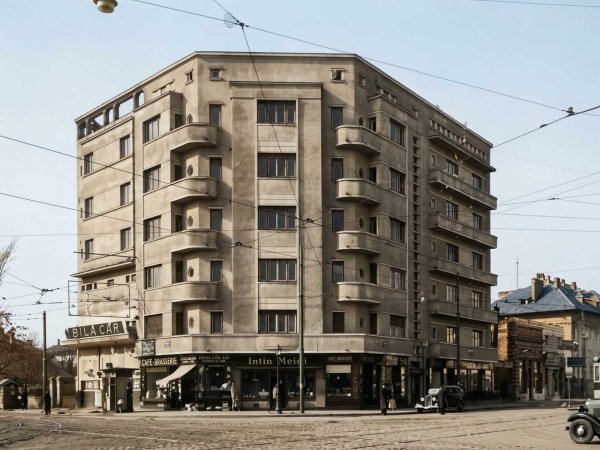
Volga was installed in a modernist building, with a Western air, which expressed very well the ambitions of the era. It was not only a functional building, but also one that discreetly conveyed the idea of being up to date, of a city connected to the great European models. The cinema hall was not located directly on the street, in everyone’s sight, but was hidden behind the building, like a withdrawn space, almost ceremonial. Precisely this placement gave it a special aura. The road to the hall did not mean only entering a building, but a symbolic passage from the agitation of the city toward the controlled darkness of the screening, toward that universe in which the lit screen suspended for two hours the reality outside.
The name “Volga” exists from the very beginning and remains connected to the place throughout its existence. Over the decades, the cinema becomes a discreet landmark of the Dorobanți area. It is not described as a noisy or spectacular space, but rather as a constant, recognizable one, naturally integrated into the life of the neighborhood. Here lies perhaps one of its most important traits: Volga did not impose itself through extravagance, but through continuity. It was there, it functioned, it received different generations of spectators and it became part of the everyday fabric of the city.
A cinema born together with the modernization of the city
The year 1933 places Cinema Volga in an essential stage of Bucharest. The capital was then living through one of its periods of intense modernization, and cinema was becoming a very clear sign of this change. Projection halls were no longer simple places where films were shown, but spaces that spoke about the new rhythm of urban life, about the taste for image, about the fascination of technology and about the need for modern collective rituals.
In this landscape, Volga fit perfectly. Its presence on Calea Dorobanților was not a simple practical choice, but also a symbolic one. Dorobanți was an artery that was beginning to gain weight in the social geography of the city, and the existence of a cinema in such a setting showed that film had become part of the civilized life of the Capital. Volga participated in this new atmosphere without being ostentatious. It did not need to dominate the area in order to matter; it was enough for it to exist there, integrated into an architecture that suggested order, refinement and openness toward the West.
The modernist building in which it functioned mattered enormously for the identity of the place. In the Bucharest of that period, modern architecture carried with it a promise: that the city could transform itself, that it could become more coherent, more elegant, more European. Volga was not an accident in just any building, but part of this promise. The fact that the hall was set back, hidden behind the building, gave it an almost secret quality. The cinema did not offer itself immediately to the gaze, but allowed itself to be discovered, which gave it a particular charm, almost intimate.
This positioning of the hall also said something about the way in which film was perceived in the era. The screening was not only a quick consumption of images, but an experience in itself. You entered another rhythm, you left the street behind, you passed into a controlled space, where light and darkness were part of the spectacle. Volga thus became a small urban sanctuary, dedicated not only to film, but also to that special state that going to the cinema offered in the decades in which the big screen had an almost magical force.
The discreet elegance of a landmark in Dorobanți
In the decades that followed its opening, Volga became a discreet landmark of the Dorobanți area. This phrase says everything about the way in which it existed in the city. It was not a strident place, it did not function through monumentality and neither through spectacle, but through constant presence. It became part of the everyday landscape and of the emotional routes of the inhabitants, becoming a stable point in a Bucharest always between change and continuity.
The cinema’s program was dominated by popular films of the era, which means that Volga remained connected to the taste of the general public. It was not an isolated space, reserved exclusively for sophisticated cinephiles, but a hall that responded to the real desire for entertainment, emotion and escape. Precisely for this reason it endured in memory: because it was frequented, lived and recognized by the public, not only admired from a distance. Popular films, in all eras, have a special power to fix places in the biography of the city, because they gather different people under the same light of the screen.
The atmosphere of the place mixed interwar elegance with the pragmatism of the 1950s and 1960s. This overlap is one of the keys to its story. In the end, Volga did not remain frozen in a single era. It crossed radical political, social and cultural changes, but it continued to exist, adapting without completely losing its identity. It preserved something of the initial air of the modernized interwar Bucharest, even when the postwar reality imposed another type of functionality, another type of rhythm and another relation to urban space.
This combination between elegance and pragmatism says a great deal about the destiny of many Bucharest buildings. They did not survive because they were ideally protected, but because they were used, reinterpreted, passed from one era to another. Volga was one of these buildings that carried on their existence not through glory, but through usefulness and adaptation. From here also comes the melancholic tone of its story today: it was a place that did not necessarily step to the front, but that had become indispensable through its simple continuity.
After 1990, between screenings and nightlife
After 1990, the space enters a new stage, perhaps the most surprising in its entire existence. The old cinema hall takes on a double life and begins to host both screenings and the Studio Martin club. It is a transformation that says a great deal about post-communist Bucharest and about the way in which the city tried to recover its freedom of expression, its appetite for socializing and the energy of the night.
Studio Martin becomes one of the places that set the tone for Bucharest nights in a period in which the Capital was learning again to go out into the world. It is not a simple conversion of function, but a mutation of atmosphere. The space created for the concentrated silence of the spectator in the cinema hall comes to be inhabited by music, by movement, by nocturnal meetings and by another form of collectivity. In a way, the place does not break away from its initial mission, because it remains a space of shared experience. Only that the public no longer comes only to watch, but also to participate directly.
This double life, as cinema and club, is one of the most interesting pages in the history of Volga. It shows how elastic an urban space with memory can become. A building born in 1933, in a Bucharest that was discovering film as a serious urban ritual, ends up being absorbed by the culture of the night after 1990. Paradoxically, precisely this transformation confirms the vitality of the place. Volga was not an inert relic, but a space still able to generate meaning, atmosphere and belonging.
For many Bucharest residents, the memory of the place was reconfigured exactly in this period. Some knew it as a cinema, others mostly as Studio Martin. The two identities coexisted and overlapped, which makes the story of the building even more interesting. We are not speaking only about a former cinema, but about a space that managed to cross two very different major urban cultures: the classic culture of going to the movies and the post-communist culture of going out at night, of clubs and of the spontaneous reconstruction of social life.
The slow degradation and the silence of the beginning of the millennium
But time always does its work, and in Volga’s case it did it slowly, without haste, almost without noise. The building begins to degrade, and the charm of urban memory is no longer enough to stop physical wear. This is, in fact, one of the cruelest truths of Bucharest: the city sometimes loves its places symbolically, but lets them die materially. Volga gradually entered this gray zone of active forgetting, in which people still know the name of a place, but no longer manage to secure its future.
The beginning of the 2000s brings an increasingly oppressive silence. Where screenings once functioned and, later, the vibration of nightlife, absence begins to settle in. It is not a sudden, spectacular disappearance, but a slow one, almost sadly banal. Precisely this slowness makes everything more painful. When a building dies slowly, the city has time to notice and yet, many times, does not intervene. Volga went through this stage like many other Bucharest spaces with a rich past: remaining more and more only a name and a shell.
In the last decade, its disappearance becomes almost complete. The image that remains is that of a cinema that crossed almost a century without raising its voice. The phrase is extremely fitting for the destiny of this place. Volga was not a monument that demanded attention aggressively. Nor did it build its legend through scandal or spectacularness. It was rather one of those spaces that accompany the city with a silent fidelity and that precisely for that reason come to be taken for granted, until the moment when they disappear.
The ruin is, in its case, more than a physical stage. It becomes an image of the way in which Bucharest consumes its past. The former cinema, then the former club, then the degraded building and, finally, the demolished place compose a sequence that speaks not only about a certain address, but about the complicated relationship between the city and its own memory. When such a space dies out, not only a building disappears, but also a certain emotional continuity.
The recent demolition and the memory of a disappeared place
The building was demolished recently, and with this intervention the material history of Cinema Volga was definitively closed. What can still be recovered from now on belongs only to memory, to photography, to evocation and to the oral history of those who knew one of its lives. Demolition always has something definitive about it. As long as a building still exists, even in ruin, it preserves a possibility. It can be saved, reinterpreted, reintegrated. From the moment it falls, everything moves into the register of the past.
In Volga’s case, this disappearance is all the more significant since we are speaking about one of Bucharest’s oldest cinemas. It was not just any space, but one that had accompanied almost a century of the city’s life, passing through the interwar period, through the postwar decades, through the transition after 1990 and through the slow degradation of the last two decades. It resisted for a long time, but not enough to defeat the logic of abandonment and demolition.
Still, physical disappearance does not cancel the symbolic importance of the place. On the contrary, sometimes it amplifies it. Volga remains important precisely because its history concentrates in miniature the history of modern Bucharest. It was a product of interwar enthusiasm, a stable landmark in an era of transformations, a space adapted to the new times after 1990 and, in the end, a victim of degradation and indifference. In this path there is something very recognizable for the destiny of many buildings in the Capital.
Today, when its name still circulates only in memories, in stories and in urban nostalgias, Cinema Volga continues to say something essential about Bucharest. It says that the city is not made only of the great monuments and of the official buildings, but also of these apparently secondary places, which discreetly accompany people’s lives. It says that urban memory is preserved not only through institutions, but also through the fragile attachments of the community. And it says something else too: that sometimes the most important spaces are not those that made the most noise, but those that remained there, constant, present enough to become part of the emotional biography of the city.
Cinema Volga disappeared, but its story remains one of those histories that help in understanding Bucharest in depth. A cinema hidden behind a modernist building, turned into a discreet landmark of Dorobanți, transformed after 1990 into an emblematic place of the night and ended recently under the sign of demolition: all these stages make it more than a simple lost address. They transform it into a symbol of the way in which the city builds, consumes and forgets its own worlds.
We also recommend: Cinema Oser, the Postal Palace and the history of film in Romania. The first permanent movie theater in Bucharest appeared 120 years ago