Symbols of Bucharest: The Story of the Famous Saint George Capra Church in the Pantelimon Neighborhood
- Articles
- 16 OCT 26
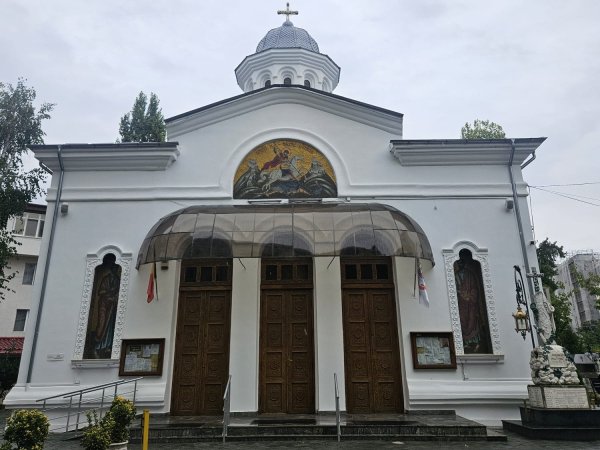
On the outskirts of old Bucharest, in an area that would undergo radical changes over the course of more than a century, a church built during Romania's War of Independence managed to survive urban transformations that erased streets, houses, and even other places of worship from the map. The Saint George “Capra” Church, located in the Pantelimon neighborhood, is today one of the discreet testimonies of Bucharest's past. Currently located at 131 Pantelimon Road, at the corner with Fântânica Street, in Sector 2, the church has two patron saints: Saint George the Great Martyr, celebrated on April 23, and Saint Panteleimon the Great Martyr, commemorated on July 27. The parish is also listed in the current records of the Archdiocese of Bucharest. Beyond its age, the history of the church is connected to one of the most spectacular operations to save Bucharest's religious heritage during the communist period. In 1985, the church was moved almost 90 meters so that it would not be demolished as part of the plans to restructure the city and widen Pantelimon Road.
A church built in the Pantelimon outskirts
The history of Saint George “Capra” Church began around 1877, in a Bucharest that was very different from the city we know today. Pantelimon was then an area on the outskirts of the city, with homes, gardens, and small commercial activities, while Pantelimon Road did not have the scale of the major thoroughfare we know today.
The initiative to build the church belonged to Constantin Duțulescu, a vegetable merchant who was well known in the area and who was nicknamed “Capra.” Together with his wife, Eufrosina, he donated the land and contributed financially to the construction of the new place of worship. Alongside the founder's family, numerous local residents contributed to the construction and furnishing of the church. Church sources speak of approximately 150 families who were involved in this community effort.
The old inscription records that the church was built and consecrated in September 1877, during the War of Independence, when Carol I was Prince of Romania and Nifon was Metropolitan Primate. The first parish priest of the new church was Father Marin Marinescu. The connection with its first founder is precisely what caused the name “Capra” to remain associated with the church to this day.
Built on the outskirts of Bucharest at the time, the church was not merely a place of worship. It became a landmark for the local community, in an area where everyday life revolved around households and small commercial activities. The cemetery was established behind the church, on land donated by the founder and other benefactors, and part of it still exists today.
Why is the church called “Capra”?
The unusual name of the church is not connected to a religious symbol or to an old legend of Pantelimon. It comes from the nickname of its founder, Constantin Duțulescu. Historical documents and accounts concerning the church refer both to its official dedication to Saint George and to the popular name “Capra.”
Nicknames were frequently used in Bucharest communities during the 19th and 20th centuries to identify certain families or individuals. In this case, however, the nickname outlived the person who carried it and became part of the identity of a monument. Thus, Saint George “Capra” Church continued to be known by this name in the neighborhood even after the area underwent radical transformations.
Documents concerning the church's beginnings also emphasize the collective nature of the project. Constantin Duțulescu and Eufrosina played the leading role, but numerous parishioners contributed to the construction and furnishing of the place of worship. According to parish tradition, the icons preserved over the years bore inscriptions recalling the families who had donated them.
After the founder's death, Constantin Duțulescu, his wife, and members of his family were buried near the church, and a funerary monument was erected over their graves. In this way, the connection between the founder and the church continued even after his death.
Repairs, paintings and transformations in the first half of the 20th century
In the decades following its construction, the church underwent several stages of repair and refurbishment. Some of these interventions changed its interior appearance without altering its character as a parish church built for the Pantelimon community.
An important intervention took place in 1924. At that time, the plasterwork was renewed, a pulpit was installed, and the flooring was replaced. The original wooden porch was replaced with a masonry one, while a new row of icons was added to the iconostasis. In 1928, oak pews and new oak entrance doors were installed.
The paintings were also restored several times. In 1926, the interior received an oil painting in the Neo-Byzantine style, created by the painter Ioanid. In 1943, it was retouched by church painter Gheorghe Raicu. Another restoration of the paintings took place in 1968-1969.
The icons on the iconostasis also underwent successive interventions. Their silver coverings were made in two stages, in 1920 and 1966. All these works demonstrate the community's concern for preserving the church during a period when it had already become a well-known landmark of the neighborhood.
The church threatened by communist urban planning
The most dramatic chapter in the history of Saint George “Capra” Church began during the communist period, when Bucharest underwent a massive process of urban transformation. In Pantelimon, the plans involved modifying existing roads and widening Pantelimon Road.
For a church built very close to the old road, the consequence was obvious: demolition. After 1975, plans to transform the area placed the church in danger of disappearing together with the rows of houses surrounding it. Concrete pressure to demolish the church intensified around 1983, when parts of the parish property were taken over, including sections of the garden and cemetery.
At this point, the role of parish priest Ion Popescu became essential. Instead of accepting the demolition, he sought a solution that would allow the church to be preserved. The answer was to be an extraordinary one for that period: moving the entire building.
The method had been developed by engineer Eugeniu Iordăchescu and his collaborators and had been used to save several Bucharest churches threatened by the communist urban redevelopment projects. The Archdiocese of Bucharest lists Saint George “Capra” Church among the places of worship saved through this technique during the 1980s.
How the church was moved almost 90 meters
Between September 10 and 22, 1985, the church was prepared and moved from its original location. The operation required special structural reinforcements and preparations so that the building could be lifted and transported without being destroyed.
According to sources concerning the history of the parish, the church was moved approximately 89.2 meters to the northeast, onto the parish cemetery grounds. Other sources record the operation within the broader period between October 1985 and April 1986, corresponding to the technical stages of the transfer and relocation.
The engineering achievement is even more impressive because the church was not dismantled and rebuilt somewhere else. The actual structure was moved as a whole, using the translation technique associated with engineer Eugeniu Iordăchescu. During the same period, other Bucharest churches were also saved using similar procedures.
Saint George “Capra” Church thus survived a period in which numerous historic buildings disappeared. Although it was moved away from its original position, and the former parish house and mortuary chapel could not be saved, the essential element remained: the church itself.
A new painting and a new beginning after the rescue
After the relocation, the church entered a new stage of repairs and restoration. As part of the works, the old painting was replaced with a new fresco. Mihai Bogdan Mociulschi worked in the Holy Altar, while the rest of the church was painted by Radu Mărculescu.
The post-relocation works took place over several years. In 1987, a new mortuary chapel and a parish office were built near the church. The place of worship was reconsecrated in 1990, during the patriarchate of Teoctist.
However, the problem of space had not disappeared. Pantelimon had been transformed into a neighborhood of apartment blocks, and its population had increased. The old church had been designed for a much smaller community and for the reality of a neighborhood consisting of houses and private gardens. In the new Bucharest, it had become too small.
At the beginning of the 2000s, the parish decided to expand the place of worship by constructing a larger narthex. The new section was built within a relatively short period and was subsequently decorated with frescoes created by painter Dan Gogu between 2003 and 2004.
The legacy of Constantin Duțulescu and the memory of Pantelimon
The parish cemetery, covering approximately 1.5 hectares according to sources concerning the church, represents another important part of the site's history. Its organization is connected with the beginning of the 20th century, when it was systematized and equipped with pathways in 1916. The land had been donated by Constantin Duțulescu “Capra” and other founders.
The church also has a special connection with Bucharest's literary memory. Saint George “Capra” Church is mentioned in the writings of Nicolae Steinhardt, who evoked the Pantelimon of his childhood and the atmosphere of the old merchant neighborhood. The Archdiocese of Bucharest and Ziarul Lumina have highlighted this connection between the church and the Bucharest world described by the future monk of Rohia.
In 2022, the church also received a fragment of the relics of Saint Panteleimon, donated by the Metropolis of Veria in Greece. This gift strengthened the connection between the church's second patron saint and the spiritual life of the parish.
Today, Saint George “Capra” Church is more than an old place of worship in Sector 2. It is a testimony to a vanished Bucharest, but also to the ingenuity that made it possible to save part of the city's heritage. Built by a merchant and the community around him, threatened with demolition almost a century later and moved nearly 90 meters in order to survive, the church has undergone transformations that reflect the history of the city itself.
Its story is, ultimately, the story of a Bucharest that has changed continuously. From the Pantelimon outskirts of 1877 to today's apartment-block neighborhood, the church has remained a landmark. And the name “Capra,” inherited from the merchant Constantin Duțulescu, continues to connect the monument with the ordinary people who helped build it and with the community that, generations later, did everything possible to prevent it from disappearing.
We also recommend: Symbols of Bucharest: Bucur the Shepherd Church, the city's first place of worship and the story behind the Capital's name