The History of the Famous ROM Chocolate Bar: Strong Romanian Sensations, Born in the Heart of the Capital
- Articles
- 12 OCT 26
Few Romanian sweets have become as instantly recognizable as the ROM chocolate bar. Its intense rum flavor, chocolate coating and packaging inspired by the colors of the national flag have turned the small bar into one of the best-known confectionery products made in Romania. Its story began in 1964, not in Timișoara, where the famous Kandia factory already existed, but in Bucharest, at the Bucharest Confectionery Products Factory. ROM appeared during a period when the Romanian food industry was undergoing a process of standardization and industrialization, while factory-made sweets were beginning to reach an increasingly large audience. Unlike the tradition of Bucharest's old confectioneries, industrial production made it possible for a product to be manufactured in large quantities and distributed nationwide. Today, Kandia Dulce presents ROM as a brand that has preserved its authenticity since 1964. However, the road to the present day was a complicated one, marked by the political and economic transformations of Romania, the reorganization of the industry after 1989, and successive changes in ownership.
ROM was born in Bucharest in 1964
Before ROM became a well-known name throughout the country, Bucharest already had an important tradition of chocolate production and consumption. Confectioneries such as Capșa, Zamfirescu, Helioty and Corso had contributed to the development of an urban culture centered around sweets, but large-scale industrial production represented a different stage. This is the context in which the appearance of the ROM bar should be understood.
The Museum of Advertising records that in 1964, at the Bucharest Confectionery Products Factory, production began on a chocolate bar filled with a cream flavored with rum. The product would go on to become one of Romania's longest-lasting confectionery brands.
An important clarification is necessary, however. ROM should not be confused with the beginnings of the Romanian chocolate industry, nor should it be presented as the first chocolate ever produced in Romania. Bucharest and other cities already had manufacturers and confectionery factories. The novelty brought by ROM was the combination of large-scale industrial production, the bar format and the rum-flavored cream, with the product eventually being distributed across a much wider market.
The bar was associated from the very beginning with the place where it was produced. The word “Bucharest” was printed on the surface of the chocolate, while “rom” appeared on the packaging, referring to the distinctive flavor of the cream. This detail is important because it explains why the product's name should not be interpreted simply as an abbreviation of the name “Romania.” The association between ROM and national identity developed gradually and was strongly reinforced by the packaging's use of the national tricolor.
From the Bucharest factory to the company now known as Kandia Dulce
The story of ROM is closely connected to the history of Romania's confectionery industry during the communist period. In 1948, several chocolate and confectionery factories were brought together under the Bucharest Confectionery Products Enterprise. The current Kandia Dulce company officially traces its history back to this reorganization.
The transformations continued after the political changes of 1989. In 1991, the enterprise was reorganized and became Excelent București, entering a new stage in its history. Documents from the Bucharest Stock Exchange record that the company had been established in 1948 under the name Fabrica de Dulciuri “București” IIS, through the nationalization and consolidation of several factories whose histories dated back to the 19th century.
An important moment came in the 2000s, when the history of the Bucharest factory intersected with that of Kandia in Timișoara. In 2003, Excelent București became the main shareholder of Kandia Timișoara, and in 2004 the two companies merged, with the new company operating under the name Kandia-Excelent.
This stage explains why the history of the present-day Kandia Dulce includes both the tradition of the Bucharest factory and that of the Kandia factory in Timișoara. The two histories are genuine, but they should not be confused: ROM was born in Bucharest in 1964, while Kandia has its own history, which began in Timișoara in 1890.
In the following years, the company underwent further important changes. In 2007, Kandia-Excelent was acquired by Cadbury, and after the international transactions that followed, the Romanian company once again came under the control of the Oryxa Capital investment fund. In 2010, the company's name became Kandia Dulce.
The tricolor packaging and the transformation of a chocolate bar into a Romanian symbol
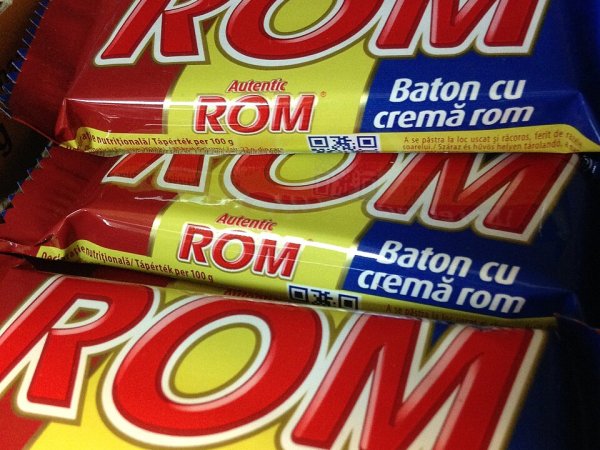
ROM did not become famous solely because of its taste. The visual identity of the product played an essential role in transforming it into a recognizable brand. The colors red, yellow and blue, used on the packaging, quickly associated the bar with Romania.
The Museum of Advertising shows that this association became increasingly powerful over time. The product eventually came to be perceived not merely as a chocolate bar with rum-flavored cream, but as a product with a strongly defined national identity.
This identity was later used extensively in the brand's advertising campaigns. One of the best-known campaigns in ROM's recent history was the one in which the tricolor on the packaging was temporarily replaced with elements inspired by the United States flag. The campaign generated strong reactions and turned the brand into a subject of public discussion, demonstrating how powerful the association between ROM and the idea of Romanian identity had become.
Paradoxically, the success of that campaign did not come from permanently abandoning the brand's Romanian identity, but precisely from exploiting the attachment that consumers had developed toward the brand's symbols.
The taste that survived communism and the market economy
ROM is also remarkable because of its longevity. The chocolate bar appeared in a planned economy, survived the radical change of system after 1989 and continued to be produced after the company's privatization and reorganization.
Kandia Dulce currently states that ROM has preserved its authenticity since 1964 and that the brand has continued to expand through new varieties. The current portfolio includes, alongside the ROM Autentic bar, other products that carry forward the brand's taste and identity.
Even the classic shape of the bar has remained a visual landmark. The ROM Autentic version is currently marketed in a 30-gram format, while the manufacturer continues to emphasize the combination of chocolate and rum-flavored cream.
There is, however, an important distinction between the brand's marketing story and the historical reality. Not every element found in accounts of ROM can be documented with the same degree of certainty. Claims such as “the first chocolate bar in Romania,” “the first Romanian chocolate,” or the idea that the name ROM was created from the beginning as an abbreviation for Romania should be treated cautiously. The institutional sources consulted more clearly support the launch date, place of production and development of the brand's identity than such absolute claims.
What ROM means today for the history of the capital
The story of ROM is ultimately also a story about Bucharest. The bar was created in a Bucharest factory and even carried the city's name on the product at a time when the capital's food industry was attempting to meet the needs of a growing national market.
Today, Kandia Dulce lists its headquarters at 20 Șoseaua Viilor, in Sector 5, the same address that appears in the historical documents of the Excelent company and in the current company's official records.
This helps explain why ROM can be described as a product born in the heart of the capital. It is not simply a brand that later adopted the tricolor for commercial purposes, but a product whose industrial history is concretely connected to Bucharest.
For more than six decades, ROM has gone through political, economic and commercial changes without disappearing from the market. In the meantime, it has become a landmark of Romanian confectionery and a rare example of a brand launched during the communist period that managed to remain relevant in an economy later dominated by international competition.
Its story therefore does not begin with a legend about “the first Romanian chocolate,” but with a much simpler and better-documented fact: in 1964, in Bucharest, a confectionery factory began producing a chocolate bar with rum-flavored cream that would become one of the most recognizable Romanian products. Everything that followed is a history of branding, advertising, nostalgia and taste — a combination that has allowed ROM to remain, more than 60 years later, synonymous with “strong Romanian sensations.”
We also recommend: Heidi chocolate was “born” near Bucharest three decades ago. The story of one of Romania’s sweetest brands