Actor Horia Șerbănescu, a seven-decade career: From child-king Michael I to Radu Zaharescu’s stage partner
- Articles
- 12 OCT 26
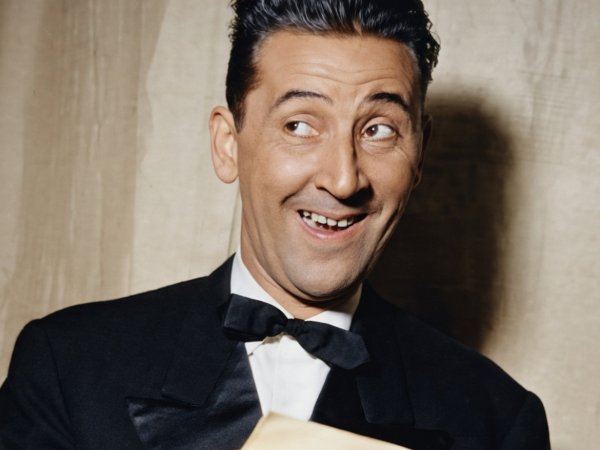
Few Romanian actors entered the world of entertainment at such a young age as Horia Șerbănescu. He was only five years old when he first stepped onto the stage, in 1929, playing King Michael in the show “Miss Revista”, presented at the “Cărăbuș” Theatre. What followed was a career spanning many decades and taking him through theatre, radio, cinema and television. Horia Șerbănescu’s name remained primarily associated with revue theatre and with the great comedy partnerships he formed throughout his career. If his beginnings were marked by encounters with personalities such as Constantin Tănase and Paul Gusti, his artistic maturity brought him a memorable collaboration with Radu Zaharescu. Together, they became one of the most appreciated comedy duos in Romanian entertainment, winning over audiences on stage, on the radio and on television.
A stage debut at only five years old
Horia Șerbănescu was born in Bucharest on March 16, 1924. He spent his childhood in the Filantropia neighborhood, in an interwar Bucharest very different from the city we know today. For him, however, his encounter with the world of entertainment was to take place extremely early, in a way that was almost unbelievable for a child his age.
In 1929, when he was only five, he appeared in “Miss Revista”, a production of the “Cărăbuș” Theatre, the company associated with the name of the great Constantin Tănase. The poster featured well-known artists of the period, including Marilena Bodescu, Lizica Petrescu, Natalița Pavelescu, Dan Demetrescu and Alexandru Giugaru, while the name of young Horia Șerbănescu also appeared among the cast.
Years later, the actor recalled that moment and spoke about the programme of the show, preserved at the “Constantin Tănase” Museum in Vaslui. For Șerbănescu, the document represented one of the concrete pieces of evidence of his artistic beginnings, at a time when he was still a child.
His debut did not remain an isolated episode. During the performance, the child’s talent was noticed by director Paul Gusti, who offered him another role, Statu-Palmă-Barbă-Cot, in “Rodia de Aur”, staged at the National Theatre. The show was broadcast by Romanian Radio, and this appearance contributed to the extremely long relationship between Horia Șerbănescu and public radio. Biographical sources describe him as one of the longest-serving collaborators of Romanian public radio.
From Bucharest stages to his first major success
The child who had appeared on stage alongside important names of Romanian theatre continued performing after his first experiences during childhood. Horia Șerbănescu worked with several theatre companies, appearing on the stage of the Sărindar Theatre, led by Tudor Mușatescu, then at “Teatrul nostru”, led by Dina Cocea, and later at the Victoria Theatre.
An important moment in his artistic development was his encounter with Tudor Mușatescu’s comic universe. At the Volta Buzești Summer Theatre, Șerbănescu achieved one of his first major successes in “Profesorul de franceză”, a play written by Mușatescu. The production gave him the opportunity to demonstrate his comic talent and move increasingly closer to the genre that would define his entire career.
Horia Șerbănescu was not only an actor, however. He was also drawn to writing, and this interest would become essential in his later collaborations. In revue theatre, where rhythm, dialogue, music and the audience’s immediate reaction are crucial, the ability to create jokes and comic texts was a considerable advantage.
Cinema and radio, two other fields of his career
Although revue theatre was his main artistic home, Horia Șerbănescu also had a film career. His film debut is recorded in “Răsună valea”, released in 1949, and he subsequently appeared in productions such as “Directorul nostru”, “Telegrame”, “Politică cu... delicatese”, “Pași spre lună” and “Mofturi 1900”.
In “Directorul nostru”, “Telegrame” and “Mofturi 1900”, Șerbănescu had the opportunity to transfer his comic style from the stage to cinema. He was not, however, an actor who built his reputation primarily through film. For Romanian audiences, his name remained much more strongly associated with revue theatre, radio and television.
Radio occupied a special place in this story. From childhood, through his participation in “Rodia de Aur”, Șerbănescu became part of the history of Romanian broadcasting. The following decades turned him into a familiar presence for listeners of entertainment and comedy programmes.
Meeting Radu Zaharescu and the birth of a memorable duo
One of the most important chapters in Horia Șerbănescu’s biography began with his collaboration with Radu Zaharescu. Before this partnership, Șerbănescu had also formed an artistic duo with Emil Popescu. His meeting with Zaharescu, however, was to create a particularly effective artistic formula that was warmly appreciated by audiences.
The two men had complementary qualities. Radu Zaharescu was a musician, pianist and composer, while Horia Șerbănescu had an obvious inclination toward writing and constructing comedy. The actor himself explained in an interview that his partner was responsible for the music, while he focused on the text, and together they handled the performance.
This division of roles contributed to the success of their formula. Zaharescu’s music supported Șerbănescu’s jokes, while the dialogue and acting brought the musical compositions to life. The result was fast-paced humour built around rhythm, punchlines and music. Sources dedicated to revue theatre describe their collaboration as one of the genre’s longest-lasting and most charismatic partnerships.
Horia Șerbănescu and the great productions at the “Constantin Tănase” Theatre
At the “Constantin Tănase” Revue Theatre, Horia Șerbănescu became one of the major figures of the stage. He took part in numerous productions, including “Revista ’58”, “Pe aripile Revistei”, “Vitamina M... Muzica!”, “Ca la Revistă”, “Concertul tinereții”, “Carnaval la Tănase”, “Cu muzica e... de glumit!” and “Horia și Radu își asumă riscul”. In some of these productions, his contribution went beyond acting, as the performer also wrote the texts.
One of the remarkable moments was his appearance alongside Radu Zaharescu and N. Stroe in “Trei Călușari”. For revue theatre audiences, such numbers became major attractions, bringing together acting talent, music and comedy in a fast-paced performance.
The success of the Horia Șerbănescu–Radu Zaharescu duo went beyond the stage, however. The two became regular presences on Romanian Television entertainment programmes and in comedy programmes broadcast on radio. At a time when television was gradually becoming one of the main forms of entertainment for Romanian audiences, their appearances greatly strengthened their popularity.
A pair who won over audiences beyond the stage
Their success was so great that performances at the Savoy Hall attracted impressive crowds. In his memories of the world of television and entertainment, Dan Mihăescu described the two artists as elegant performers with a distinctive stage presence, comparing them to the image of the great stars of American cinema.
Beyond their public appearances, Horia Șerbănescu and Radu Zaharescu represented a highly synchronized artistic formula. They were not simply two performers appearing together, but a partnership based on complementarity. One brought the music, the other the text and the punchlines, and together they transformed the material into a comic performance designed for the audience.
For Șerbănescu, success was not achieved overnight. It was the result of experience accumulated from childhood and continued through theatres, radio, cinema and later television. This very longevity explains why his name remained associated with several generations of spectators.
Horia Șerbănescu, the artist who remained faithful to comedy
Horia Șerbănescu’s career can be viewed as a genuine history of Romanian entertainment during the 20th century. He stepped onto the stage during the interwar period, when revue theatre was experiencing spectacular growth, lived through the difficult decades of the communist regime and continued to appear in shows, on radio and on television.
He was an actor, performer, comedy writer and an artist capable of adapting to different forms of entertainment. He went from playing the child who portrayed King Michael at the age of five to becoming a veteran of the Romanian stage, without abandoning the comic genre that had made him famous.
In 1968, his artistic activity was also recognized through the award of the “Merit in Culture” Order, fourth class, for outstanding achievements in musical activity, according to biographical sources.
Horia Șerbănescu died in Bucharest on September 19, 2010, at the age of 86. He was laid out in the foyer of the “Constantin Tănase” Theatre, the place with which his name had become so closely associated, and was later buried at Bellu Cemetery.
His legacy, however, cannot be reduced to a few film roles or a list of theatre productions. It can be found in the history of Romanian revue theatre, in the archives of Romanian Radio and Television and, above all, in the memory of an audience that followed him for decades. From the five-year-old child who played King Michael in “Miss Revista” to Radu Zaharescu’s stage partner, Horia Șerbănescu had one of the longest and most remarkable careers in Romanian entertainment.
We also recommend: The Incredible Story of Actor Radu Zaharescu: He Made His Debut “in Flames” on the “Tănase” Stage at Just 17