Legends of Bucharest’s Princely Court: The Ghost of Vlad the Impaler and the Spirit of the Mysterious Dancer Baba Manu
- Articles
- 12 OCT 26
In the heart of Bucharest’s Old Town, the ruins of the Old Princely Court preserve not only some of the most important traces of the medieval city, but also a fascinating collection of legends that have survived for centuries. The former residence of the Wallachian rulers is associated with the name of Vlad the Impaler, secret underground passages, hidden treasures and mysterious apparitions said to wander among the old walls after nightfall. Today, Curtea Veche is one of the most important medieval monuments in Bucharest. Archaeological research has revealed several stages in the development of the princely residence, from the fortress associated with Vlad the Impaler to the palace expanded and transformed by later rulers. The site became a museum complex during the 20th century, while the surrounding Old Town developed into one of the most visited historic areas of the capital. Yet beyond the historical facts, Curtea Veche has always been surrounded by stories that are much harder to verify. Among the most famous are the legends of underground tunnels connecting the princely residence with other important places in the city, the ghost of Vlad the Impaler, a bell supposedly hidden in a well and the mysterious Baba Manu, an old woman said to have appeared at night, singing and dancing among the ruins.
Curtea Veche, the place where medieval Bucharest developed
The history of Curtea Veche is closely connected to the development of Bucharest itself. The site is considered the oldest medieval monument in the capital, and archaeological discoveries indicate a long period of habitation in this area. The princely residence became an important political and administrative centre of Wallachia, particularly from the 15th century onward.
One of the most significant moments in the history of the site is connected to Vlad the Impaler. A document issued on September 20, 1459, contains the first documentary mention of the name “Bucharest” in the form of “the fortress of Bucharest.” The ruler strengthened the settlement and built a fortified residence that later became part of the complex known as Curtea Veche.
The princely court continued to evolve under subsequent rulers. The palace was rebuilt and expanded, reaching an important stage during the reigns of Mircea Ciobanu, Constantin Brâncoveanu and Ștefan Cantacuzino. Each ruler left his mark on the complex, creating a mixture of medieval and later architectural elements.
The name “Curtea Veche” appeared after Alexandru Ipsilanti established a new princely court in the area of Dealul Spirii in the 18th century. The former court gradually lost its importance, and its buildings were eventually affected by neglect, urban transformations and major fires.
One of the most destructive events was the Great Fire of Bucharest on March 23, 1847. The fire severely damaged the Voivodal Palace and the nearby Church of the Annunciation, contributing to the disappearance of much of the historic complex above ground.
Archaeological investigations carried out during the 20th century helped uncover the remains of the medieval and early modern structures. The museum was arranged between 1969 and 1974, allowing visitors to see fragments of the princely residence and remains associated with different stages of its history.
The secret tunnels, between reality and Bucharest’s underground legends
Perhaps the most persistent legends surrounding Curtea Veche concern the underground passages supposedly built beneath the princely residence. For generations, stories have circulated about tunnels that allegedly connected the court with other important locations in the city.
One of the most frequently repeated versions claims that a passage once linked Curtea Veche with Hanul lui Manuc, while other underground routes supposedly led toward churches, monasteries or strategic points around Bucharest. According to the legend, these passages could have been used by rulers and inhabitants to escape during periods of war or Ottoman attacks.
Stories about underground Bucharest are not entirely without a historical basis. Archaeological excavations have revealed vaulted cellars, underground spaces and other structures belonging to the former princely complex. Similar underground constructions were also documented in other historic buildings in the city.
However, the existence of a single, continuous tunnel system connecting all the places mentioned in urban legends has not been conclusively demonstrated by archaeological research. The idea of a vast underground network therefore remains part of Bucharest’s folklore rather than an established historical fact.
The legends nevertheless became an important part of the mythology surrounding Curtea Veche. The underground spaces, dark cellars and thick medieval walls provided the perfect setting for stories about secret escapes, hidden treasures and mysterious encounters.
The ghost of Vlad the Impaler and the hidden rooms of the palace
Few historical figures are more closely associated with the legends of Curtea Veche than Vlad the Impaler. The ruler lived and exercised his authority from the princely residence, and his name became permanently connected with the medieval history of Bucharest.
Over time, however, the historical Vlad the Impaler was transformed by popular imagination into a much darker and more mysterious figure. According to local legends, his spirit never completely left the place where he once ruled.
Some stories claim that Vlad’s ghost can be seen wandering among the ruins after dark. Others place the apparition in the underground cellars, where the atmosphere created by the stone walls, vaulted ceilings and darkness has encouraged generations of visitors to imagine that the past has somehow remained trapped there.
Paranormal enthusiasts have sometimes associated the old cellars with unexplained sounds, strange sensations or apparitions. Such stories are part of the folklore surrounding Curtea Veche and cannot be treated as historically verified evidence of a supernatural presence.
The fascination is understandable. Beneath the visible ruins are traces of several centuries of history, including structures associated with the fortress built during Vlad’s reign and later princely buildings. Archaeological research has shown that the palace of Mircea Ciobanu was constructed over the earlier fortress associated with Vlad the Impaler.
The contrast between the documented history of the site and the legends surrounding it makes Curtea Veche particularly intriguing. Visitors can stand among genuine medieval remains while hearing stories that transform those same stones into the setting of ghostly encounters.
The bell hidden in the well and the fear of invaders
Another legend connected with Curtea Veche tells the story of a church bell supposedly hidden underground during an Ottoman invasion. According to the story, people feared that the invaders would seize or destroy the bell, so it was taken from the Domnească Church and hidden inside a deep well.
The opening of the well was then supposedly covered, concealing the bell from anyone who might try to find it. Some versions of the legend claim that it remains there even today, waiting to be rediscovered.
There is no reliable archaeological evidence confirming that such a bell is still hidden beneath the site. Nevertheless, the story fits perfectly into the atmosphere of medieval Bucharest, a city that experienced repeated periods of political instability, military conflict and foreign threats.
Stories about valuables being hidden during invasions are common in the folklore of many old European cities. They often emerge from a mixture of historical events, collective memory and the mystery created by archaeological remains whose original purpose is no longer fully understood.
At Curtea Veche, such legends are reinforced by the existence of genuine underground structures. The vaulted cellars and wells that survive around the old princely residence make it easy to imagine that other objects might have been hidden there centuries ago.
Whether the bell ever existed in the form described by the legend is difficult to establish. What remains certain is that the story has become part of the rich folklore associated with one of Bucharest’s oldest historic sites.
Baba Manu, the woman who supposedly danced at night through Curtea Veche
Among the most unusual legends connected with the Old Princely Court is the story of Baba Manu, a mysterious woman who is said to appear around midnight among the old palace ruins.
According to urban tradition, Baba Manu could be seen singing and dancing through the former princely residence. Her apparition was not necessarily considered threatening. On the contrary, some versions of the story describe her as a protective spirit who continued to watch over the old court.
The legend also presents Baba Manu as a real woman who allegedly lived in Bucharest. She is described in some accounts as a beggar and fortune-teller who used to sit on the steps of the church near Curtea Veche. People supposedly believed that her words had a prophetic quality, and her reputation gradually became part of the mythology of the place.
The story becomes even more dramatic when connected with the Great Fire of Bucharest in 1847. According to the legend, Baba Manu died in her own house during the devastating fire that swept through the city on March 23 of that year.
Her supposed death did not end the story. Instead, folklore transformed her into a ghostly figure said to return to the place where she had once been known. The image of an old woman singing and dancing in the darkness among medieval ruins is one of the most evocative legends associated with Curtea Veche.
There is no solid historical evidence proving that Baba Manu became a supernatural presence at the site. Her story should therefore be understood as an urban legend rather than documented history. Nevertheless, it illustrates the way in which the people of Bucharest have continually added new stories to the old stones of the city.
Curtea Veche, between ruins and a new attempt to save the site
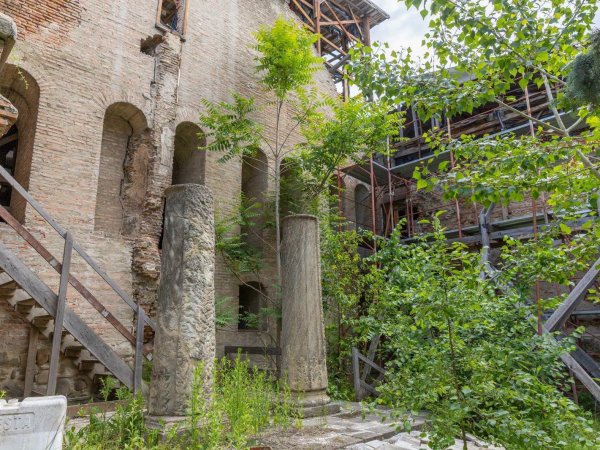
The legends surrounding Curtea Veche continue to attract attention, but the monument faces a much more concrete challenge: preserving the historic remains for future generations.
The Voivodal Palace has suffered from serious deterioration over the years. The complex covers approximately 3,380 square metres and includes nine building bodies, making its conservation a difficult and complex undertaking.
In September 2026, Bucharest City Hall announced the start of new safety and conservation works at Curtea Veche. The project is intended to protect the walls, vaults and exposed historic surfaces and includes repairs to the roof as well as the installation of a temporary protective roof. The works were announced with a duration of approximately three months and a budget of around 2 million lei.
It is important to distinguish these measures from a complete restoration of the monument. The current intervention is primarily aimed at stopping further deterioration and creating the conditions necessary for future archaeological investigations and conservation works.
The site has already gone through previous attempts to improve its safety. An earlier intervention started in 2018 was eventually halted and abandoned roughly two years later, leaving the complex vulnerable to continued deterioration.
Future restoration plans could reveal even more about the history hidden beneath Curtea Veche. Archaeological investigations may help clarify the foundations of Vlad the Impaler’s fortress, the palace built under Mircea Ciobanu, the chapel associated with Grigore Ghica, the structures created during Constantin Brâncoveanu’s reign and other elements of the former princely residence.
Curtea Veche therefore remains a place where documented history and urban legend exist side by side. The stones tell the story of rulers, wars, fires, architectural transformations and the gradual development of Bucharest, while the legends add ghosts, secret tunnels, hidden bells and mysterious characters.
Whether Vlad the Impaler’s ghost really wanders among the ruins or Baba Manu truly returns after midnight is impossible to prove. What is certain is that these stories have become part of the cultural memory of Bucharest. They give Curtea Veche an atmosphere unlike any other historic site in the capital and continue to transform the old princely residence into a place where history and legend meet.
We also recommend: Curtea Veche Palace – Bucharest’s oldest monument, forgotten and in ruins