The History of the National Salvation Cathedral in Bucharest, the Largest Orthodox Church in the World
By Bucharest Team
- Articles
- 15 OCT 26
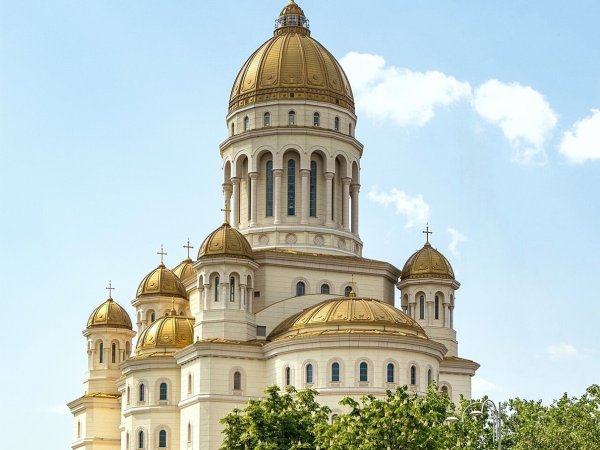
The National Salvation Cathedral, officially known as the National Cathedral, is one of the most spectacular and controversial buildings constructed in Bucharest after 1989. Located on Arsenal Hill, immediately next to the Palace of Parliament, the building dominates the cityscape of the capital with its enormous dimensions and has already become one of the city’s most recognizable landmarks. Construction began in 2010, following more than a century of projects, delays and disputes over where a cathedral representative of the Romanian Orthodox Church should be built. The foundation stone had been consecrated as early as November 29, 2007, but actual construction work began only in December 2010. The Romanian Patriarchate presents the building as the largest Orthodox church in the world by volume and floor area, while its dimensions place it among the largest places of worship on the planet. The cathedral is dedicated to the Ascension of the Lord and Saint Andrew the Apostle, the Patron Saint of Romania. The altar was consecrated in 2018, while the consecration of the interior mosaics and the official opening for worship took place on October 26, 2025, the year in which the Romanian Orthodox Church marked the centenary of its elevation to the rank of Patriarchate.
The idea of a national cathedral has a history spanning more than a century
The idea of building a large Orthodox cathedral in Bucharest did not emerge in recent decades. The project dates back to the period following the War of Independence of 1877, when Romania was consolidating its institutions and seeking to define its national symbols. According to the Romanian Patriarchate, in the summer of 1884, King Carol I promulgated the Law on the Cathedral Church of Bucharest. The law was never repealed, but its implementation would be delayed for more than a century.
The need for a representative cathedral was revived after the First World War and the Great Union. King Ferdinand reaffirmed the project in 1920, while Patriarch Miron Cristea was among its supporters. Various locations were proposed and architectural projects were developed, but none were ever brought to completion. Among the architects involved in discussions and projects for such a building was Petre Antonescu.
The communist period interrupted any realistic prospect of carrying out the project. In a Bucharest radically reshaped by demolitions and urban planning, the authorities had no interest in constructing a national Orthodox cathedral. After 1989, the idea returned to the public agenda and, following several proposals and disputes, the project finally began to take shape.
Why the Arsenal Hill area was chosen
The cathedral’s location next to the Palace of Parliament carries a powerful symbolic significance. The Arsenal Hill area had been profoundly transformed during the communist regime, when a large part of the old Uranus neighborhood and the urban fabric surrounding Dealul Spirii was demolished to make way for the House of the People and the regime’s new political and administrative center under Nicolae Ceaușescu.
In 2006, the Romanian Parliament made the land intended for the construction of the National Cathedral available to the Patriarchate, and the project entered a new phase. The site provided the space necessary for a building of extraordinary dimensions, but it also generated controversy. The cathedral was to become a monumental presence immediately next to the building that symbolizes one of the most radical urban transformations in Bucharest during the 20th century.
The location is therefore more than a simple address. Two radically different architectural and political visions meet in the same area: communist monumentalism, represented by the former Palace of the People, and the religious monumentalism of the National Cathedral. This proximity has fueled numerous discussions about the symbolic role of the new building in contemporary Bucharest.
From the foundation stone to a construction site of impressive proportions
A key moment came on November 29, 2007, when Patriarch Daniel consecrated the site of the future cathedral, on the eve of the feast of Saint Andrew the Apostle. The event took place after the location had been selected, but construction could not begin immediately. Between 2008 and 2010, consultation and design stages were carried out, with several architectural proposals being considered.
The building permit was issued on September 2, 2010, and the first actual construction works began on December 20, 2010. The project was designed to combine traditional Orthodox architecture with modern engineering solutions required for a building of such dimensions and one located in an area with significant seismic risk.
Construction progressed in stages, from the foundations and structural framework to the dome, towers and finishing works. During the years of construction, hundreds of workers were involved simultaneously so that the building could reach a sufficiently advanced stage for the religious events scheduled for 2018. In 2017, Patriarch Daniel stated that the number of workers had reached approximately 800 during certain periods, working in several shifts.
The dimensions that turned the National Cathedral into a monument of records
The National Salvation Cathedral is impressive above all because of its proportions. According to data presented by the Romanian Patriarchate, the building has a total height of approximately 132 meters, including the cross, a length of around 126 meters and a volume of approximately 323,000 cubic meters. The cathedral’s built-up area is approximately 6,000 square meters.
The Romanian Patriarchate presents it as the largest Orthodox church in the world by volume and floor area. It is also one of the tallest domed churches ever built, while its nave has extraordinary dimensions for an Orthodox building. These records should nevertheless be considered according to the criteria being used, since international rankings of the world’s largest churches may be based on floor area, volume, height or seating capacity.
One of the most spectacular features is the central dome, which dominates the entire complex. Above it rise the lantern and monumental cross, contributing to the total height of 132 meters. Through these dimensions, the National Cathedral has become a visual landmark that is impossible to overlook in central Bucharest.
An interior dominated by mosaics, gold and a monumental iconostasis
If the exterior impresses through its sheer volume, the cathedral’s interior is dominated by the scale of its liturgical decoration. The mosaic work represents one of the largest projects of its kind ever created for a contemporary place of worship. The area decorated with mosaics covers tens of thousands of square meters, while the work required millions of individual tesserae.
The mosaics use glass tesserae and high-quality materials, including elements produced according to the tradition of workshops specializing in Byzantine art. Gold, vivid colors and depictions of numerous saints create an interior that continues the Orthodox iconographic tradition on a monumental scale.
Another spectacular element is the iconostasis. With an area of approximately 407 square meters, it is presented by the Romanian Patriarchate as the largest Orthodox iconostasis in the world. Its size transforms the area between the altar and the nave into one of the most impressive spaces in the entire building.
The enormous chandeliers, stained-glass windows, icons and columns contribute to the monumental appearance of the interior. Overall, the architecture and decoration seek to convey the same idea of grandeur suggested by the exterior.
The 25.2-ton bell and the other records
One of the objects that attracted the most attention even before the cathedral was completed is its monumental bell. Weighing approximately 25.2 tons, it is presented as the world’s heaviest free-swinging church bell. Its dimensions required special technical solutions for its installation and operation.
The bell is not the only feature that sets the National Cathedral apart. The entire project was conceived to transform the building into a landmark of contemporary Orthodox architecture, both through the dimensions of the construction and through its iconography and technical infrastructure.
A larger complex was designed around the cathedral, including underground and above-ground spaces, porticos, towers and other auxiliary structures. For this reason, when discussing the cost of the project, it is necessary to distinguish between the cost of the cathedral itself and the value of the entire complex. In 2025, the Romanian Patriarchate stated that the investment in the entire National Cathedral complex had reached approximately 270 million euros and that more than 10 percent of the costs had been covered from its own funds.
The consecration of the altar in 2018 and the historic moment in 2025
A major moment in the history of the National Cathedral took place on November 25, 2018, when the altar was consecrated. The event was symbolically connected with the centenary of the Great Union, and the building began to be used for liturgical events even though construction had not yet been completed.
One year later, in 2019, the National Cathedral was visited by Pope Francis during his apostolic visit to Romania. The moment carried considerable symbolic significance, as the building was still undergoing completion, but had already become one of the most important religious projects in contemporary Romania.
The decisive moment came on October 26, 2025. During the centenary year of the Romanian Patriarchate, the mosaics of the National Cathedral were consecrated by Ecumenical Patriarch Bartholomew I and Patriarch Daniel, together with a large gathering of bishops, priests and deacons. The event represented the official consecration of the cathedral for worship, approximately 15 years after construction began.
However, the 2025 consecration did not mean that every project within the entire complex had been definitively completed. At the beginning of 2026, the Romanian Patriarchate announced that the building would once again be closed so that interior works could continue. Therefore, it is more accurate to speak of its official opening for worship rather than the absolute completion of every construction and finishing work.
The cost of the cathedral and the controversies surrounding its funding
No discussion of the National Cathedral can avoid the issue of money. The project has been controversial from the beginning, with one of the main criticisms focusing on the appropriateness of constructing such a large building at a time when Romania was facing significant social and economic problems.
In 2025, the Romanian Patriarchate stated that the investment in the entire complex had reached approximately 270 million euros and that more than 10 percent of the costs had been covered from its own funds. The rest of the financing came over the years from public contributions and other sources provided for under the legal framework.
There are, however, differences between the figures communicated by the Patriarchate and some independent analyses concerning the total amount of public allocations. An investigation published in 2025 estimated that cumulative budgetary allocations from public institutions had exceeded 315 million euros, highlighting differences between the funding identified in state documents and the figures presented by the Church. These estimates refer to funding mechanisms and periods that must be analyzed separately from the 270 million euro figure communicated by the Patriarchate for the entire complex.
This is where one of the cathedral’s most persistent controversies originates. For supporters of the project, the building represents a symbol of Orthodox faith and national identity, while critics view it as an example of costly monumentalism, built at a time when public resources are heavily contested.
A new landmark of Bucharest
Regardless of opinions about its architecture, size or financing, the National Salvation Cathedral has permanently changed the image of Bucharest. Its silhouette rises above the 13 Septembrie area and can be seen from a considerable distance, making it an urban landmark comparable, in terms of visibility, to the capital’s major monumental buildings.
Its story is also the story of a project that crossed several political regimes and generations. The idea was formulated in the 19th century, supported after the Great Union, abandoned during the communist period and revived after 1989. The foundation stone was laid in 2007, construction began in 2010, the altar was consecrated in 2018, and the official consecration of the mosaics and opening for worship took place in 2025.
Today, the National Cathedral is simultaneously a place of worship, an architectural monument and the subject of a public debate that will probably continue for many years. For the Romanian Orthodox Church, it represents the expression of an aspiration more than a century old and a symbol of the continuity of faith. For critics of the project, it remains one of the most expensive and controversial religious buildings of contemporary Romania.
One thing, however, is certain: with its 132-meter height, enormous volume, monumental iconostasis, dome and impressive mosaic surfaces, the National Salvation Cathedral has already entered the history of Bucharest. And its story, which began more than 140 years ago as a project and was finally realized only in the 21st century, is one of the longest and most controversial construction histories in modern Romania.
We also recommend: Saint Spyridon the New Church, the second largest Orthodox church in Bucharest, was founded 260 years ago by Prince Scarlat Ghica