Top 10 Vintage Advertisements That Sold Bucharest
By Eddie Țone
- Articles
- 16 OCT 26
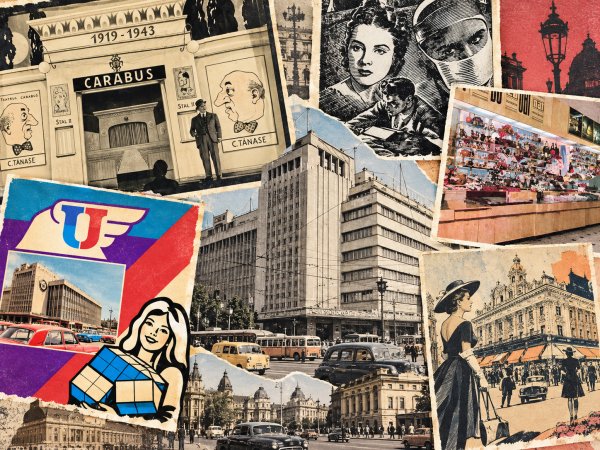
Old Bucharest knew how to sell itself. Sometimes with an impeccably illustrated lady, sometimes with lettering as large as a shop window, and occasionally, in a moment of commercial inspiration, with a sea eagle clutching a fish in its talons which, somehow, was supposed to persuade people to buy… fabrics. Urban advertising had its moments of brilliance, when logic took the afternoon off and memory was declared the winner.
During the interwar period, the Romanian capital had become the country's main testing ground for advertising. Newspapers carried advertisements of every size, major department stores ran seasonal campaigns, international advertising agencies opened local branches, and by 1930, Bucharest even had companies specializing in illuminated advertising. Shop windows, printed posters, and radio were already working together toward the same goal, one as old as merchants and wallets themselves: turning desire into a purchase.
After the war, the language of commerce changed along with the economy. Advertising became part of a state-controlled system, with institutions such as Pavoazarea Capitalei and the RECOM and ARTIS agencies managing much of the city's commercial promotion. Yet advertising continued to exist, sometimes with delightful innocence. Shops promised elegance, restaurants offered historic atmosphere, and large department stores presented themselves as entire shopping cities compressed between the ground floor and the top floor.
These ten advertisements offer a parallel history of Bucharest. At times, the city looks Parisian; at others, technologically ambitious, socialist and lavishly stocked on paper, or eager to go out for an evening's entertainment. Almost every era printed its dreams in capital letters.
1. Galeries Lafayette – When Paris Came to Calea Victoriei
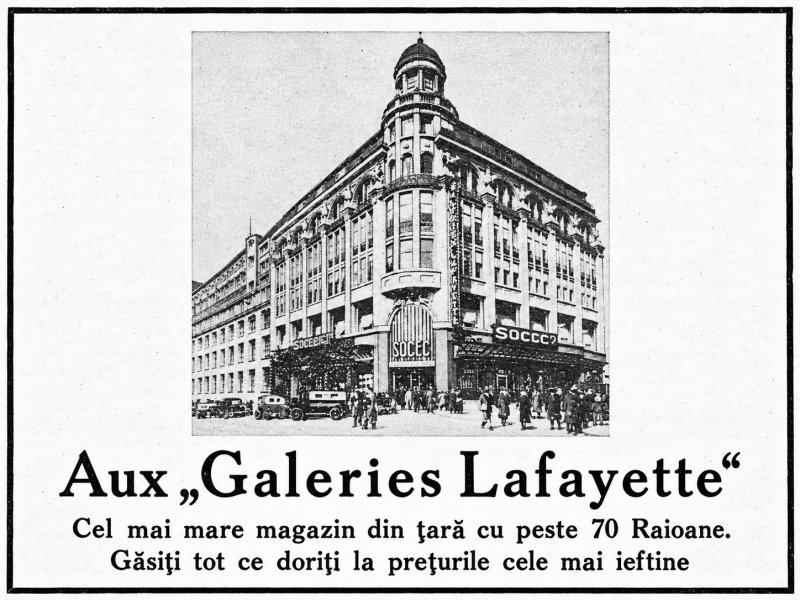
Galeries Lafayette was probably the most direct expression of interwar Bucharest's Western ambitions. The department store stood on Calea Victoriei, at its intersection with Lipscani Street, in a building constructed in 1928 to the designs of architect Herman Clejan. Its inspiration clearly came from the great Parisian department stores, while the Bucharest interior featured spacious shopping areas, an elevator, and marble floors. Commerce had to look modern before the first customer even opened a wallet.
A 1937 advertisement described it as "the only Western-style department store in the country" and emphasized the merchandise arriving from its Paris headquarters, with the latest seasonal fashions delivered practically straight from the source. The wording reveals a great deal about its intended customers. Shoppers were buying a garment and, symbolically, a few inches of Paris.
Another poster relied on sheer scale, announcing "The Largest Department Store in the Country." What else needed to be said? At that level of advertising ambition, modesty would have been a rather unprofitable strategy.
Following nationalization in 1948, the same building became home to Victoria Department Store, and the story of Bucharest advertising performed one of those historical pirouettes that the city seems to execute with remarkable frequency.
2. "La Vulturul de Mare cu Peștele în Ghiare" – Branding Before the Word Entered the Boardroom
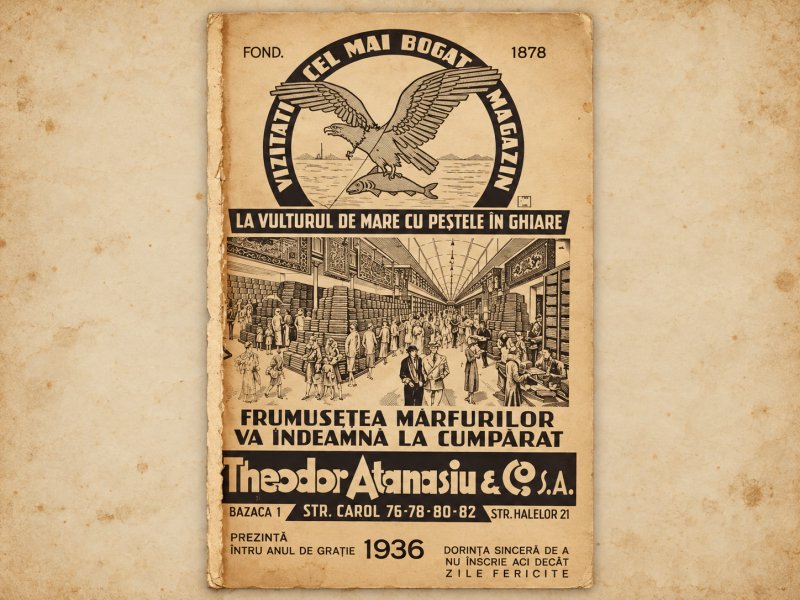
If a contemporary branding consultant were asked to name a clothing store "At the Sea Eagle with the Fish in Its Talons," the meeting would probably last a very long time. In old Bucharest, however, the name worked remarkably well.
The store owned by Theodor Athanasiu, founded in 1878 and located in the Bărăției area, had become one of the city's commercial landmarks. The Advertising Museum considers it one of the first Romanian stores to develop a coherent advertising campaign, and its famous emblem remained on the building until around the 1970s.
A 1937 advertisement proclaimed it "the best-stocked store," accompanied by the unmistakable illustration of a bird clutching its prey. The copy suggested that the beauty of the merchandise would encourage the public to make purchases. Advertising copywriters of the period undoubtedly had a very straightforward relationship with the fate of the money in people's pockets.
But the greatest advertising lesson lies in the name itself. A Bucharest resident might forget an address, a price, or the pattern of a particular fabric, but a sea eagle holding a fish in its talons stood a very good chance of settling comfortably into their memory.
3. The Romanian Telephone Company – Modern Comfort Was Calling
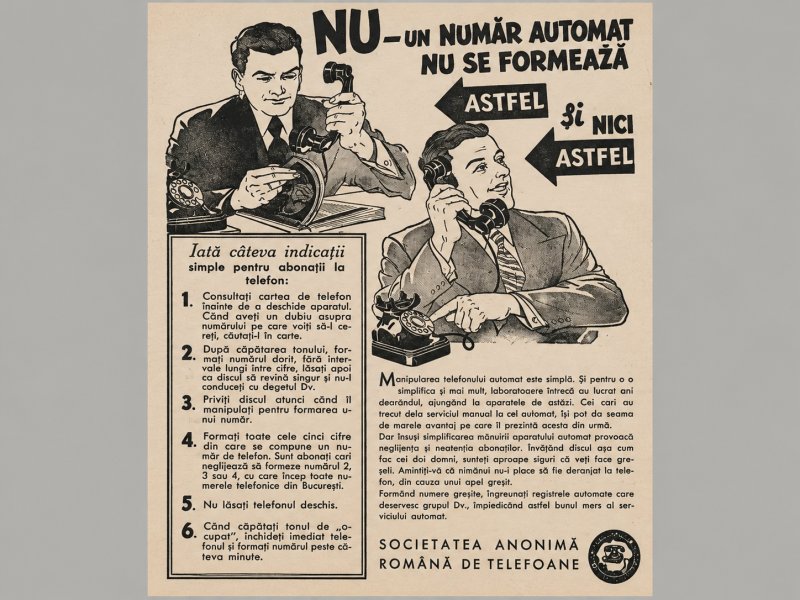
In the 1930s, having a telephone at home was a statement of status and modernity, and the Romanian Telephone Company (Societatea Anonimă Română de Telefoane) knew exactly what it was selling. Its advertisements associated the telephone with the comfort of a modern apartment and compared the cost of long-distance calls with the price of travelling. The telephone wire thus became a sort of very long train that could fit on a small table in the hallway.
The urban setting helped deliver the message beautifully. The Telephone Palace was inaugurated on April 24, 1933, and Bucharest's telephone network was fully automated that same year. The capital then had approximately 18,000 lines and 8,000 telephone sets. The building on Calea Victoriei was itself a three-dimensional advertisement for the future. In a city still dominated by low-rise buildings, the tower announced at a glance that technology had arrived and established its headquarters downtown.
Telephone advertising was therefore selling both minutes of conversation and a new version of urban life. Distance was becoming negotiable, an idea that must have sounded rather spectacular in 1932.
4. Cărăbuș – How Constantin Tănase Turned His Face into a Brand
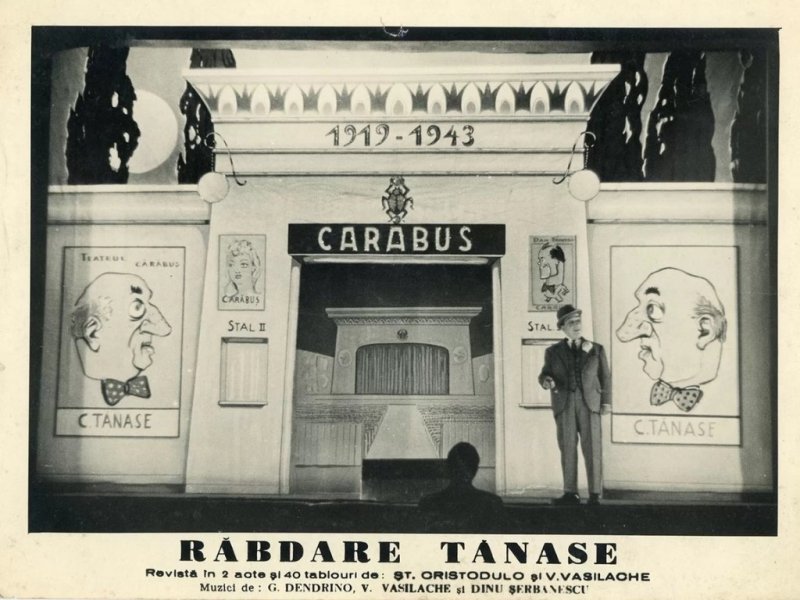 Photo credit: taetrultanase.ro
Interwar theatre advertising had one tremendous advantage: stars. Constantin Tănase had become so recognizable that his silhouette alone could serve as a logo. His famous nose, suit, and distinctive posture appeared on the programmes and promotional materials of Cărăbuș Theatre, giving illustrators plenty to work with.
The Cărăbuș open-air theatre had been founded by Tănase on Academiei Street, with the foundation stone laid on May 23, 1919. Its official opening took place on July 2, with the revue Pisica pe orez ("The Cat on the Rice"). In the following years, the company became one of Bucharest's major entertainment institutions, and its illustrated programmes from the 1930s show just how well the theatre world understood the value of a visual identity.
A Cărăbuș programme from 1933 places Tănase at the centre of the composition, surrounded by theatrically illustrated female characters. The printed page was already selling the evening's entertainment before the spectator had even taken a seat.
There is also a wonderful piece of local show-business history here. Tănase had seen Josephine Baker perform in Paris in 1927, and the following year, the international star appeared in Bucharest in the production Negru pe alb ("Black on White"). Cărăbuș had understood early on a principle that the entertainment industry still follows today: the show begins with the poster in the street.
5. Cinema ARO – The Advertisement Where the Building Became the Star
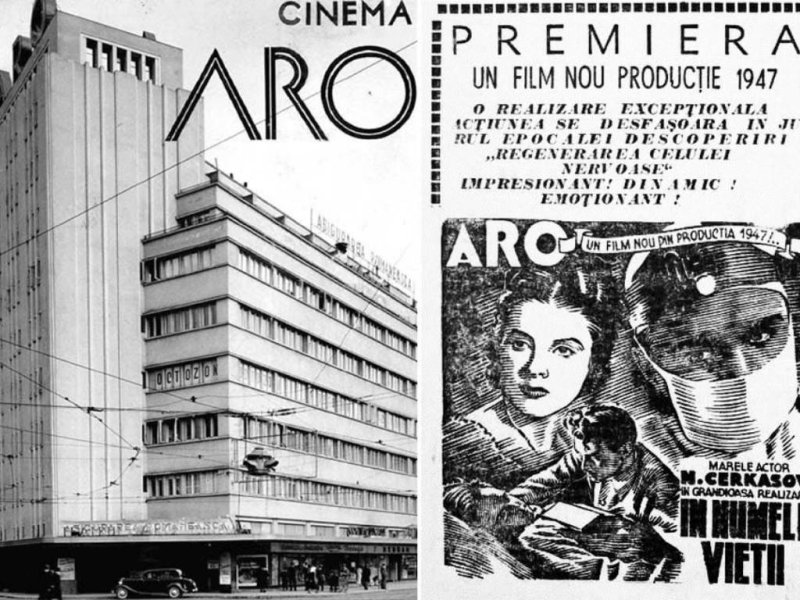
The programme cover of Cinema ARO from the 1930s looks as though it was designed by someone who had just discovered the pleasures of modernist lines and decided to make the most of them. The building itself dominates the cover, with its vertical geometry and that unmistakable air of a Bucharest that had just bought itself a new wardrobe.
The ARO cinema, later renamed Patria, was built in 1934 and inaugurated in January 1935. With almost 2,000 seats, it was the largest cinema in the capital at the time. Horia Creangă's design included a spectacular reinforced-concrete vault spanning 32 metres.
This is where the advertisement takes on an interesting dimension. The cinema could promote the film showing that evening, but its architecture was already promoting the experience. Audiences entered a space that looked radically contemporary for its time. Magheru Boulevard was becoming a showcase of Bucharest modernism, with ARO occupying one of its most prominent positions.
On a printed programme, the illustration of the building says almost everything. Bucharest in the 1930s was selling entertainment through cinema while simultaneously selling its own image as a modern metropolis.
6. Victoria Department Store – "50 Stores Under One Roof"
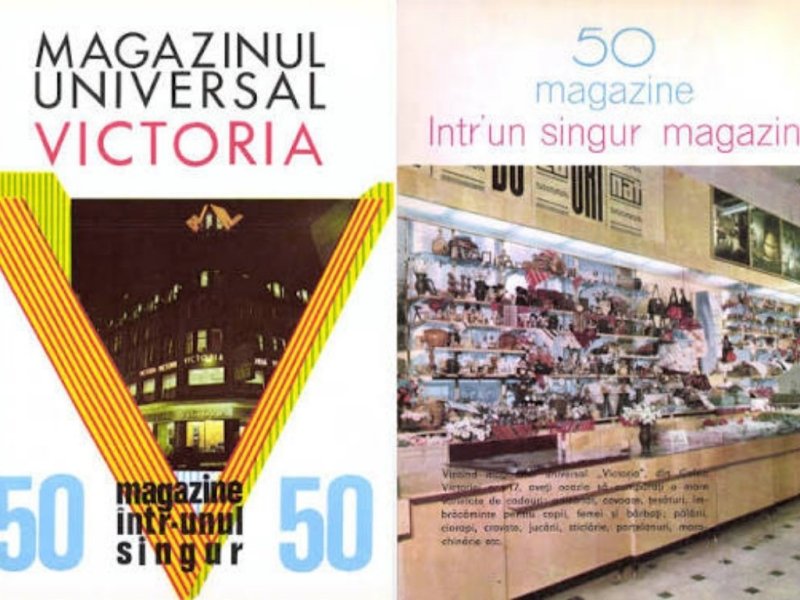
The same building that had once promoted the Parisian elegance of Galeries Lafayette received a new name after 1948: Victoria. With it came an advertising language suited to the new era. The slogan that remained in the memories of Bucharest residents was wonderfully concise: "50 Stores Under One Roof."
A 1986 advertisement used the slogan as its central idea and turned the department store's floors into a shopping guide. Each level had its own specialization, and the intended effect was clear: Victoria was to be seen as a complete shopping universe.
In 1968, the store had introduced escalators, a first for a Romanian department store, while also experimenting with modern self-service shopping during the same period.
There was a very… orderly continuity in this particular building's history. The interwar era shouted "the largest department store," the socialist period replied with "50 stores under one roof," and the building remained where it was, watching the slogans change beneath the same roof.
7. Romarta, Eva and Adam – Socialist Elegance Advertised Itself
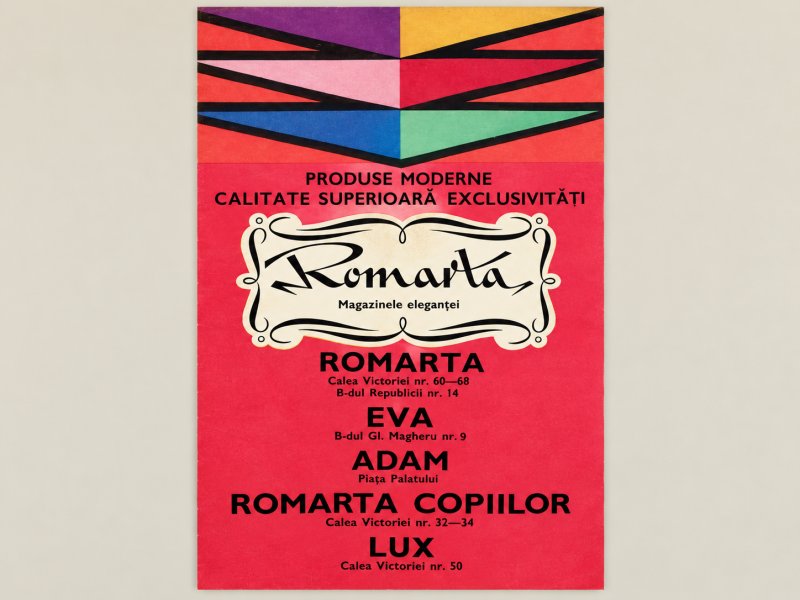
A Romarta advertisement from 1978 used the phrase "The Stores of Elegance." The design was clean, the store names occupied the visual centre, and the message attempted to create exactly what commercial advertising had always sought to build: prestige.
The Bucharest retail network included specialized stores with well-defined identities. Eva, at 9 General Magheru Boulevard, had operated since 1964 and focused on women's fashion. Documentation from the Bucharest Municipal Museum even mentions limited-production collections and a monthly event called "Parada Modei" ("The Fashion Parade"). Adam, which opened in January 1965 in Palace Square, was presented as "the store of masculine elegance." Romarta Copiilor, opposite the Military Circle, sold children's clothing and accessories.
The advertisement reveals something interesting about Bucharest at the time. Even in a planned economy, fashion still needed storytelling, status, and visual differentiation. A shirt remained a shirt, but customers could walk into "Adam," and the experience immediately sounded a little more sophisticated. Western-style commerce had disappeared from the official vocabulary, but elegance had survived remarkably well.
8. Hanul lui Manuc – History Served at the Table
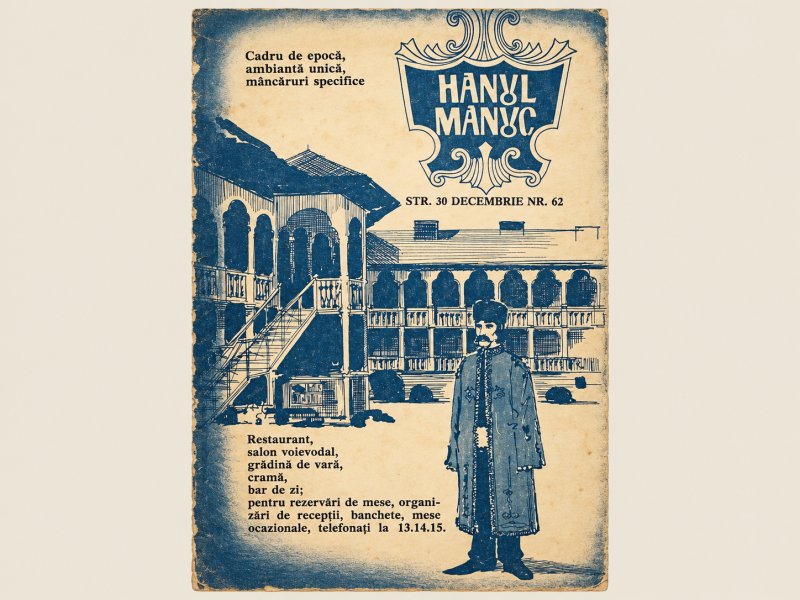
In 1973, an advertisement for Hanul lui Manuc (Manuc's Inn) promoted its restaurant by drawing directly on the site's historic heritage. The inn had been restored between 1966 and 1970, after which it rejoined Bucharest's restaurant scene. The building, whose construction was begun in 1806 by Manuc Bey, thus became a setting, a selling point, and a tourist attraction all at once.
The advertisement presented the complex with its restaurant, wine cellar, and hotel, while dishes on the menu carried names associated with Manuc. The strategy was clear and remains highly relevant today: the customer, treated as the "master," was supposed to feel they were dining inside a piece of historic Bucharest.
Did it work? The aroma of the past probably did half the job before the kitchen had even started. The inner courtyard, wooden galleries, and the name of a nineteenth-century Armenian merchant provided the marketing department with material that many contemporary restaurants would regard with a certain amount of envy.
Manuc Bey, born in Ruse in 1769, had begun building the inn in the second half of 1806. Nearly 170 years later, his name was still selling dinners in Bucharest.
9. Unirea Department Store – "A Store for Everyone"
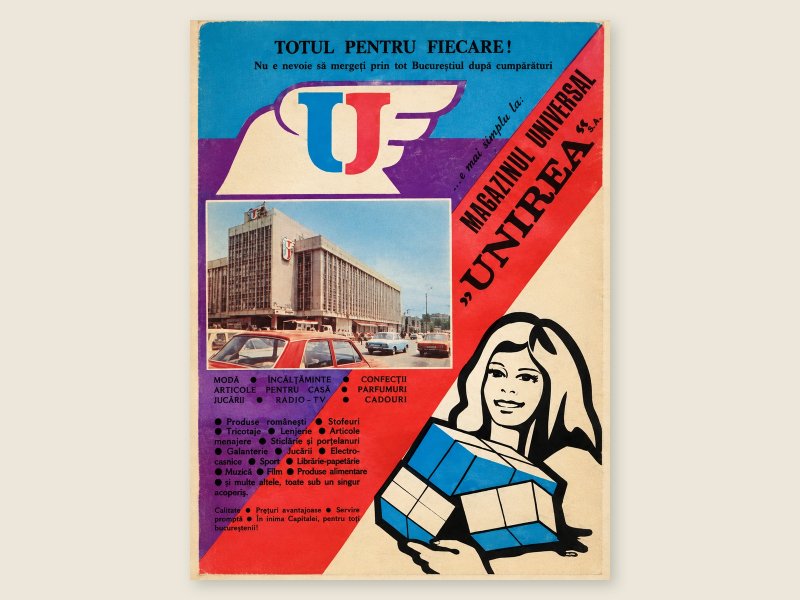
An advertisement in the 1988 edition of Magazin Almanac presented Unirea through an almost programmatic slogan: "A Store for Everyone." The illustration of the building and its oversized logo created the image of a shopping destination capable of swallowing up a considerable proportion of a Bucharest family's everyday needs.
The department store had been inaugurated on September 2, 1976, based on a design by architect Gheorghe Leahu. Construction had begun in 1973, and the complex extended over eight levels, including the basement and ground floor. Contemporary commercial documentation described it as a large department store intended to serve a very broad range of customers.
Unirea's advertising used the sheer monumentality of the building as its main selling point. In photographs and illustrations, the store looked like an enormous shopping machine planted at the edge of Unirii Square.
The 1988 slogan deserves to be remembered for its simplicity. "A Store for Everyone" sums up the ideal of the socialist department store in a sentence that any copywriter would have been delighted to put into a layout before lunch.
10. București Department Store – The Façade That Advertised After Dark
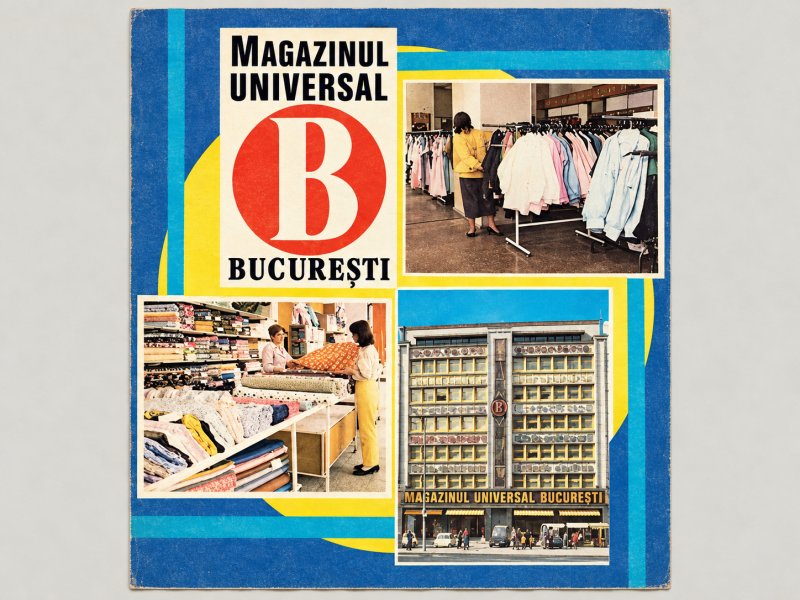
Magazinul Universal București (București Department Store), at 2 Bărăției Street, as it was formerly known, offers another form of urban advertising. Period photographs show its façade covered with illuminated signs identifying the different departments, turning the building itself into something resembling a newspaper page standing upright after dark.
The state-owned store's history began on December 6, 1947, with the takeover of stock from existing commercial businesses. It would go on to become one of the major department stores in the city centre. It had seven shopping levels and a retail floor area of 2,654 square metres. The store even operated an ordering service that allowed customers to purchase certain items for a commission.
The illuminated lettering on the façade transformed Bucharest at night into a catalogue. Advertising lived directly on the building and became part of the streetscape.
From the sea eagle clutching a fish in its talons to the enormous socialist department stores, Bucharest advertising changed its vocabulary, graphic design, and promises. Yet the city continued doing what every commercial metropolis does: turning an address into a story, and a story into a reason to walk through the door.
Viewed today, these advertisements tell us even more about Bucharest than about the products they were selling. The interwar years dreamed of Paris, telephones, and cinemas, while the communist decades favoured gigantic department stores, elegance organized by shopping departments, and restaurants with a flavour of history. Between them stands the city itself, always ready to change the sign above the entrance and carry on with business as usual.
You may also like: What communist-era Bucharest shops looked like and what they sold, from Unirea to neighborhood alimentaras