What communist-era Bucharest shops looked like and what they sold, from Unirea to neighborhood alimentaras
By Eddie Țone
- Articles
- 10 JUN 26
Communist Bucharest could sometimes be read directly in its shop windows. In the city center, the large department stores displayed their sections, the promise of a modern, orderly life, with curtains, fabrics, crystalware, electronic watches, and clothes “in the latest fashion.” In the neighborhoods, the grocery shop, the greengrocer’s, the tobacconist’s, the Tehnometal hardware store, and the pharmacy formed the daily geography of urban survival. Between these two worlds stretched a strange distance, measured in cloth shopping bags, connections, whispers, and patience. A great deal of patience.
For Bucharest residents of the 1970s and especially the 1980s, shopping became a form of applied vigilance. Eyes followed the movement of the supply truck, ears caught the word “meat” in passing, and the body learned the official posture of waiting: slightly tense, slightly resigned, with a net bag in hand and the hope that the person in front was buying for their family, not for the entire apartment block, staircase B, and an aunt from the provinces.
The large department stores, the socialist shop windows of the city
In the commercial imagination of communist Bucharest, the large department stores occupied a privileged place. Victoria, București, Unirea, Cocor, and Bucur-Obor were urban landmarks, meeting points, places for strolling and, occasionally, places where one could actually find something. The socialist state favored these large, orderly buildings with specialized departments because they looked good in photographs and speeches. Commerce had to appear modern, abundant, and disciplined, even when the shelf had a contemplative air.
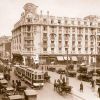
The Victoria store, formerly Galeries Lafayette, remained tied to a commercial history that began in the interwar period, in the area of Calea Victoriei and Lipscani. The building, erected in 1928 according to the plans of architect Herman Clejan, had been conceived after the model of the great Parisian department stores, with generous display spaces, an elevator, marble, and a Western atmosphere. Under communism, the name and clientele changed, but the place continued to function as a commercial landmark in central Bucharest.
The București store, located in the Lipscani–I.C. Brătianu area, with a history connected to the old Popp & Bunescu commerce near Bărăția, belonged to the same world of urban trade organized by floors. The interwar building had a compact volume, spread over seven levels, and during the socialist period it functioned as a department store, with sections for household goods, clothing, footwear, textiles, children’s items, and other consumer goods. Between the inventory listed in guides, advertisements, or official presentations and the buyer’s concrete experience, however, there intervened that small Balkan-socialist subtlety called availability.
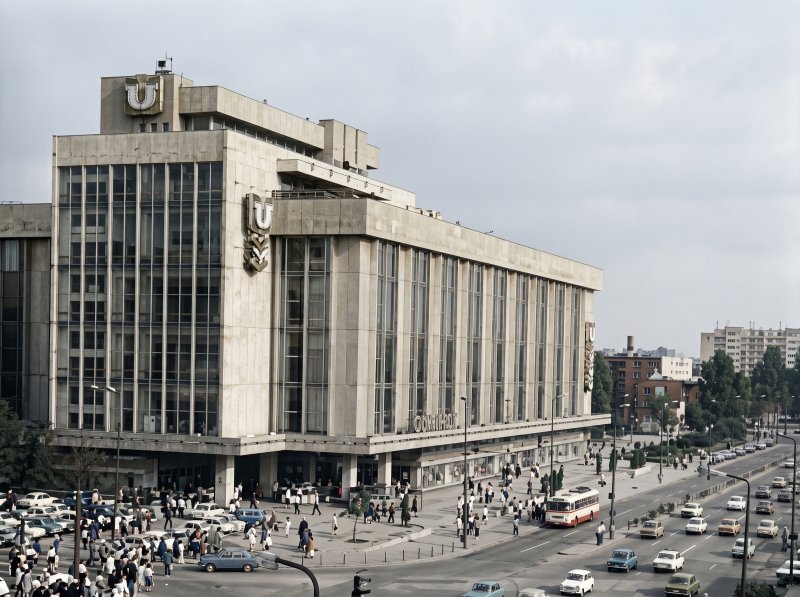
Unirea store, in the 70s.
Unirea Department Store was one of the great commercial symbols of the capital. It was built according to the plans of a team of specialists led by architect Gheorghe Leahu and inaugurated on September 2, 1976. The building, located in Piața Unirii, was conceived as an important piece in the stage design of socialist commerce: large volume, multiple floors, departments, and a visual promise of order.
The departments were organized by levels, from food products and everyday goods to clothing, home items, leisure goods, and products considered luxurious or produced in small batches. On paper, Unirea looked like a well-behaved catalogue of urban life: crystalware, watches, jewelry, handicrafts, ties, cosmetics, bicycles, furs, fine drinks, records, cassette players, curtains, fitted carpets, household appliances. Unirea was an entire world arranged across floors.
Gheorghe Leahu deserves mention here as a character of the city, because his name remains connected to Unirea Department Store and to important urban projects in communist Bucharest. An architect and watercolorist, Leahu, born in Chișinău in 1932 but a Bucharest resident from 1940 onward, left behind a double view of the city: one technical, as a designer, and one melancholic, as a witness to a Bucharest often pushed toward rigidity by official plans.
Unirea looked like a promise of orderly abundance. In practice, people went there with carefully calibrated expectations. They searched for somewhat better clothes, shoes, gifts, cosmetics, household items, electrical appliances, things for the home. Sometimes they left satisfied. Other times they left only with the information that “maybe they’ll bring some in on Thursday.”
The neighborhood grocery shop, the true theater of daily life
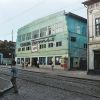
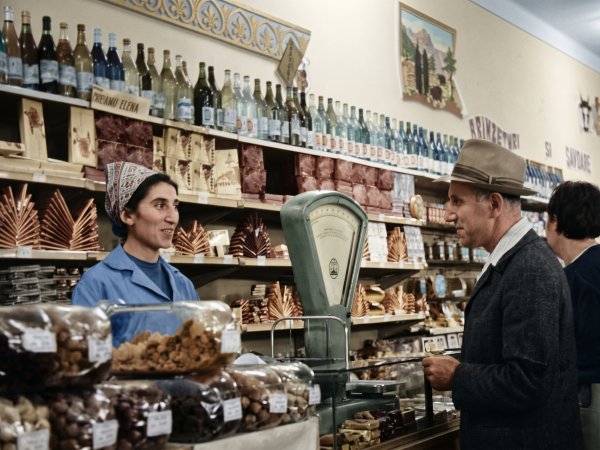
If Unirea was the grand stage, the neighborhood grocery shop was the small theater where the daily play unfolded. Many areas of the city had a small local commercial center: a grocery shop, a greengrocer’s, a pharmacy, a post office, a tailor’s, a Tehnometal hardware store, sometimes a tobacconist’s and a confectionery. That was where the real news of the neighborhood could be found. Who had received salami. Where oil had been delivered. When the bread would arrive. Who had a connection with the store manager. Who had seen the truck.
Compared with the 1980s, the 1970s remained in the memory of many Bucharest residents as a more bearable period. Basic products could still be found, even if the selection was limited and quality varied. In the 1980s, against the background of austerity, Ceaușescu’s mad idea of accelerated repayment of the foreign debt, the compression of imports, and pressure on exports, grocery shops became increasingly poor. The shelves sometimes seemed decorated with solitary jars, impersonal cans, hard biscuits, pasta, rice, flour, or products bought on the principle of “take it now, see what you do with it at home.”
Irregular supply turned shopping into an endurance sport. People went to work with a shopping bag in their briefcase, because good news could appear at any moment. In the language of the period, “marfă s-a băgat” — literally, “goods have been put in” — meant that the shop had received a batch of products. The expression had an almost military energy. The goods came in, the news ran, the queue formed, and personal time disappeared into the great mechanism of waiting.
What could be found and what became treasure
The list of available products varied depending on period, neighborhood, connections, and luck. Many basic products — meat, oil, sugar, milk, eggs, flour, bread, or cornmeal, depending on the period and locality — entered the logic of rationing, limited quantities, and queues. Some shops had common products, but that very ordinariness became extraordinary through scarcity.
Meat occupied first place in the mythology of supply. When meat appeared, the neighborhood reacted with a promptness that public administration might have envied. A long queue formed, shopping bags were symbolically left in line, neighbors were sent on reconnaissance, and children were mobilized to hold a place. Cold cuts had their own status, and salami with soy entered collective memory as the bitter emblem of the decade.
Sugar and oil had their own period of rationing, and the queues that formed while waiting for grocery shops to be supplied were sometimes endless. With no guarantee that everyone who joined them would also be rewarded.
Real coffee became difficult to access, while substitutes based on chicory, barley, or other mixtures entered the routine of the period; the famous “nechezol” appeared. Fish was officially promoted, and various food solutions presented as rational tried to cover the cracks in the supply system. The regime produced explanations. The population produced jokes. In that competition, the jokes won decisively in the memory department.
The real shortages of communist Bucharest
What was especially missing was predictability and the dignity of the buyer. What was missing was the certainty that, after eight hours of work, a person could buy the food needed for the family. Options were missing. Normality was missing. Meat, butter, milk, eggs, coffee, sugar, oil, oranges, bananas, better chocolate, detergent, toilet paper, light bulbs, batteries, quality footwear, and genuinely good-looking clothes came in, went out, disappeared, reappeared, circulated through rumors and analog social networks, with the neighbor from the second floor in the role of push notification.
Oranges and bananas had a special aura, especially around the holidays. For children, they seemed to come from a colorful, tropical, somehow magical world. For adults, they were proof that the system could offer small joys, carefully portioned out, according to a choreography resembling the distribution of a prize for patience.
Stores such as Victoria, Cocor, Unirea, Obor, Eva, or Adam were part of the circuit of clothing searches, but Bucharest residents often relied on bought fabrics, tailors, alterations, improvisations, and exchanges. Fashion was built with a needle, patience, and small arrangements. Urban elegance existed, but it required work, a good eye, and, somewhere along the way, a discreet connection in the right place.
The queue, an urban institution with its own rules
The queue was one of the great informal institutions of communist Bucharest. It had rules, vocabulary, hierarchies, and tensions. The classic question was “What are they giving out?”, and the answer could completely change the day’s schedule. One held a place in line with a shopping bag, a child, a neighbor, or through periodic presence, a method that inevitably provoked sidewalk-level legal debates. When the goods arrived in small quantities, mathematics became emotional. Every person ahead represented one fewer portion, and every newcomer seemed suspicious on principle.
The queue was also a place for socializing. News circulated about the apartment block, relatives, installments, schools, job placements, films seen on Bulgarian television, and who had received another package from Germany. Humor worked as a defense mechanism. A Bucharest resident could stand for hours in the cold and still find the resources for a sharp remark. Sometimes the remark was the only product available in sufficient quantity.
The expression “a băga marfă” perfectly summarized the mechanism. Goods seemed to be introduced into the city as an event, rather than delivered as part of a normal system. The verb “to put in” suggested something sudden, almost clandestine, as if products were sneaking into reality. “They’ve put chicken in at the corner grocery shop” could sound like strategic news, and people reacted accordingly.
Ration cards, norms, and “scientific nutrition”
In December 1980, Law no. 13 established the framework for the creation, allocation, and use, by county, of resources intended to supply the population with meat, milk, vegetables, and fruit. Official language spoke of resource management, the state fund, self-management, and satisfying the needs of the population. In daily life, these formulas translated into limited quantities, controlled supply, and increasing pressure on urban consumption.
In 1982, the Program for the Scientific Nutrition of the Population added a pseudo-medical hat to the crisis. Doctors, specialists, ministries, the press, mass organizations, and the entire propaganda apparatus were mobilized around it. Iulian Mincu, a physician specialized in nutrition and metabolic diseases, frequently appears in documentation about this program as one of the central figures in the elaboration of rational nutrition norms.
Beyond the scientific packaging, people felt the effect directly at the shelves. The regime explained the limitation of consumption through health, economy, and social discipline. The Bucharest resident quickly translated it into everyday language: another queue. In this difference between the official phrase and the reality inside the grocery shop, a substantial part of the black humor of the 1980s was born.
“Brands” from communist-era shops
In the 1970s, the shops of Bucharest still had a sense of imperfect but recognizable commercial normality. You could find bread, milk in glass bottles, yogurt, sana, sour cream, telemea cheese, cașcaval, eggs, canned goods, fish, meat and cold cuts with a frequency that, seen from the perspective of the 1980s, now seems to carry an almost nostalgic glow.
Children had Eugenia biscuits, Rom chocolate, Kandia, caramels, hard candy, fondant sweets, menthol candies, wafers, halva, Turkish delight, sherbet, compotes and jars of jam sitting quietly in the pantry like small reserves of domestic optimism. As for soft drinks, Cico, Brifcor, Quick-Cola and Pepsi were part of the urban landscape, with Pepsi having a special history in Romania, beginning in the 1960s, when it became one of the small capitalist extravagances tolerated by the system.
In summer, beer had its own ritual: Gambrinus, Grivița, Rahova, Bucegi and Azuga appeared in shops, restaurants, taverns and beer gardens, with clear emotional hierarchies, since some people swore by Azuga, others by Gambrinus, while Rahova beer was one of Bucharest’s popular everyday beers.
At the tobacconist’s, you could find Carpați, Mărășești, Snagov, Bucegi, Amiral, Dacia, Lido, Diplomat, Bega and BT, some as harsh as a block meeting argument in a stairwell, others regarded as somewhat more elegant. Foreign cigarettes — Kent, Marlboro, Rothmans or Camel — circulated in a different register, through hard-currency shops, parcels from abroad, connections and small parallel economies.
Price lists from the period show the variety of Romanian cigarette brands, from Carpați and Mărășești to Snagov, Amiral, Dacia or Diplomat. In the 1980s, that same scenery shrank like a garment washed too hot: bread, oil, sugar, meat, milk, eggs, butter, coffee and cold cuts increasingly became matters of queues, ration cards, luck and connections, while the old sense of ease was replaced by soy salami, nechezol, anonymous canned goods, frozen fish, hard biscuits, pasta, rice, peas, jars lined up without much enthusiasm and sweets that appeared like small events.
Cuban candies, imported hard candy, chewing gum, oranges, bananas, better chocolate, real coffee or a packet of Kent cigarettes acquired the status of trophies. What mattered was not only taste or usefulness, but the story of access: who managed to get them, who brought them, who saved them, who “knew someone.”
The “hunger circuses” and the promise of centralized food supply
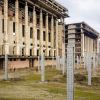
In the mid-1980s, the projects popularly known as the “hunger circuses” were officially conceived as large agro-industrial commercial complexes, integrated into the systematization of Bucharest. The idea was to centralize part of the distribution of food and prepared meals, while also offering the image of grand modernization. In official discourse, such spaces were meant to appear rational, efficient, and capable of disciplining supply.
Bucharest residents, however, gave them a name that proved stronger than any administrative document: “hunger circuses.” The nickname says almost everything about the distance between propagandistic intention and public perception. The massive, circular buildings, raised in an era of cold, scarcity, and forced saving, seemed like monuments dedicated to postponed abundance. Some were completed or transformed after 1989, and their memory remains tied to the typical paradox of the period: the state was building food buildings while people were hunting food through the neighborhood.
Connections, the small parallel economy, and the art of getting by
In communist Bucharest, official commerce had a discreet double. The shop assistant, the manager, the driver, the warehouse worker, the relative at the depot, someone from the factory, someone from the greengrocer’s, someone who “knows when it’s coming” became important characters. Connections could shorten a queue, reserve a better piece, announce the arrival of goods, or open access to products otherwise difficult to catch.
This economy of connections had its own code. Small favors were offered, exchanges were made, obligations were kept. A packet of coffee, a bottle, a better soap, or timely information could function as social currency. The regime spoke of equality, but daily life produced very concrete hierarchies, arranged around access to goods.
Here one of the system’s fine ironies becomes visible. Socialist commerce aimed to eliminate speculation and privilege, but shortage created a culture of small privilege, spread horizontally. The person who knew the right person became, for a few hours, a small aristocrat of salami.
The “shops,” display windows into a world entered with foreign currency
Communist Bucharest also had a separate category of stores, usually referred to simply by a short word that already sounded Western: the “shop.” These were Comturist stores, designed mainly for foreign tourists and for sales in hard currency, where one could find products that, in ordinary retail, seemed to come from a parallel civilization: foreign cigarettes, fine drinks, perfumes, cosmetics, chocolate, coffee, clothes, shoes, electronic devices or good-quality Romanian souvenirs.
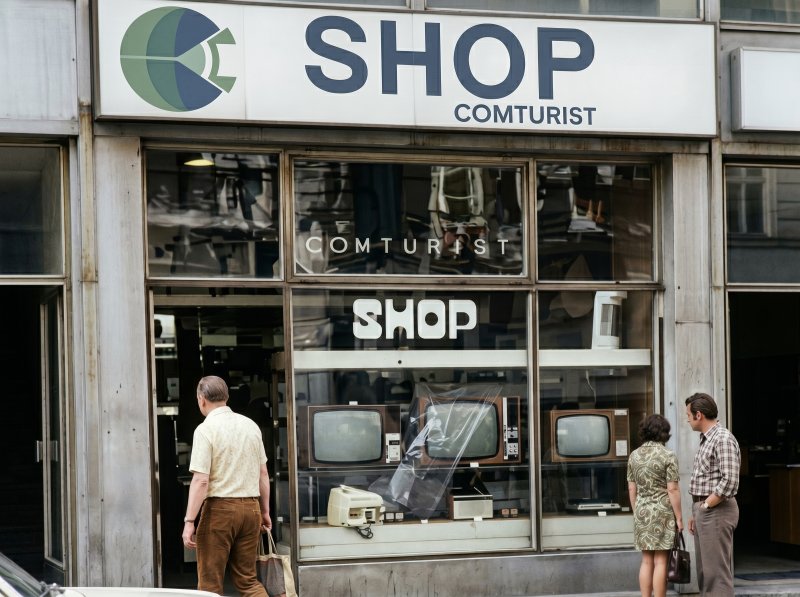
In a city where toilet paper could become the subject of a stairwell-level investigation, the mere existence of these stores felt almost indecent. They proved that goods did exist, only not for everyone and not in lei. Access depended on foreign currency, status, relatives abroad, official trips or small detours through the system.
For the average Bucharester, the shop was less a store than a display-window demonstration: proof that scarcity was not a natural fate, but a social architecture with separate doors. In the alimentara, people asked, “What’s being sold?” At the shop, the real question was, “Who is allowed to buy?” The Comturist network operated in communist Romania as a hard-currency store system connected to tourism, and by the late 1970s it had developed a substantial presence in major cities and tourist areas.
The legacy of an era with the shopping bag always ready
The stores of communist Bucharest tell stories about the city, power, and adaptation. Unirea, Victoria, București, Cocor, and Obor showed the ambition to modernize socialist commerce, with floors, departments, shop windows, and speeches about consumer goods. The neighborhood grocery shops showed the harsh reality of the final communist decade, when supply became a centrally administered lottery.
For Bucharest residents, shopping was a daily lesson in attention, patience, and irony. The shopping bag carried preventively, the queue formed by instinct, the question “What are they giving out?”, the news that “goods have been put in,” all remained in urban memory as signs of an era in which consumption was planned from above and improvised from below.
Today, as Unirea Mall stands in the city center like a building caught between several successive lives — sadly, the immense space has become rather abandoned — and the old grocery shops have been replaced by supermarkets, cafés, or brightly lit pharmacies, the memory of queues seems almost unbelievable to those raised with full shelves. Yet Bucharest still bears the traces of that geography. In the stories of parents and grandparents, in the expressions that remain, in the reflex some people still have to buy things “just in case,” one can still feel the city where goods appeared like a rumor and disappeared like a badly managed miracle.
/ Images restored and colorized using artificial intelligence, preserving the original details.
You may also like: What once was, what remains – iconic communist-era department stores and what they’ve become