Why Bucharest never had its own "Monte Carlo," unlike Sinaia or Constanța
- Articles
- 22 JUL 26
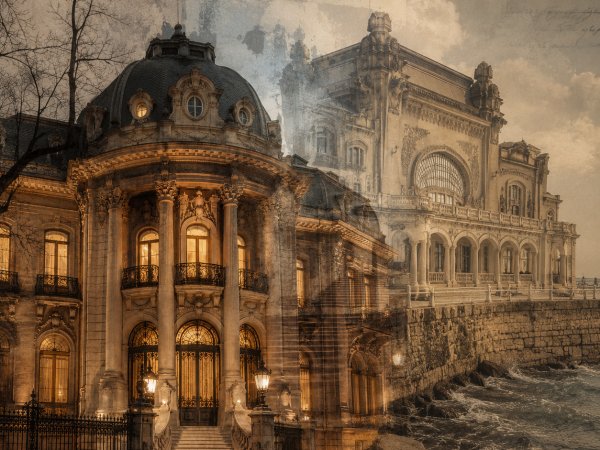
Sinaia has a casino built in 1912, designed from scratch after the Monte Carlo model, with gardens and a mountain view. Constanța has its own on the seafront, commissioned by the city council in 1902 and designed by architect Petre Antonescu in Art Nouveau style, finished around 1910. Bucharest, the capital, the city with the largest concentration of wealth in the country, never put up a building meant for that single purpose. Everything we call the city's "luxury casinos" today occupies houses built for something else entirely.
A resort-town model, not a capital-city one
Romania's early 20th-century casinos showed up wherever high society spent the summer: spa towns or the seaside, as part of a full leisure package — hotel, garden, promenade or park, with the casino as the centerpiece. Sinaia, Constanța, later Vatra Dornei or Slănic Moldova, all followed the same European pattern of cure towns, where gambling was one ingredient of the vacation, alongside walks, mineral water, and evening concerts.
Bucharest never needed that package. The city's elite didn't come here on holiday — they lived and worked here year-round, and their social life played out in the drawing rooms of their own houses, not in a public building set aside for entertainment. In the capital, gambling stayed a parlor activity rather than a resort one.
A boyar's house, turned into a gambling salon
The clearest example is Casa Vernescu, built in 1820 for the boyar Filip Lenș and restored in 1889 by architect Ion Mincu. From the 19th century into the early 20th, the house became a gathering place for Bucharest's elite — and, along with that, a place where fortunes were lost at roulette. Foreign diplomats who frequented the house sometimes ran up large gambling debts, and those debts became, for the intelligence services of the era, a convenient lever for extracting state secrets. The house's opulence worked as cover for what later got called "corridor diplomacy."
None of this happened inside a building erected for gambling. It happened in a boyar's residence informally repurposed, through the habits of the people who frequented it, into a gambling space — long before any licensed, signed casino ever operated there.
From nightclub to open market
Under communism, the Romanian casinos that survived operated in a hybrid form, closer to a nightclub than an actual gaming hall. Only after 1990, with foreign investors entering the market, did the industry take a shape recognizable by Western standards. Liberalization peaked between 1995 and 1997, when the state issued 10,000 gambling licenses; by 1997, 57 casinos were operating nationwide, 17 of them in Bucharest. Right in that window, in 1995-1996, Casa Vernescu officially got its casino license, under the name Palace Casino — essentially the legal continuation of a habit the house had already kept for a century.
What's left of all that
Today, the city's two "showcase" casinos remain Palace Casino, still inside Casa Vernescu on Calea Victoriei, and Grand Casino România, inside the JW Marriott hotel, near the Palace of the Parliament — a direct contrast between borrowed interwar elegance and a corporate hotel built after 2000. Neither building was originally conceived as a gambling venue.
Underneath that layer of luxury sits Bucharest's real gambling market, far less photogenic: over 500 electronic gaming halls scattered across the city, with none of the Belle Époque architecture of the resort casinos. The gap between those two worlds sums up the whole history of gambling in Bucharest — the capital never needed its own Monte Carlo, because it already had plenty of boyar houses where a fortune could be lost without anyone leaving town.