The Rebel Telephone Operators of 1928: How Bucharest Went Silent for Three Weeks, Out of Revenge
- Articles
- 17 JUL 26
On March 11, 1928, the Bucharest press reported something that today would sound like a routine technical glitch: for almost three weeks, a large number of telephones across the capital had simply stopped ringing. Except it wasn't a glitch. It was, the papers said, revenge — from the young women running the switchboards, fed up with being blamed daily in print for answering calls too slowly.
There was no official statement, no signed list of demands. "Revenge" was the word journalists used to explain the silence, not a declaration that came from the operators themselves. It remains, though, the only explanation we have from the period for a city that suddenly couldn't make a phone call — and for a group of women whose names appear nowhere in the record, but whose absence from duty was felt in every household with a telephone in Bucharest.
A switchboard with five subscribers
Bucharest's telephone network started at a scale that's hard to picture today. The city's first manual telephone exchange was installed in 1889, serving just five subscribers — Parliament and a handful of ministries. The invention reached private homes around 1890, and by 1898 the number of subscribers had already climbed to 700, according to research by Alexandrina Nicolae at the Bucharest Municipal Museum.
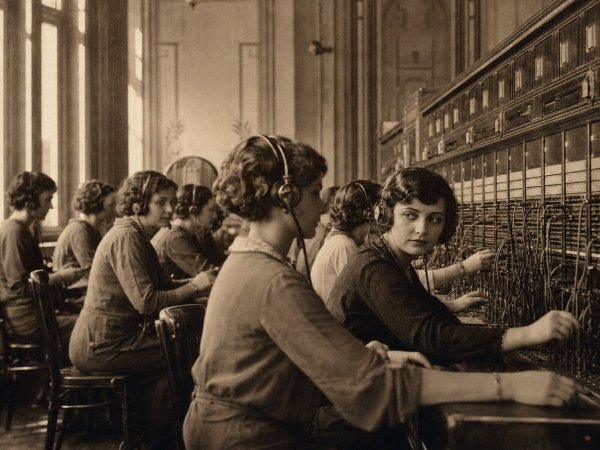
None of the technology worked the way we picture "calling someone" today. There was no dialing a number directly. Every call passed through an operator, who took the request and physically connected the two parties by plugging a jack cable into the switchboard. If the two subscribers were on different exchanges, the operator had to request the connection from another operator in turn. The system worked, but rarely without incident.
Writer Ioana Pârvulescu reproduces, in her book "Întoarcere în Bucureștiul interbelic" (Return to Interwar Bucharest), a period theater excerpt by Ion Manu that captures the chaos perfectly. A man asks for number 19/35 and gets, in succession, 18/42, the gas company, and an artificial ice factory, before finally reaching the National Theatre. The scene was written as comedy, but Bucharest residents who called daily recognized it without much exaggeration.
Blamed for everything that went wrong
Telephone operators were the public's favorite target. Any delay, any wrong connection, any silence on the line landed on their shoulders, even when the problem was, in fact, technical. The press of the era accused them almost daily of being slow to respond.
The March 1928 episode shows the other side of that story. At a time when they had no visible union and no formal bargaining power, Bucharest's operators appear to have found a form of protest far more effective than any written complaint: they simply stopped answering. Three weeks of silence, in a city that had become, contemporaries said, dependent on the telephone.
For Bucharest's interwar cultural elite, that dependence was almost literary. Eugen Lovinescu ran his entire Sburătorul literary circle over the phone. Camil Petrescu would wake Mihail Sebastian at night to share a new idea. Hortensia Papadat-Bengescu was among the first novelists to bring telephone conversations directly into her fiction. Three weeks without a working line was not, for people like these, a minor technical inconvenience.
Matchsticks instead of an unpaid bill
The technology of the era had its own brand of humor, documented by the podcast "re:connect Palatul Telefoanelor," produced by Orange Romania with theologian and historical storyteller Damian Anfile. Tudor Arghezi joked, in the magazine "Bilete de Papagal," that the two T's in PTT — Telegraph and Telephone — broke down so often that you were, in practice, at the mercy of the P, the Post. Sometimes, he wrote, the operator would ask whether you wanted your telegram sent "by train or by cart," a sign that the telegraph line had failed again.
An unpaid bill had its own solution, just as makeshift: two matchsticks were inserted into a mechanism inside the telephone, and the dial tone disappeared instantly. No letter, no formal notice — just a dead line, until you paid.
The end of a profession
Automation arrived fairly quickly, though not overnight. The country's first automatic exchange opened in Ploiești on April 16, 1932. Bucharest followed a year later, on April 24, 1933, when the Romanian Telephone Company switched on the capital's automatic exchange. From that point on, dialing a number directly began replacing the voice at the other end of the line — the voice that, until then, decided whether you reached where you were trying to go.
The symbol of that shift still stands on Calea Victoriei: the Telephone Palace, built between 1929 and 1934, 52.5 meters tall, the first building in Romania with a steel skeleton and, until 1956, the tallest in Bucharest. When it opened, the building drew as much controversy as admiration — a 1935 magazine compared it to an industrial warehouse, too massive for the boulevard's familiar silhouette. Today it houses offices and is part of the city's heritage circuit.
Of the women who held, with a jack cable and a switchboard, the voice connection of an entire city, no name survives in the records consulted. What remains is a newspaper headline from March 1928, and one assumption: that when no one listened to their complaints, they simply chose to go quiet.
Also recommended How Telephones Appeared and Evolved in Bucharest. Who Had Them, How Much They Cost, and How Calls Were Made
AI-generated illustration, inspired by vintage photographs of Bucharest telephone operators from the 1920s