How Telephones Appeared and Evolved in Bucharest. Who Had Them, How Much They Cost, and How Calls Were Made

By Eddie Țone
- Articles
- 11 MAR 26
Late-19th-century Bucharest was a symphony of absolute chaos. It was a place where mud blended gracefully with European ambitions, and where public order was more of a philosophical idea than a daily reality. On dusty streets or snow-covered avenues, long-distance communication relied entirely on lung power, on coachmen muttering curses under their breath, and on shop boys sent running across town with hastily folded notes in their pockets.
Before the arrival of those talking wooden boxes, any well-to-do Bucharester solved urgent matters by dispatching a servant to the other side of the city, a process that took an eternity and inevitably involved prolonged stops at various taverns. The appearance of the telephone in these lands felt like a technological shock comparable to a spaceship landing in the middle of Moșilor Market, an event observed with a mixture of bourgeois enthusiasm and deep suspicion.
A Government Whim and a Wire Stretched Over the Post Offices
The first attempts to introduce this technological sorcery in Romania’s capital were strictly institutional, completely bypassing the ordinary citizen.
The year 1883 marked the moment when a telephone line connected the Ministry of the Interior with the Central Post Office on Calea Victoriei.
This innovation arose from pure bureaucratic necessity. Ministers wanted a faster way to send orders without waiting for official couriers who had an unfortunate tendency to lose their way. Wires were strung somewhat chaotically over rooftops, defying every rule of urban aesthetics and drawing puzzled looks from passersby who probably wondered what kind of laundry was about to be hung at such impressive heights.
The first devices were massive machines made of polished walnut wood, decorated with brass elements and equipped with hand cranks that had to be turned with the determination of someone training in a gym.
A ministry clerk wishing to send a message would sit in front of this technological altar, spin the crank furiously to generate the current needed for the call, and then literally shout into a metal funnel. The reply came as a distorted voice drowning in an ocean of crackles, hisses, and noises reminiscent of a summer storm, which made every conversation sound like an argument conducted from the depths of a flooded cave.
Who Could Afford to Talk to the Wall
The expansion of this service to the private sector took place a year later, in 1884, when the first individuals and companies were allowed to connect to the capital’s tiny network.
The cost of such a subscription defied any financial logic for the average person, turning the telephone into a status symbol far more impressive than a gilded carriage or a countryside estate in Ilfov.
The annual fee for having a telephone installed at home often ranged between 300 and 500 gold lei, an enormous fortune at a time when even a respectable salary barely ensured subsistence. A teacher or civil servant would have had to starve for months to afford the privilege of owning a ringing device in their living room.
As a result, Bucharest’s first subscribers came exclusively from a narrow elite: a select gathering of aristocrats, bankers, renowned physicians, and newspaper editors.
Among the pioneers of the network were the editorial offices of the newspapers Românul and Timpul, publications desperate to obtain information before their competitors.
Owning a telephone in those days came with a rather amusing philosophical problem, given the tiny number of subscribers. A wealthy gentleman who had paid a small fortune to install the device quickly discovered he could only call the ministry, the newspaper office, the pharmacy, and a few equally wealthy friends. The telephone network thus resembled an exclusive club whose members often called each other simply to confirm that the line was still working.
The Anatomy of a 19th-Century Phone Call
Initiating a telephone conversation required a complex ritual involving strict steps and a fair amount of meteorological luck.
The technology relied on manual switching, meaning that subscriber wires ran directly to a central exchange where a human operator physically connected the lines.
If an influential gentleman living near Kiseleff Road wanted to order medicine from a pharmacy on Calea Victoriei, he would lift the receiver, which looked suspiciously like a small dumbbell, and begin turning the magneto crank. This action sent an electric signal to the exchange, where a metal flap dropped noisily, announcing that someone wished to speak.
Sound quality depended enormously on weather conditions, humidity, and the amount of dust accumulated on brass contacts. On rainy days, poorly insulated cables hanging through tree branches produced spectacular short circuits, and conversations were accompanied by loud cracking sounds that made subscribers flinch, fearing the device might explode.
Users were instructed to speak slowly, extremely loudly, and to articulate every syllable. Any private conversation therefore turned into a public speech that every servant in the house could hear clearly, along with, occasionally, the neighbors across the street. Communication privacy was nonexistent. Telephones were usually installed in the hallways of large houses, precisely in the busiest areas of domestic life.
The Switchboard Ladies, the True Rulers of Bucharest
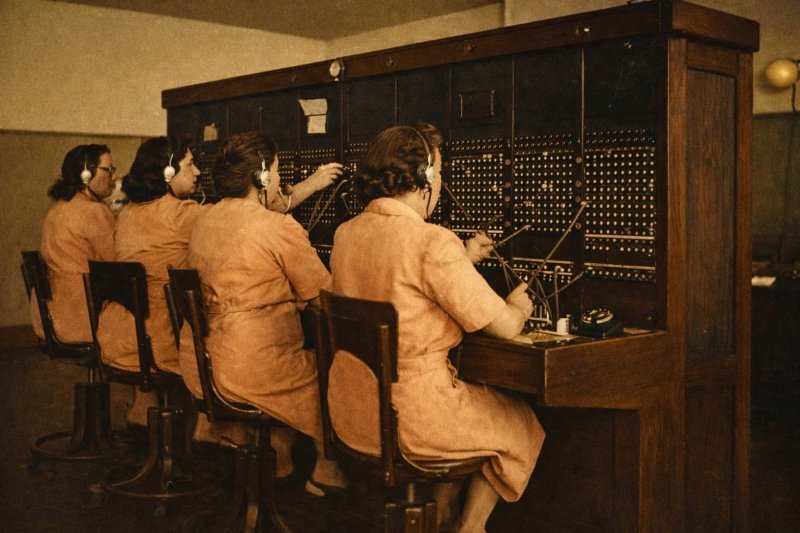
As the number of subscribers increased, it became obvious that dedicated staff were needed to manage the massive panels filled with wires and plugs.
Initially, young men were hired, but they quickly proved completely unsuited to the job. Their patience evaporated almost instantly, and many were dismissed after developing the unfortunate habit of swearing at impatient customers or making tasteless jokes over the lines.
The solution came by adopting the American model: the postal administration decided to hire women exclusively for this delicate task.
Thus appeared a new professional class of enormous importance, composed of the famous “telephone ladies”, women who effectively controlled the entire flow of information in the capital.
The hiring criteria for a switchboard operator were almost absurdly demanding. Candidates had to come from respectable families, possess impeccable diction, remain unmarried so they would not be distracted by domestic concerns, and, in a detail of purely anatomical importance, they had to be tall with sufficiently long arms to reach the highest sockets on the switchboard.
Their work unfolded at an infernal pace in a room filled with tangled cables. They had to answer calls politely, listen to the subscriber’s request, locate the correct socket for the destination, and insert the jack with surgical precision.
These women memorized dozens of numbers and recognized the voices of important clients, becoming a sort of living directory and an involuntary confidante. If a subscriber asked to be connected to his doctor, the operator knew exactly which doctor he meant and often knew whether the physician was at home or out on a visit.
Their access to the secrets of Bucharest’s elite was complete. By simply keeping the listening key open, they could overhear any conversation. It was a temptation that few could resist during a slow Tuesday afternoon.
A Slow Expansion Blocked by Mud and Bureaucracy
As the twentieth century approached, Bucharest’s network began to grow beyond its status as a technological curiosity for the wealthy.
The number of subscribers passed the symbolic threshold of one thousand, forcing the authorities to consider a more systematic organization of the network.
Overhead wires multiplied so rapidly that some intersections in the city center looked covered with gigantic spider webs. These fragile structures collapsed at the first serious snowfall. A winter storm usually meant total paralysis of the system, sending teams of technicians into the streets to climb icy poles and attempt to reconnect hundreds of broken lines.
The Romanian state, faithful to its tradition of complicating simple matters, maintained a monopoly on telephony for a long time. Installing a telephone became an administrative odyssey.
Anyone wanting a telephone had to complete endless forms, prove financial reliability, obtain approvals from the postal administration, and then wait months until a bored team of workers finally appeared at their gate carrying a spool of cable and a new device.
Telephone models gradually evolved, moving from wall-mounted wooden boxes to more elegant desk versions equipped with a cradle and a unified receiver, allowing the user the ultimate luxury of sitting down during a conversation.
The Skyscraper on Calea Victoriei and the American Dream of the Interwar Era
The interwar period swept away the inefficient romanticism of hand cranks and replaced it with the corporate discipline of the American giant IT&T (International Telephone and Telegraph).
In 1930, the Romanian state granted the telephone service concession to this company, turning Bucharest into a construction site of modernity.
The symbol of this transformation was the Telephone Palace, inaugurated in 1933.
Built in Art Deco style and inspired by New York skyscrapers, it became the first steel-frame building in Romania, a structure so robust that it survived earthquakes and bombardments without serious damage.
For Bucharest residents who still traveled by carriage, the building looked like a vision from the future: a concrete and steel “factory” where thousands of automatic relays gradually replaced the army of switchboard ladies.
The introduction of automatic exchanges meant that, for the first time, people could dial numbers themselves without speaking to an operator. Telephones became smaller, made of glossy black ebonite, and the famous rotary dial began dictating the rhythm of fingers in Bucharest living rooms.
Survival by Wire: From Bombings to Communist Nationalization
World War II severely tested the network.
During the 1944 bombings, the Telephone Palace became a strategic target, as it represented the nerve center of both military and civilian communications.
After the war, with the arrival of the communist regime, telephony underwent a brutal ideological transformation.
In 1948, the Romanian Telephone Company was nationalized and became an extension of the Ministry of Posts and Telecommunications.
While in the interwar period the telephone had been a luxury available to the bourgeoisie, in the 1950s it became both a surveillance tool and a privilege granted according to political dossiers. Priority was given to state institutions, party activists, and workers considered exemplary.
Postwar Bucharest gradually filled with cables connecting not only palaces but also the first workers’ apartment blocks, although demand far exceeded the technical capacity of the exchanges inherited from the Americans.
The Party-Line Era and Forced Socialization in the 1960s–1970s
The 1960s and 1970s brought a form of democratization to telephony, though at the cost of a practice that became urban legend: the party line.
Because individual lines were scarce, authorities connected two subscribers to the same wire. The result was a forced coexistence between strangers who shared the right to communicate.
If your party-line partner happened to be a talkative grandmother or a lovestruck teenager, your telephone effectively turned into useless furniture. The busy signal could echo for hours.
Telephones from this era, especially the models produced by the Electromagnetica factory, became iconic objects. Heavy, made of bakelite or hard plastic, in colors ranging from industrial gray to muddy yellow or dark green, these devices were practically indestructible.
In the 1970s, Bucharest telephone numbers expanded from five to six digits, a sign that the city had grown massively.
Public telephone booths also appeared during this period. Painted metallic blue, they became landmarks in bedroom suburbs such as Drumul Taberei or Balta Albă. Finding a booth with intact windows and a phone that didn’t swallow your coin without connecting the call counted as a small daily victory.
Communist telephony turned conversation into an exercise in caution. Everyone knew, or suspected, that “the walls had ears.” The wires ran through the attentive listening of the Securitate, transforming the small device on the bedside table from a friend into a potential witness for the prosecution.
Thus, from the enthusiasm surrounding the first wires stretched across Calea Victoriei, the telephone traveled through an entire century, evolving from a technological curiosity into a tool of control and ultimately into a vital necessity of modern life.
You may also like: What does Bucharest sound like? An exploration of the city's sonic identity