10 emblematic buildings of Bucharest from the last century that have disappeared today
- Articles
- 24 APR 26
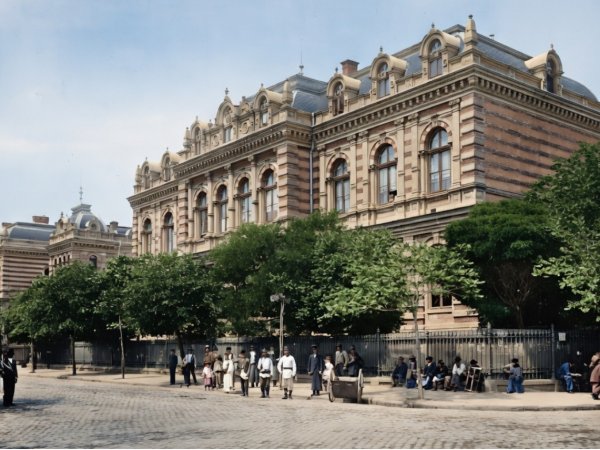
Old Bucharest was a city of spectacular contrasts, where aristocratic palaces coexisted with old inns, historic churches, and monumental buildings that gave the capital a special charm. In the last century, especially during the interwar period and later during the communist regime, numerous valuable constructions were destroyed, either because of bombings or because of the authorities’ desire to radically reshape the city.
Some of the greatest buildings of the Capital
Many of these buildings were not just simple properties, but true symbols of Bucharest’s identity. They preserved the memory of an elegant era, of a cosmopolitan city, and of a society that built its prestige through architecture. Unfortunately, today they can only be admired in old photographs, engravings, or in the accounts of historians.
Among the most important losses are the Great Theatre on Calea Victoriei, the Sturdza Palace of Beizadea Vițel, and the Sarindar Monastery, as well as other buildings that have almost completely disappeared from the urban landscape.
The Great Theatre on Calea Victoriei
One of the most painful disappearances from Bucharest’s heritage was the Great Theatre, the first building of the National Theatre, located on Calea Victoriei. Built between 1846 and 1852 according to the plans of the Viennese architect Joseph Heft, the building was also known as the National Theatre of Bucharest and represented one of the most important cultural centers of the capital. The first performance took place on December 31, 1852, with the play “Zoe or A Romanian Love.”
The building had an elegant baroque air and was the place where the intellectual and political elite of the time met. Important performances were staged here, artistic careers were formed, and the cultural life of the city was consolidated. For Bucharest residents, the theatre had become a symbol of modernization and of closeness to the great European capitals.
After the Second World War, the building was heavily damaged, and instead of being restored, it was demolished during the government of Petru Groza. Its disappearance left a huge gap in the memory of the city and became one of the best-known examples of lost heritage.
The Sturdza Palace of Beizadea Vițel
The Sturdza Palace, popularly known as the Palace of Beizadea Vițel or “The Cake at the End of the Bridge,” was one of the most spectacular constructions in the Victory Square area. Built starting in 1897 by Prince Grigore Sturdza, the son of Moldavia’s ruler Mihail Sturdza, the palace impressed through its eclectic style, decorative little towers, and luxurious interiors. The press of the time considered it one of the most unusual and beautiful buildings in Bucharest.
Grigore Sturdza was known by the nickname Beizadea Vițel, an eccentric figure of the Romanian aristocracy, and his palace perfectly reflected this extravagant personality. The construction was located in the area where the Victoria Palace stands today and represented a true urban attraction.
From 1904 to 1945, the building became the headquarters of the Ministry of Foreign Affairs, and important diplomats and major Romanian politicians passed through its salons. The bombings of 1944 seriously affected the palace, and in 1946 the communist regime decided to demolish it, preferring the elimination of a symbol of the old aristocracy instead of its restoration.
Sarindar Monastery
Sarindar Monastery was one of the most important religious settlements in the center of Bucharest and was located in the area where the National Military Circle stands today. Built in the 17th century, the monastery was for a long time a spiritual and urban landmark of the city.
Its name came from the religious term “sarindar,” which designated a series of memorial services. Over time, the monastery was restored by several rulers and important boyars, becoming a reference point for the religious life of Bucharest.
In the 19th century, the construction had reached an advanced state of degradation, and the authorities decided on its demolition. In its place, the current Military Circle was later built, one of the best-known monumental buildings of the Capital.
The disappearance of Sarindar Monastery meant not only the loss of a religious monument, but also the erasure of an important part of the historical memory of the city center.
The Great Hall in Unirii Square
The Great Hall, also known as the Central Hall, was one of the most important commercial markets of Bucharest. Built at the end of the 19th century, it had a modern structure for that time and quickly became an essential point for urban trade.
Food products, all kinds of goods were sold here, and merchants from all areas of the city met there. The hall was not only an economic space, but also a social one, where daily life pulsed intensely.
During the years of communist systematization, the building was demolished for the radical transformation of Unirii Square. Along with it disappeared the traditional commercial atmosphere of the old Bucharest center.
Republic Stadium
Republic Stadium was one of the most important sports arenas of Bucharest and a symbol of Romanian sports in the 20th century. Initially built under the name ANEF Stadium, it hosted important competitions and large-scale sports events.
The arena was located on Spirii Hill and had a spectacular position in the city’s landscape. Entire generations of Bucharest residents remember the matches and events held here.
During the construction of the House of the People, the stadium was practically buried and dismantled, becoming one of the major victims of the brutal transformation of Bucharest in the years of late communism.
Enei Church
Enei Church was one of the most beloved historic churches of the Capital, located near today’s University Square. The place of worship had a strong symbolic value and was connected to the cultural life of the city.
The 1977 earthquake seriously affected the construction, but many specialists believed that restoration was possible. However, the communist authorities decided on complete demolition, a fact that caused strong reactions among the intellectuals of the time.
Its disappearance remained one of the most controversial episodes of the destruction of religious heritage in Bucharest.
Brâncovenesc Hospital
Founded by Safta Brâncoveanu in the 19th century, Brâncovenesc Hospital was one of the most important medical institutions of the city. The building had both functional and architectural value, being an important landmark for Romanian medicine.
Thousands of patients were treated here, and the institution had an essential role in the development of the healthcare system in the Capital. Its central location made it a strategic point of the city.
In the 1980s, the building was demolished for the expansion of the area around the Civic Center, becoming yet another dramatic example of sacrificing heritage for major ideological projects.
Zlătari Inn
Zlătari Inn was one of the oldest and best-known inns in Bucharest, located in the central area of the city. It was an important commercial point and an essential part of the urban landscape of old Bucharest.
Inns represented the economic heart of the city in past centuries, and Zlătari was one of the best-known examples. Merchants, travelers, and traders carried out their activity here daily.
The aggressive modernization of the center led to its disappearance, and along with it, part of the traditional commercial charm of the city was lost.
Slătineanu House
Slătineanu House was one of the remarkable aristocratic residences of old Bucharest, appreciated for its architectural elegance and its central positioning. It was part of that boyar Bucharest that gave the capital the image of “Little Paris.”
Such houses were not only homes, but true symbols of social prestige. The sumptuous interior and the ornamented facades told the story of a sophisticated and influential world.
Its demolition was part of the broader process of losing the aristocratic identity of the city in the 20th century.
The Old Army Arsenal
The Army Arsenal was an important military construction, located in the Dealul Spirii area. The building had both strategic and historical value, being connected to the administrative and military development of the Capital.
That area underwent radical transformations during the major demolitions of the communist period, and the arsenal completely disappeared from the urban landscape.
Today, few people still remember its existence, although it represented an important part of Bucharest’s institutional history.
A city that lost part of its memory
The disappearance of these buildings does not mean only the loss of beautiful monuments, but also the erasure of entire chapters from Bucharest’s identity. Every demolished palace, every disappeared church, and every destroyed theatre took with it part of the city’s story.
The Great Theatre, the Sturdza Palace, and Sarindar Monastery are only a few examples of a heritage sacrificed in the name of modernization or ideology. Some were victims of war, others of administrative neglect or political ambitions.
Today’s Bucharest still carries the traces of these losses. That is precisely why the memory of these buildings must be kept alive, so that the city’s history does not remain only a forgotten photograph in an old album.
We also recommend: The Story of the Brâncovenesc Hospital: The Legacy and the Curse of Safta Brâncoveanu That May Have Brought About Ceaușescu’s Fall