Childhood in interwar Bucharest: What family life, playtime, and school meant for little children
- Articles
- 22 APR 26
The interwar period was one of the most fascinating stages in the history of Bucharest. The city was rapidly modernizing, blending European elegance with local traditions, and everyday life took on a special atmosphere. In this context, childhood had a distinct charm, different from today’s, marked by strict social rules but also by simple, joyful moments. Children in interwar Bucharest grew up in a city between two worlds: a traditional one, with strong family values, and a modern one in full transformation. Their lives were influenced by social environment, education, and an urban space that was constantly changing.
Family life in interwar Bucharest
The family represented the center of the child’s universe in the interwar period. In most households, parental authority was firm, and respect for elders was a basic rule. The father was usually the dominant figure, responsible for important decisions, while the mother took care of daily education and childcare.
In Bucharest homes, whether modest or bourgeois, daily routine was well organized. Children were taught from an early age to respect meal times, study hours, and household rules. Wealthier families often had governesses or nannies, sometimes even private tutors, while in simpler families children also contributed to household chores.
Family meals also played an important role. It was the moment when all members gathered and discussed the events of the day. Respect and discipline were essential, and children were encouraged to listen more than to speak.
The neighborhood and the world of urban childhood
Interwar Bucharest was a city of contrasts. Paved streets, horse-drawn trams in the early years and later electric ones, gardens, and houses with inner courtyards offered children a space for exploration, but within a relatively controlled framework.
Neighborhoods had a strong community life. Children knew each other, played in the streets, and formed stable groups of friends. Neighbors also played an important educational role, sometimes intervening when children broke behavioral rules.
In wealthier areas of the city, such as Cotroceni or Dorobanți, children had access to larger gardens and organized educational activities. In working-class neighborhoods, games were simpler but equally creative, using whatever resources were available.
Play – the free universe of childhood
Although discipline was strict in both family and school, playtime represented a true oasis of freedom. Interwar children played a lot outdoors, in streets, courtyards, or parks.
Games were varied and mostly improvised. Group games such as “hide and seek,” “country, country, we want soldiers,” or “elastic” were extremely popular. Boys often played with balls or invented simple sports competitions, while girls preferred role-playing games or handmade dolls.
Green spaces of the city also played an important role. Parks such as Cișmigiu Park or Herăstrău Park became meeting places for children, offering a safe environment for play and socialization.
Despite material limitations, children’s imagination was limitless. Toys were often handmade, and creativity compensated for the lack of store-bought items.
School and education in the interwar period
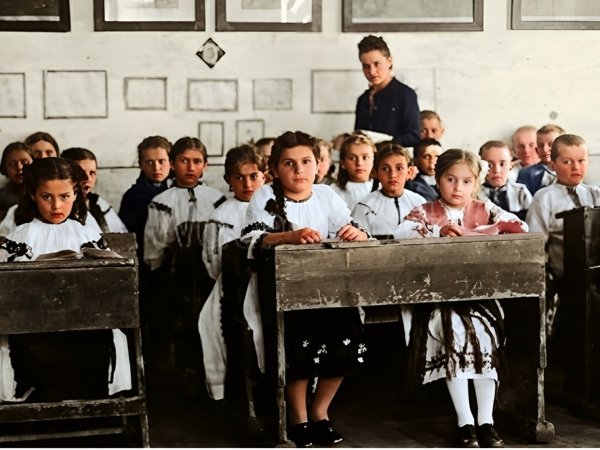
Education played a central role in shaping children in interwar Bucharest. School was seen as a prestigious institution, and parents placed great emphasis on results and discipline.
The school program was rigorous, and teachers held strong authority. Students learned basic subjects such as reading, writing, mathematics, as well as history, geography, and religion. The focus was on memorization and rule-following.
School uniforms were mandatory in many institutions, and student behavior was closely monitored. Punishments were more frequent than today, and discipline was considered essential for character building.
Among the important institutions of the time was Saint Sava National College, one of the oldest and most prestigious schools in the Capital, which educated future elites of Romanian society.
Social differences and their impact on childhood
An important aspect of interwar childhood was the clear difference between social classes. Children from wealthy families had access to private education, piano lessons, foreign languages, and cultural activities, while children from modest families sometimes had to work from an early age.
In urban environments, these differences were visible but coexisted in the same space. Children met at school or in the streets, where social barriers became less obvious. Still, education was seen by most families as a path to social advancement, and parents made significant sacrifices to send their children to school.
Free time and small joys of childhood
Beyond school and family, interwar children enjoyed simple but memorable moments. Walks in the city, visits to the zoo, or children’s theatre performances were real events.
An important cultural place was the National Theatre Bucharest, where performances accessible to children were sometimes held. Cinemas also began to become popular, offering children a window into new worlds and fascinating stories.
A childhood between discipline and freedom
Childhood in interwar Bucharest was a combination of strict discipline and genuine moments of freedom. On one hand, children were educated in a spirit of respect and responsibility, while on the other hand, they had the chance to play freely and develop their imagination. This duality contributed to shaping a strong, adaptable generation deeply connected to the values of that society.
Conclusion
Looking back at childhood in interwar Bucharest, we discover a different world in which family values, education, and community played a central role.
Although material and social conditions were very different from today, the essence of childhood remained the same: the desire for play, discovery, and belonging. That period left a strong mark on the identity of the city and continues to inspire nostalgia and curiosity even today.
We also recommend: How the bourgeoisie's life unfolded in Bucharest between the two World Wars