Why Bucharest was called the Little Paris during the Belle Époque period
- Articles
- 24 APR 26
At the end of the 19th century and the beginning of the 20th century, Bucharest went through one of the most spectacular periods in its urban, cultural, and social history. The capital of Romania was becoming increasingly elegant, more cosmopolitan, and closer to the Western model that the elites of the time deeply admired. In that era, the city received the nickname “Little Paris,” a name that was not at all accidental, but reflected a visible reality in architecture, lifestyle, fashion, social life, and the ambitions of a society in full modernization.
The French influence on the Romanian elite
The Belle Époque period, associated in Europe with refinement, optimism, and cultural development, had a strong echo in Bucharest as well. The city was trying to detach itself from the oriental image inherited from the Phanariot era and to transform into a European capital worthy of the great metropolises of the time. The French influence was decisive in this change, and Paris became the main model of inspiration.
The name “Little Paris” was not just a poetic metaphor, but a description of a collective aspiration. Bucharest wanted to be modern, sophisticated, and admired, and for many contemporaries it had truly succeeded in this.
One of the most important explanations for this comparison with Paris is related to the deep fascination that the Romanian elites had for French culture. In the 19th century, France represented the supreme model of civilization, elegance, and progress, and the Romanian aristocracy and bourgeoisie wanted to adopt this lifestyle.
Many young people from wealthy families studied in Paris, especially law, medicine, architecture, or literature. Once they returned to the country, they brought not only prestigious diplomas, but also Western habits, tastes, and mentalities. The French language had become almost mandatory in aristocratic salons, and in certain circles it was considered even more elegant than the Romanian language.
Social conversations, correspondence, children’s education, and even the menus at important receptions were strongly influenced by the French model. Ladies wore dresses inspired by Parisian fashion, and gentlemen closely followed the clothing style of the great European capitals.
This cultural closeness created a distinct identity for Bucharest. The city was no longer perceived only as an administrative center, but as a space of social refinement, where elegance and appearances had major importance. In this context, the comparison with Paris came almost naturally.
The urban and architectural transformation
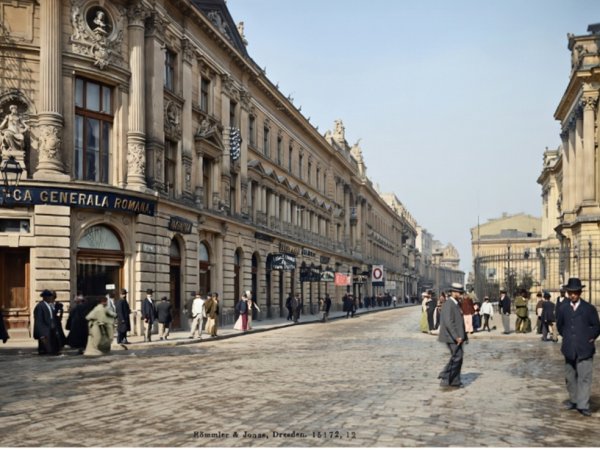
Another essential reason why Bucharest was called “Little Paris” was its spectacular architectural transformation. During the Belle Époque period, the city experienced a broad process of urban modernization, and the new constructions clearly reflected French and Western influence.
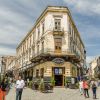
Wide boulevards, imposing buildings, elegant palaces, and public gardens resembled the atmosphere of the great European capitals. Calea Victoriei had become one of the most prestigious arteries of the city, the place where the aristocracy, politicians, diplomats, and businessmen met. Here were luxurious hotels, high-end shops, elegant cafés, and impressive residences.
Romanian and foreign architects designed buildings inspired by the Beaux-Arts style, French neoclassicism, and the eclecticism specific to the era. The CEC Palace, the Romanian Athenaeum, the Cantacuzino Palace, or numerous boyar villas built during that period contributed to the image of a sophisticated and modern capital.
At the same time, Bucharest was among the first cities in the region to introduce public electric lighting and modern transport with trams. These innovations strengthened the impression of a city keeping pace with the great European transformations.
Even bridges, squares, and commercial passages were designed to offer an elegant and functional urban experience. Residents had the feeling that they were living in a city that was reinventing itself and ambitiously building a new identity.
The social life and the salon atmosphere
The nickname “Little Paris” did not refer only to buildings and boulevards, but also to the intense social life that defined the capital. Belle Époque Bucharest was a city of balls, soirées, diplomatic receptions, and cafés where politics, art, and literature were discussed.
Aristocratic salons had a central role in cultural and social life. Writers, politicians, artists, and diplomats met here, and elegant conversation was almost an art. An invitation to such a salon was a sign of social prestige and an opportunity for affirmation.
Theaters and operas attracted large audiences, and performances were true social events. It was not only the play that mattered, but also who was present in the hall, what dresses the ladies wore, and what social or political alliances were formed behind the scenes.
Bucharest cafés also had a special charm. Inspired by the Parisian model, they became meeting places for intellectuals, journalists, and politicians. Here French newspapers were read, the latest European events were discussed, and important relationships were strengthened.
The evening walk on Calea Victoriei was a true urban ritual. People came to see and be seen, to socialize, and to participate in the elegant spectacle of the city. This cosmopolitan atmosphere perfectly supported the image of a Bucharest close to the Parisian spirit.
The contrasts behind the elegant image
However, the image of “Little Paris” should not be completely idealized. Beyond the luxurious façade and the brilliance of social life, Bucharest maintained strong contrasts between wealth and poverty, between modernity and the lack of infrastructure in certain areas.
While the city center impressed through elegance, many peripheral neighborhoods had unpaved streets, poor sanitary conditions, and modest housing. Social differences were very large, and modernization did not reach all social categories equally.
At the same time, urban development was often chaotic. The city grew rapidly, sometimes without coherent planning, and this generated administrative and infrastructure problems. Bucharest could be splendid and disorderly at the same time, sophisticated and provincial, Western and Balkan.
Even contemporaries noticed these contradictions. Some considered the nickname “Little Paris” a legitimate pride, while others viewed it with irony, believing that the city rather imitated Western appearances than the deep substance of French civilization.
Nevertheless, this very combination of elegance and imperfection made Bucharest unique. It was not a faithful copy of Paris, but a local interpretation, adapted to the Romanian spirit and the historical context of the time.
The Belle Époque legacy in today’s Bucharest
Even though wars, earthquakes, and the political transformations of the 20th century profoundly changed the city, the traces of the Belle Époque period are still visible in contemporary Bucharest. Many of the emblematic buildings constructed then continue to define the identity of the capital.
Calea Victoriei remains one of the most important historical arteries, and the palaces and elegant buildings of the past still tell the story of an era of ambition and refinement. The Romanian Athenaeum, former aristocratic residences, and historic hotels preserve the charm of that world which dreamed of Paris.
The expression “Little Paris” continues to be used even today, sometimes with nostalgia, other times with a critical spirit. It evokes not only the architectural beauty of the city, but also the desire of a society to modernize, to connect to European values, and to build a capital worthy of international respect.
Ultimately, Bucharest was called “Little Paris” because it dared to dream of elegance, culture, and prestige in a time when national identity was rapidly being built. It was not just an aesthetic comparison, but the expression of a historical aspiration.
This name has remained in collective memory precisely because it perfectly captures the spirit of a period in which Bucharest perhaps shone the brightest: a capital full of contrasts, but also of charm, which tried to transform modernity into a way of life.
We also recommend: 10 things about Belle Époque Bucharest you didn’t know until now