Sport and leisure in interwar Bucharest: how Romanians kept fit 100 years ago
- Articles
- 23 APR 26
Interwar Bucharest did not mean only elegant cafés, rare automobiles, and walks on Victory Avenue, but also a profound change of mentality regarding health and the way people spent their free time. After the First World War, together with the accelerated modernization of the Capital, sport began to be seen not only as an activity reserved for the elites, but also as a necessary form of discipline, hygiene, and social prestige.
Movement as a sign of modernity
The idea of “physical culture” was becoming more and more present in the press of the time, in schools, and in urban life. People talked about the importance of walking, gymnastics, swimming, and outdoor exercises. Doctors recommended movement for a healthy life, and middle-class families began to include walks and sport in their weekly schedule. For young people especially, sport became an expression of the modern, Western lifestyle.
During this period, Bucharest borrowed much from the atmosphere of the great European capitals. The city was nicknamed “Little Paris,” and its inhabitants wanted to live in the same rhythm as Paris, Vienna, or Berlin. Going to the lido, playing tennis, going to the hippodrome, or skating in Cismigiu in winter was not only entertainment, but also a social statement: you were part of an urban world that was active, educated, and connected to new trends.
Sport was practiced differently depending on social class. The elite frequented the hippodrome, tennis clubs, and equestrian competitions, while ordinary people preferred walks “At the Avenue,” popular lidos, football matches, or cycling. However, regardless of status, the idea of movement had become an important element of daily life.
“At the Avenue,” the promenade that also served as a gym
One of the best-known forms of active leisure in interwar Bucharest was the promenade on Kiseleff Avenue, known simply as “At the Avenue.” Here Bucharest residents came for long walks, conversations, meetings, and, without using this term, for cardio.
Walking was a true social institution. People walked elegantly dressed, and walking was practiced seriously. Families went out on Sundays, young people met in the evening, and ladies and gentlemen turned the promenade into a spectacle of urban fashion. Beyond the social side, walking was considered beneficial for health and was recommended by doctors.
The Kiseleff area was preferred precisely for its cleaner air, abundant vegetation, and distance from the agitation of the center. Around the alleys there were gardens, restaurants, terraces, and spaces dedicated to sport. Even in the contemporary period, Kiseleff Avenue is associated with outdoor movement, symbolically preserving the role it had almost a century ago.
The promenade was not a banal activity, but a form of urban discipline. In an era when few people had a car, walking was naturally integrated into daily life. People walked much more than today, and this naturally contributed to maintaining physical shape.
The lidos and the cult of the active summer
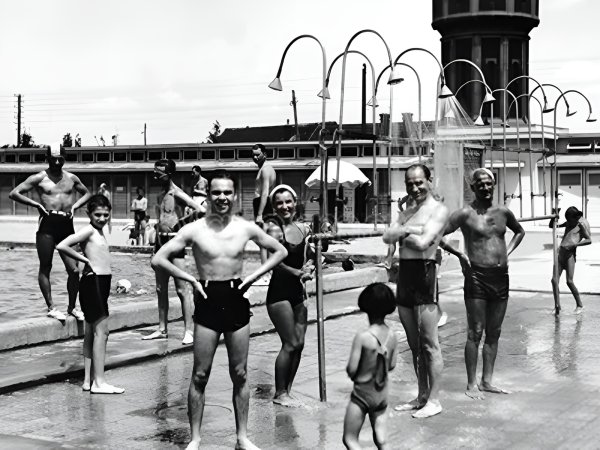
If winter was dominated by skating and walks, summer belonged to the lidos. During the interwar period, Bucharest began to develop modern aquatic leisure bases, and going to the lido became one of the most popular forms of active relaxation.
The most famous was Kiseleff Lido, inaugurated in 1929 and considered at that time one of the most impressive sports bases in the Capital. It was located in a privileged area, between the School of Agriculture and Băneasa Hippodrome, and it was built in a spectacular time, in only 52 days. The complex included a very large pool, an artificial beach of approximately 12,000 square meters, tennis courts, race tracks, restaurants, cafés, and even spaces for dancing and jazz. For the era, it was a true demonstration of urban modernity.
Going to the lido did not mean only staying in the sun. Swimming was intensely promoted as a complete exercise for the body, and young people practiced it enthusiastically. Swimming competitions, sports demonstrations, and even polo competitions were organized. For many Bucharest residents, the lido had become the ideal place where health, socialization, and entertainment were combined.
There were also more accessible, popular lidos, frequented by people from all social categories. Class differences were visible, of course, but water had the gift of democratizing urban space. In an increasingly crowded and hotter city during summer, the lido became a necessity, not just a luxury.
The hippodrome, tennis, and prestige sports
For the wealthy classes of interwar Bucharest, sport was also a sign of status. Băneasa Hippodrome represented one of the most elegant meeting places of the elite. Horse races, elegant stands, sophisticated hats, and fashionable appearances turned every event into a social spectacle.
The hippodrome functioned not only as a sports space, but also as a place of public affirmation. Here politicians, businessmen, military men, and influential families could be seen. Horse races had the charm of competition, but also that of belonging to a certain world. During the interwar period, horse riding was one of the sports most associated with refinement and prestige.
Tennis had a similar evolution. Tennis courts appeared in private clubs and in elegant residential areas. Practiced especially by the bourgeoisie and aristocracy, tennis became the symbol of civilized, Western sport. It was a sport that required discipline, technique, and free time, all associated with the idea of social success.
Equestrianism also had an important role, especially in military and aristocratic environments. Riding was seen both as physical exercise and as an expression of complete education. A well-raised young man had to know how to ride a horse, just as he had to know how to dance or converse elegantly.
Football, cycling, and mass sport
If the hippodrome belonged to the elite, football belonged to the crowd. In the interwar years, this sport began to become truly popular in Romania, and Bucharest was one of the main centers of the phenomenon.
Matches attracted large audiences, and local clubs developed the first forms of urban sports identity. Football was more accessible, more spectacular, and closer to the general public. Improvised fields in neighborhoods coexisted with official stadiums, and boys dreamed of becoming well-known players.
Besides football, cycling was extremely appreciated. Bicycle races were organized in the city, and the bicycle was at the same time a means of transport and an instrument for maintaining physical shape. For many young people, riding a bicycle meant freedom, independence, and modernity.
Athletics, gymnastics, and school physical exercises completed this landscape. Schools placed more and more emphasis on physical education, and the idea of a healthy body was linked to the formation of a disciplined citizen. Sport also began to be seen as an investment in the future of the nation, not only as entertainment.
Winter in the city: skating and mountain escapes
The cold season did not stop sports activities. On the contrary, winter came with its own leisure rituals. The frozen Cismigiu Lake became one of the most loved places for skating, and the atmosphere was almost cinematic: music, discreet lights, elegant couples, and children learning to glide on the ice.
Skating was both entertainment and sport. Young people loved it, and the press of the time frequently presented such outings as part of a modern and refined urban life. For those who did not leave the city, Cismigiu became the center of the cold season.
Those with greater financial possibilities chose Sinaia, Predeal, or other mountain resorts for skiing and fresh air. Special trains for skiers were a reality of the era, and winter holidays were beginning to look more and more like Western ones. Sport thus became part of tourism and of the idea of an active vacation.
This culture of movement shows that Romanians from one hundred years ago already understood something that we are rediscovering today: health is not built only in hospitals, but also in the park, on the sports field, at the lido, or on a simple promenade alley.
What we lost and what we can recover
Looking at interwar Bucharest, we notice that sport and leisure were not separated from daily life. Movement was natural, integrated into the rhythm of the city and into social habits. People walked more, spent more time outside, and considered sport a normal part of urban existence.
Today, although we have more fitness rooms and more technology, we often move less. The modern city keeps us in traffic, in offices, and in front of screens. Precisely for this reason, the lesson of interwar Bucharest remains surprisingly current.
It is not about nostalgia, but about balance. Walking, swimming, cycling, sport practiced for pleasure and not only out of obligation can once again transform the city into a space of health. The interwar period shows us that keeping fit was not a trend, but a lifestyle.
Perhaps Romanians from one hundred years ago did not have smartwatches, fitness applications, or premium gym subscriptions, but they had something essential: the habit of moving. And sometimes, exactly there lies the difference between a passing fashion and a life truly lived well.
We also recommend: Childhood in interwar Bucharest: What family life, playtime, and school meant for little children