Fashion in Belle Epoque Bucharest. How gentlemen and young ladies dressed at the end of the 19th century
- Articles
- 23 APR 26
The end of the 19th century represented for Bucharest one of the most spectacular periods of urban and social transformation. The capital of Romania was beginning to acquire the air of a Western city, with wide boulevards, elegant buildings, public gardens, and an increasingly intense social life. In this context, fashion became more than a practical necessity – it transformed into a symbol of social belonging, education, and refinement.
Elegance as a sign of social status
The Belle Epoque period brought to Bucharest strong influences from Paris, Vienna, and Berlin, and the Romanian elites looked with admiration toward the great European capitals. Wealthy families ordered their clothes directly from France or turned to dressmakers and milliners inspired by Western fashion magazines. To dress well did not mean only to look elegant, but also to send a clear message about your position in society.
Clothing had become a form of social language. A well-tailored dress, a sophisticated hat, or an impeccable suit immediately said who you were, from which family you came, and what place you occupied in the high society of Bucharest. Public appearances were carefully calculated, and walks on Victory Avenue or evening gatherings in aristocratic salons became true parades of style.
In an era in which appearances mattered enormously, fashion was regarded with an almost ceremonial seriousness. Ladies and gentlemen respected clear rules regarding daytime, evening, visiting, or promenade outfits, and any deviation could attract comments and severe social judgments.
The young ladies of Bucharest: corsets, lace, and spectacular hats
Women's fashion in Belle Epoque Bucharest was deeply influenced by the Parisian style, and the beauty ideal of the time emphasized the slim silhouette, the very well-defined waist, and a delicate, almost theatrical appearance. The corset was the central piece of the female wardrobe and defined the entire clothing construction.
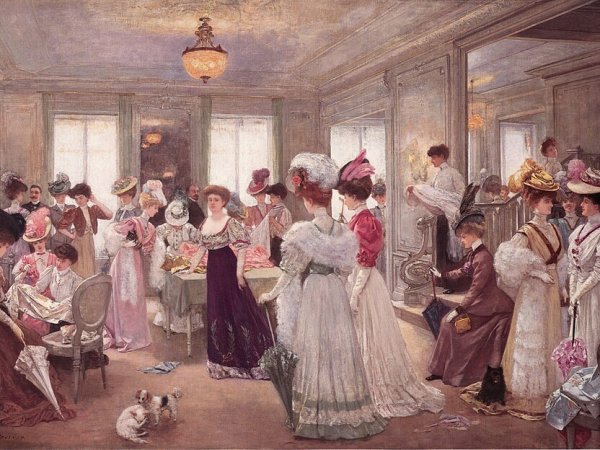
Women from high society wore ample dresses made of expensive materials such as silk, velvet, satin, or fine muslin. Day dresses had high collars, long sleeves, and numerous decorative details: ruffles, embroidery, pearls, ribbons, and lace. Evening dresses, on the other hand, were much more elaborate, with elegant necklines, trains, and luxurious accessories.
The hat was indispensable. No respectable lady went out into the city without a hat, and it often became the most spectacular piece of the entire outfit. Decorated with exotic feathers, artificial flowers, veils, or large bows, hats conveyed elegance and status. Sometimes, they became so elaborate that they attracted more attention than the dress itself.
Gloves, parasols, and fans completed the feminine image. A well-raised lady had to know not only how to dress, but also how to wear these accessories with grace. The fan, for example, was not only a useful object on hot days, but also a discreet communication tool in fashionable salons.
Shoes were elegant, usually closed, with a small heel and made of fine leather or cloth. Even if they were not always visible under the folds of the long dresses, they had to be impeccable. Women's fashion was, essentially, a spectacle of detail.
The elegant gentlemen of the Capital: the frock coat and the cane
If women impressed through the complexity of their outfits, men stood out through sobriety, precision, and impeccable clothing discipline. Male fashion during the Belle Epoque was dominated by English and French influence, and elegance was built through perfect tailoring and discreet but refined accessories.
The daytime suit generally consisted of well-ironed trousers, a vest, a starched white shirt, and a frock coat or long jacket. The predominant color was black, dark gray, or navy blue, and sobriety was considered a sign of seriousness and respectability. A gentleman should not stand out through color, but through the quality of the material and the perfection of the details.
The tie or lavallière was mandatory, and the stiff, high collars offered that specific image of the elegant man of 1900. The hat – bowler, top hat, or felt hat – was just as important for gentlemen as it was for ladies. Going out without a hat in the city center was considered bad manners.
The cane was not only a useful accessory, but also a symbolic one. It completed the image of the respectable man and was carried naturally during walks on Victory Avenue or at social meetings. The pocket watch, cufflinks, and fine gloves completed the outfit.
For elegant evening gatherings, balls, or official receptions, the tailcoat became mandatory. It was worn with a white bow tie, white vest, and impeccably polished shoes. Clothing etiquette was strict, and mistakes were not tolerated in a society that placed great value on appearances.
Victory Avenue – the catwalk of Bucharest fashion
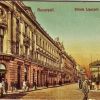
If today the great boulevards are commercial and tourist spaces, at the end of the 19th century Victory Avenue was the true catwalk of Bucharest fashion. Here one could see who was who, here the newest trends were noticed, and here social reputation was built through simple public appearance.
The afternoon promenade was an almost mandatory ritual for high society. Ladies went out in elegant carriages or walked on foot, carefully observed by others. Gentlemen made their appearance in impeccable suits, exchanging discreet greetings and participating in this social theater of appearances.
Luxury shops, fashion ateliers, and large stores brought to Bucharest the latest clothing novelties from the West. Fashion magazines circulated intensely in aristocratic circles, and famous dressmakers became important figures of social life. Some ladies preferred to order their outfits directly from Paris, to be sure they would not appear at the same ball in the same creation as someone else.
Photography, increasingly popular at the end of the century, also contributed to the consolidation of fashion as an instrument of public image. Studio portraits captured ladies in sophisticated dresses and gentlemen in ceremonial suits, and these images became testimonies of social status.
Victory Avenue was not just a street, but a stage on which every appearance mattered. There it was clearly seen who respected the elegant codes of the Belle Epoque and who remained outside this exclusive universe.
Middle-class fashion and social differences
Although the image of the Belle Epoque is often associated with aristocracy and luxury, fashion was not exclusively the privilege of the very rich. The middle class – clerks, teachers, doctors, merchants – also tried to adopt the style of the era, adapting it to their own financial possibilities.
Dresses were simpler, made of more accessible materials, but they kept the general line of Western fashion. The corset existed here as well, as did the desire for elegance, but without the extreme opulence of the aristocracy. Women invested a lot in a few well-made outfits, which they maintained carefully and adapted for several occasions.
Middle-class men wore less sophisticated suits, but they respected the basic rules of clothing decency. A clean shirt, a well-maintained vest, and polished shoes could say a lot about a person's seriousness.
Social differences were immediately visible, however, in the quality of the materials, in the number of accessories, and in the frequency with which the wardrobe was renewed. The elite changed fashion with the season, while ordinary people patiently adapted the same clothes for years.
In popular environments, clothing often kept traditional influences, especially in peripheral neighborhoods or in areas where the population coming from the provinces maintained its habits. Belle Epoque Bucharest was thus a fascinating mixture between Western modernity and local roots.
Elegance as a form of urban identity
Fashion in Belle Epoque Bucharest cannot be reduced only to beautiful clothes or aristocratic extravagances. It represented an expression of a society in full transformation, which was searching for its place between East and West, between tradition and modernity.
The way gentlemen and young ladies dressed reflected the aspirations of a capital that wanted to be European, sophisticated, and respected. Elegance became a civic ideal, not only an aesthetic one. To be well dressed meant to respect the rules of the modern city and to participate in its public life.
Today, looking at the old photographs of Bucharest from 1900, not only the beauty of the buildings or the charm of the carriages impresses, but also the extraordinary attention given to personal appearance. People seemed to understand that style is not a superficial detail, but a form of respect for oneself and for others.
Perhaps this is precisely the most valuable legacy of Belle Epoque fashion: the idea that elegance does not mean opulence, but culture of detail, care for image, and the assumption of a dignified presence in public space.
The Bucharest of that time lived through appearances, gestures, and carefully constructed outfits. And behind every sophisticated hat or every elegant cane there was the deep desire to belong to a modern, refined, and memorable world.
We also recommend: Fashion in interwar Bucharest: how gentlemen and ladies of the Capital dressed a century ago