Spayer Palace in Bucharest – the story of the residence of Herman Spayer, the son-in-law of Mauriciu Blank
- Articles
- 15 JUL 26
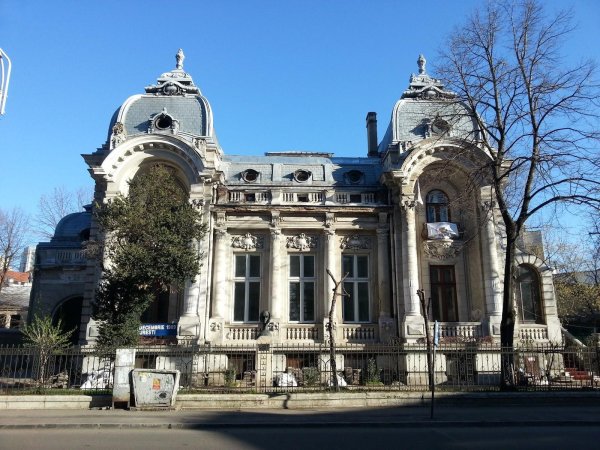
Hidden on Batiștei Street, in an area of the Capital rich in history, Spayer Palace is one of the most spectacular aristocratic residences built in Bucharest at the beginning of the 20th century. The elegance of its architecture, its connection with the Blank family, and the impressive destiny of the building make this historic monument one of the most interesting edifices in Bucharest’s heritage. From the luxury of the Belle Époque to communist nationalization and then to the restoration begun in recent years, Spayer Palace continues to fascinate through its history.
Who built Spayer Palace and what is the connection with Mauriciu Blank?
Spayer Palace was erected at the initiative of banker Herman Spayer, who lived here together with his wife, Margot Spayer, née Blank. She was the daughter of Mauriciu Blank, one of the co-founders of the famous Marmorosch-Blank Bank, one of the most important financial institutions in modern Romania.
Construction began after Herman Spayer obtained the building permit on January 20, 1899, and the works were completed in 1900. The residence was conceived as a luxurious villa, arranged over a basement, ground floor, upper floor, and attic, with a surface area of approximately 435 square meters.
The architecture of Spayer Palace, the work of Louis Pierre Blanc
Spayer Palace is one of the most representative examples of the academic beaux-arts style of neoclassical inspiration in Bucharest. The author of the project was the Swiss architect Louis Pierre Blanc, one of the most appreciated architects who contributed to the transformation of the Capital during the reign of King Carol I.
The interior impressed through the richness of its decorations: sculptures, stuccoes, marble columns, wooden paneling, ornamental fireplaces, and elegant wallpapers. The decorative paintings were initially made by the artist Marechal, and later completed by Francisc Vodak.
The monumental entrance intended for carriages, on which the year 1900 is inscribed, still represents one of the most spectacular elements of the building today.
Louis Pierre Blanc and his contribution to the modernization of Bucharest
Having arrived in Romania in 1884, at the recommendation of Ion Mincu, architect Louis Pierre Blanc became one of the essential figures of Romanian architecture at the end of the 19th century.
Besides Spayer Palace, he designed the Ministry of Agriculture, the Faculty of Medicine, the Bacteriological Institute, the greenhouses of the Botanical Garden, and the residences of important personalities of the time, such as Mauriciu Blank, Nicolae Filipescu, and Ion Lahovary.
Louis Pierre Blanc also stood out as a real estate developer, investing in land that he parceled out and on which he built elegant villas, contributing to the emergence of modern neighborhoods in Bucharest.
Changes made to the residence over time
After the death of Louis Pierre Blanc in 1903, work on the property continued. Between 1907 and 1909, architect Ion D. Berindey designed the stables and the greenhouse and restored part of the palace’s decorations.
Archival documents show that maintenance works were also carried out in 1913, when a staircase was replaced and the plasterwork was redone.
Was Spayer Palace the headquarters of Marmorosch-Blank Bank?
One of the most widespread erroneous pieces of information claims that Spayer Palace housed the headquarters of Marmorosch-Blank Bank. In reality, historical documents do not confirm this statement.
The confusion is explained by the fact that Herman Spayer was the son-in-law of Mauriciu Blank and was part of the bank’s Board of Directors. There is also the hypothesis that the building may have been brought as a contribution to the share capital during the economic crisis of the 1930s, but this theory is not confirmed by documents.
Until the establishment of the communist regime, the palace remained in the ownership of the Spayer family and was so appreciated that its image appeared on postcards and in Bucharest tourist guides.
What happened to Spayer Palace after 1948?
Nationalized after the establishment of the communist regime, the palace was used for storing works of art and for holding official meetings of the party.
After the Revolution of 1989, the building came under the administration of RA-APPS, then became the headquarters of the Association “21 December 1989.” Between 1992 and 1996 it hosted the central headquarters of the Romanian Democratic Convention.
In front of the palace stands the bust of Corneliu Coposu, unveiled in 1997, in memory of one of the most important political leaders of post-communist Romania.
The restoration of Spayer Palace and its current situation
In recent years, Spayer Palace has gone through a new stage of its existence. After being returned to the heirs, the building was purchased by the Chamber of Notaries Public, which launched an extensive restoration project.
Since the autumn of 2020, the building has been undergoing consolidation and restoration, access being possible only with the owner’s approval. Since 2013, the ensemble has been listed in the Register of Historic Monuments, confirming its architectural and cultural value.
Today, Spayer Palace remains one of the most elegant historic monuments in Bucharest and a symbol of the period when the Capital was nicknamed “Little Paris.” The story of the Spayer family, the talent of architect Louis Pierre Blanc, and the transformations this residence has undergone make the palace an important landmark of Romanian heritage and a destination worth rediscovering once the restoration is completed.
We also recommend: Assan House, the palace in the heart of the Capital where the first Romanian to travel around the world lived