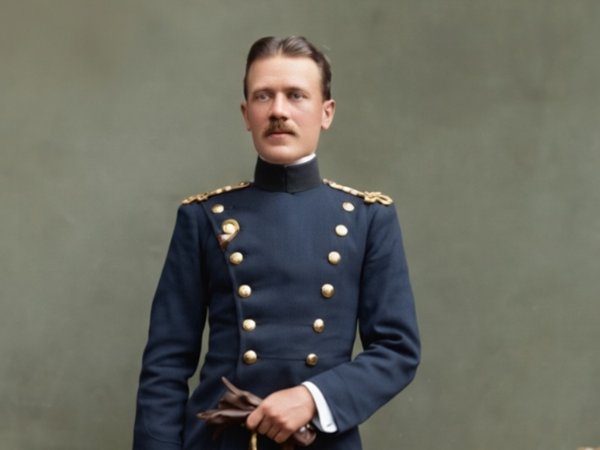
Lieutenant Gheorghe Caranda, the first Romanian aviator to die in an aviation accident, has a street named after him in Bucharest
- Articles
- 16 JUL 26
The history of Romanian aviation is full of names that made decisive contributions to the development of flight during a period when every takeoff represented a challenge and every landing was a victory. Among these pioneers was Lieutenant Gheorghe Caranda, the first Romanian aviator to lose his life in an aviation accident. Although his destiny came to a tragic end at the age of only 28, his memory has remained alive, and today there is a street in Bucharest that bears his name, as a sign of recognition for the sacrifice he made in the service of the progress of Romanian aviation.
A pioneer of Romanian aviation, admired by the public and respected by his colleagues
At the beginning of the 20th century, aviation was still in its infancy. Airplanes were fragile, engines suffered from numerous technical problems, and every flight involved enormous risks. Even so, a generation of courageous young men chose to dedicate their lives to conquering the skies. Gheorghe Caranda was part of this select elite, alongside personalities such as Prince George Valentin Bibescu, Aurel Vlaicu, and other pioneers who laid the foundations of Romanian aviation.
Caranda quickly became one of the most highly regarded aviators of his time. He took part in aerial demonstrations watched by thousands of people, and his spectacular performances made him a favorite of the public. His reputation extended beyond Romania. The French press described him as one of the most agile aviators in Europe, an outstanding distinction at a time when France was considered the world's center of aviation.
His talent, courage, and mastery of the aircraft established him as one of the most promising aviators of his generation. No one suspected that his destiny would be cut short so early.
A day of mourning for the whole of Romania
June 20, 1912, remains one of the saddest dates in the history of Romanian aviation. On that very day, Romania was shaken by two tragedies that occurred more than 200 kilometers apart.
In Dolj County, an automobile carrying several prominent figures, including a former member of Parliament, a senator, a lawyer, and the French lecturer Chilot, who was concluding a lecture tour in Romania, was struck by passenger train No. 164 near the railway guardhouse between Pielești and Circea. The accident claimed numerous victims and deeply affected even the French authorities, who lowered their national flag to half-mast.
At the same time, in Bucharest, on the Cotroceni airfield, another tragedy was unfolding that would permanently mark the history of Romanian aviation. During a training flight, Lieutenant Gheorghe Caranda crashed with his airplane and became the first Romanian aviator to die in an aviation accident.
The entire country received the news with profound emotion. The newspaper Dimineața wrote that although technological progress inevitably requires sacrifices, there had been hope that Romanian aviation would be spared tragedies like those that had already struck other European countries. Sadly, Caranda's death was only the beginning of a long series of sacrifices. Just one year later, Romania would also lose Aurel Vlaicu, one of the greatest aircraft designers and aviators of his era.
How the tragedy occurred on the Cotroceni airfield
The witnesses of the accident remained haunted for the rest of their lives by the horrific images they saw that morning. Among them was Lieutenant Constantin Fotescu, who later described the events in detail.
He was following the flight of the aircraft piloted by Gheorghe Caranda when he noticed the moment the biplane lost control. Immediately after the impact, he ran toward the wreckage, hoping that the aviator might still be saved. The reality, however, was devastating.
According to his account, the airplane's engine had fallen on top of the pilot's body, while part of the aircraft's structure had inflicted fatal injuries. The scene was so shocking that Caranda's fellow aviators considered it necessary to photograph the crash site in order to preserve evidence of a moment that would become part of Romanian aviation history.
The alarm was raised immediately. Assistance was requested from the Romanian Rescue Society, headed by Dr. Nicolae Minovici, and the aviator's body was transported to the Military Hospital. Unfortunately, the doctors could do nothing more.
His death generated a wave of emotion throughout Romanian society. For Romanians, Caranda had become the symbol of a generation willing to risk their lives for technological progress and for the prestige of their country.
From a military career to an aviator's license
Gheorghe Caranda was born in Iași on April 11, 1884. He chose a military career and entered the Military School in September 1906. Two years later, he was promoted to the rank of lieutenant in the infantry.
His passion for aviation, however, completely changed his professional path. In the autumn of 1911, he was assigned to the Military Aviation School at Cotroceni, where he completed pilot training and earned his aviator's license in a remarkably short time.
His abilities as a pilot were immediately recognized. He executed difficult maneuvers with a natural ease that impressed both his instructors and the spectators attending aerial demonstrations. Around the celebration of May 10, King Carol I signed the decree promoting Caranda, confirming the high regard in which he was held within the Romanian Army.
His participation in numerous flight demonstrations helped popularize aviation in Romania at a time when the public was discovering with fascination mankind's ability to conquer the skies.
The airplane that had already raised concerns
The investigation conducted after the accident established that Gheorghe Caranda had been flying a Farman biplane, the very same aircraft that had been used only a few weeks earlier by Second Lieutenant Negrescu during an aerial raid between Bucharest and Bârlad.
Serious problems with the aircraft had already been observed. The airplane showed a pronounced tendency to pitch upward, making it difficult and dangerous to control. For this very reason, after completing the raid, Negrescu chose not to return by air. Instead, the airplane was transported back to Bucharest by train, while the pilot continued his journey by automobile.
On the morning of the accident, the aircraft had also been flown by Lieutenant Pîrvulescu. He noticed that the engine was running irregularly and producing insufficient power. Because of these problems, he concluded that the airplane should not be flown again until the defects had been repaired.
Caranda, however, saw the situation differently. Believing that his experience would enable him to control the aircraft, he climbed into the cockpit and took off.
Witnesses immediately noticed that the airplane was climbing at an unusually steep angle. It is said that Pîrvulescu, seeing the dangerous behavior of the biplane, withdrew into the hangar, stating that he did not wish to witness what was about to happen. His fears would be confirmed only moments later.
The conclusions of the military investigation
The investigation carried out by the military authorities lasted several days and sought to determine the exact causes of the accident.
The investigators examined two main possibilities. The first suggested that the pilot had failed to perform the recovery maneuver in time by using the elevator control. The second hypothesis was that he had attempted the maneuver, but the aircraft no longer had sufficient speed for the controls to be effective.
The specialists concluded that the airplane's technical deficiencies played a decisive role. The tendency to pitch upward was an inherent characteristic of the aircraft, while the engine failed to develop enough power to provide the propeller with the thrust necessary to recover the airplane.
Moreover, the airplane was unable to reach the minimum speed of approximately 40 km/h required to maintain lift according to the technical standards of the period. Under these conditions, the aircraft inevitably entered a rapid descent, and the impact with the ground could no longer be avoided.
The investigation report noted that Gheorghe Caranda had a tendency to perform daring maneuvers and displayed genuine virtuosity in piloting. It was precisely this confidence in his own abilities that led him to accept the risk of flying an aircraft that had already raised serious concerns.
Criticism regarding the technical condition of Romanian aircraft
Shortly after the tragedy, numerous questions emerged concerning the technical condition of the airplanes used by the Military Aviation School.
A letter sent to the editorial office of the newspaper Dimineața by a contributor identified as P. Stoicescu argued that an accident had merely been a matter of time. According to him, many of the biplanes in use were not original Farman aircraft but copies built in the school's hangars based on an older model.
The construction work was carried out in the workshops at Chitila, using plans copied by Nikita Paceff, who was believed to have previously worked as a mechanic at Henry Farman's factory. The problem was that the model used as the basis no longer matched the modern versions, since the French manufacturer had introduced numerous improvements to his aircraft in the meantime.
The author of the letter believed that Romanian aviators compensated for technical shortcomings with enthusiasm and courage, while warning that enthusiasm could never replace prudence and safety.
Although the authenticity of all these claims could not be fully verified, they fueled the debate over the urgent need to modernize Romania's air fleet.
National funeral and recognition of his sacrifice
Following the accident, the body of Lieutenant Gheorghe Caranda was laid in state at the chapel of the Military Hospital in Bucharest.
There, his fellow officers, representatives of the Ministry of War, members of the Royal Family, and numerous prominent figures of the time came to pay their final respects. King Carol I, Crown Prince Ferdinand, and Prince Valentin Bibescu sent floral wreaths in memory of the aviator.
The moment when Caranda's father arrived in Bucharest to take his son home deeply moved public opinion. Contemporary newspapers described the somber atmosphere of the farewell, symbolically suggesting that even the sky itself seemed to share in the nation's mourning.
After the religious service held in the military chapel, the coffin was placed in the funeral railway carriage and transported to Iași, the aviator's hometown.
In the capital of Moldavia, impressive state funeral ceremonies were organized, attended by officials, military personnel, and numerous citizens who came to bid farewell to the first hero of Romanian aviation.
General Argetoianu, the Minister of War, proposed that Gheorghe Caranda be posthumously awarded the Order of Military Virtue, arguing that he had lost his life "at his post of honor." King Carol I immediately approved the decree, and the decoration was placed on the aviator's chest before he began his final journey to his resting place.
Among the most moving speeches delivered on that occasion was that of Major Zizi Cantacuzino, who told his fellow aviators that Caranda's sacrifice should not discourage them, but instead inspire them to continue developing Romanian aviation. He declared that the blood shed by the young lieutenant would become the foundation upon which Romania's future air fleet would be built.
Gheorghe Caranda's legacy
Gheorghe Caranda's death marked a turning point for Romanian aviation. The accident exposed the technical limitations of the aircraft then in service and accelerated efforts to modernize them.
In the same year, the League for Romanian Aviation, led by Prince George Valentin Bibescu, launched a fundraising campaign aimed at purchasing modern aircraft. Thanks to these funds, the first Bristol-Coandă airplane was acquired, followed by a second one the following year, significantly improving the safety and performance of Romanian aviation.
Although Gheorghe Caranda's life was tragically short, his contribution to the development of Romanian aviation remains unquestionable. The courage with which he flew imperfect aircraft and his passion for aviation transformed him into a symbol of the beginnings of Romanian military aviation.
Today, his name is borne by a street in Bucharest, serving as a discreet yet meaningful tribute to the man who became the first Romanian aviator to fall in the line of duty. Beyond this commemoration, Gheorghe Caranda remains one of the pioneers who paved the way for modern Romanian aviation, demonstrating that progress is often built upon the sacrifice of those courageous enough to venture where no one has gone before.
We also recommend: Who was Lieutenant Aviator Iuliu Tetrat and why does a street bear his name in Bucharest