Elie Radu House in Bucharest. The story of the home designed by an Italian architect for one of Romania’s leading engineers
By Raluca Ogaru
- Articles
- 06 OCT 26
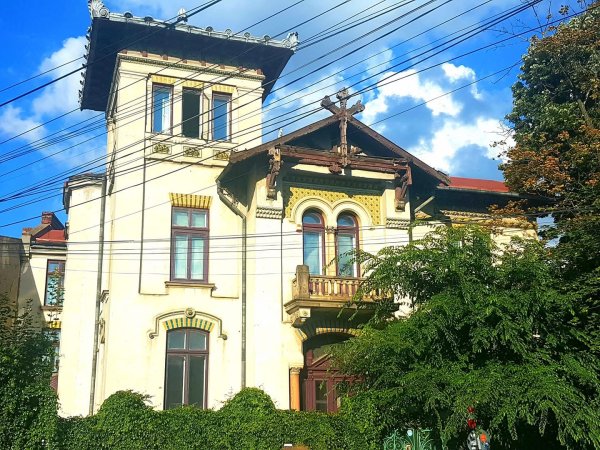
Elie Radu House stands at 40 Alexandru Donici Street, on the corner of Icoanei Street, and bears the name of the engineer who helped develop Romania’s railways, bridges and water supply systems. Designed by Italian architect Giulio Magni, the residence connects two careers that also crossed paths on public works projects.
The building dates from the late 19th century and is a listed historic monument. For anyone exploring the Icoanei neighbourhood, it offers an opportunity to discover both the architecture of a private residence and the story of a professional whose work changed how people travelled and how cities obtained their water.
A house dating from 1898, where Donici and Icoanei streets meet
The property appears in the List of Historic Monuments in Bucharest as “Casa Elie Radu”, under reference B-II-m-B-18613. The document confirms its address in Sector 2 and dates it broadly to the late 19th century.
Specialist sources provide a more precise date: 1898. This year appears both in Giulio Magni’s entry in the META Cultural Foundation’s architecture encyclopaedia and in the architectural trail dedicated to him by the Art History Association. Other accounts give the period 1894–1898, but this should not be mistaken for a construction timeline established through permits and official records.
Several other houses on the same street are also listed as heritage buildings: the Lenș lawyer’s house at number 23, General Lahovary’s house at number 28 and Pan Halipa’s house at number 32. Elie Radu House can therefore be one of several stops on a walk exploring the architecture of Alexandru Donici Street.
Giulio Magni, the Italian architect who worked in Bucharest
Giulio Magni was born in 1859 in Velletri, Italy, and worked in Romania between 1894 and 1904. He designed schools, railway stations, public buildings and private residences. Hala Traian is among the Bucharest buildings associated with his name.
During those years, Magni incorporated elements of local architecture into his designs, at a time when the Romanian Revival style was beginning to establish itself. The profile on Arhiva de arhitectură describes his growing engagement with Romanian tradition and the influence of the professional circles in which he worked.
His relationship with Elie Radu extended beyond the commission for a house. The entry in the META encyclopaedia records their collaboration on railway projects and the Mavrogheni Communal School. The same source draws a stylistic connection between the engineer’s home and the school. The residence on Donici Street was therefore part of a broader professional collaboration between the architect and the engineer.
Who Elie Radu was and what he did for Bucharest
Born in Botoșani in 1853, Elie Radu studied in Belgium and returned to Romania in 1877 with an engineering degree. He joined the Ministry of Public Works, and one of his earliest assignments was to inspect construction work on the Ploiești–Predeal railway alongside Anghel Saligny.
His work encompassed railway routes, roads, steel and reinforced-concrete bridges, as well as urban infrastructure. One of his significant contributions to Bucharest was a scheme to draw groundwater from the Bragadiru area. According to a study published by the General Association of Engineers in Romania, Radu proposed the solution in 1892, and construction began in 1897.
He was also a teacher, beginning his academic career at the National School of Bridges and Roads in 1894. His courses connected technical training with practical urban challenges, including water supply and sewerage.
Academic recognition came in 1926, when he became an honorary member of the Romanian Academy. This is the year recorded by the institution. Elie Radu died in 1931.
How to include the house in a walk around the neighbourhood
To find the building, use the address 40 Alexandru Donici Street, Sector 2, on the corner of Icoanei Street. Its location makes it easy to include in a walk through the streets around Grădina Icoanei, alongside other historic residences.
No current, confirmed public visiting schedule was found for the interior. If you are making a special trip to see the building, plan to view its exterior from public space. Access to the courtyard or house should be checked and arranged with those responsible for the property.