Five sensational trials that kept Bucharest on the edge of its seat
By Eddie Țone
- Articles
- 19 NOV 26
In Bucharest during the first half of the 20th century, a high-profile trial could dominate newspaper front pages for weeks. Politicians found themselves in the dock, lawyers prepared their arguments for audiences far larger than those gathered in the courtroom, and reporters turned every statement into another installment of a story to be followed over morning coffee. The city already had theatres, cinemas and variety shows, but the justice system occasionally staged performances featuring a cast that no ordinary theatre could ever have assembled.
Judicial spectacle, of course, had one rather unpleasant feature for those involved. The curtain could fall on a death sentence.
After 1945, the relationship between justice and spectacle changed dramatically. Public trials became instruments through which the new political authorities portrayed their opponents as criminals, using indictments and press coverage to establish the official version of events. Some cases concerned genuine war crimes and serious historical responsibilities. Others were designed to eliminate political opposition through fabricated charges. The distinction between the two is essential.
Five trials held in Bucharest between 1945 and 1954 reveal how the courtroom became a political stage. Their protagonists came from very different worlds, but their stories share one common element. Each trial revealed something about the society watching it and, above all, about the people who held power.
1. The generals' trial of 1945. The Odessa massacres before the People's Tribunal
In May 1945, Bucharest found itself in a political situation that its residents would have struggled to explain to a visiting foreigner. The war in Europe had just ended, Soviet troops were stationed in Romania, and the government led by Petru Groza, installed on March 6, was beginning to reorganize the state.
At the centre of these changes stood the People's Tribunal, a special court established to prosecute individuals accused of war crimes and contributing to the country's disastrous wartime situation.
Its first major trial, held between May 14 and 22, 1945, focused on General Nicolae Macici and the responsibility of Romanian military personnel for the reprisals carried out in Odessa in the autumn of 1941.
The story began hundreds of kilometres from Bucharest. On October 22, 1941, an explosion destroyed the Romanian military headquarters in Odessa, killing a large number of soldiers and officers. The Romanian authorities responded with extraordinarily brutal reprisals in which thousands of civilians, particularly Jews, were murdered.
The Odessa massacres constitute one of the major episodes of the Holocaust in territories administered by Romania during the war.
Inside the Bucharest courtroom, the proceedings examined the responsibility of those involved in these actions. Public prosecutors Avram Bunaciu and Dumitru Săracu played prominent roles, delivering exceptionally forceful indictments.
This was a new judicial arrangement that brought a visible change. The People's Tribunal had a special structure, comprising magistrates and judges appointed under legislation adopted after the war, while the concept of people's justice occupied a central position in official discourse.
General Macici was sentenced to death, although his sentence was subsequently commuted to life imprisonment.
How could wartime atrocities be judged rigorously at a time when the justice system itself was undergoing rapid political transformation? Responsibility for the atrocities had a genuine historical basis, while the new judicial system simultaneously raised questions about judicial independence and the protection of procedural rights.
The generals' trial opened a period in which Bucharest would increasingly see prominent figures become the central characters in major political prosecutions.
2. The journalists' trial of 1945. Newspaper articles became evidence in a criminal case
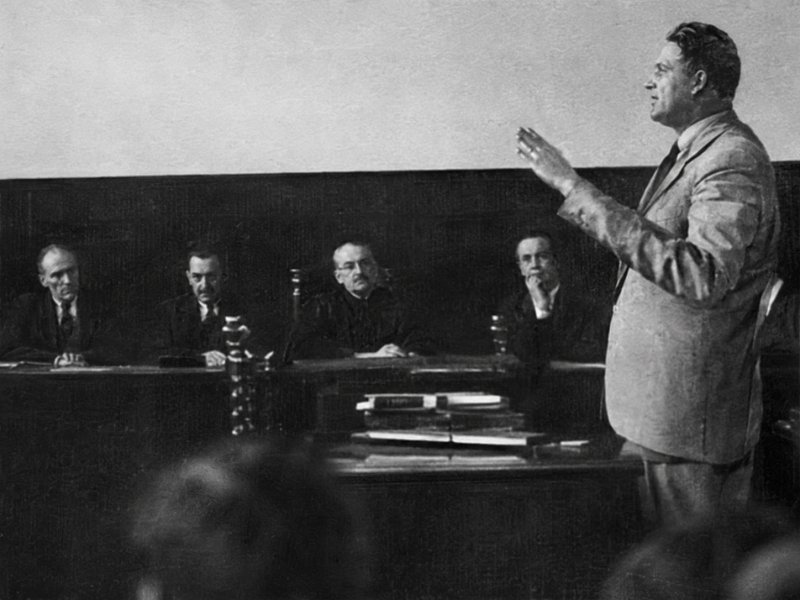 The journalists trial
At the end of May 1945, the Romanian capital witnessed a trial featuring a remarkable cast by any standard of Romanian press history.
Among those prosecuted were Pamfil Șeicaru, founder and editor-in-chief of the newspaper Curentul, Nichifor Crainic, former editor of the magazine Gândirea, and the poet Radu Gyr. They were well-known figures whose writings had circulated through newsrooms and bookshops for years. This time, their articles were being presented before judges.
The trial, which began on May 30, 1945, examined the responsibility of journalists and commentators for fascist propaganda and for supporting policies that had contributed to Romania's involvement in the war alongside Nazi Germany.
The accusations concerned the influence exerted through the press. A regime that was building its legitimacy partly by controlling information was putting prominent journalists on trial, an act with an obvious political significance of its own.
Pamfil Șeicaru was a particularly important figure. His newspaper, Curentul, had been one of the influential publications of the interwar period. He was a journalist with extensive political connections and a reputation that extended far beyond the newsroom. By 1945, Șeicaru was already abroad. He was tried in absentia and sentenced to death.
Other defendants faced different outcomes. Nichifor Crainic and Stelian Popescu were sentenced to life at hard labour, while Radu Gyr received a 12-year prison sentence.
The verdict was delivered on June 4, 1945, and one detail reveals much about the atmosphere of the time. In a country where the press had served for years as an instrument of wartime propaganda, the new authorities were using those same channels of public communication to announce the conviction of the previous regime's propagandists. Romania was witnessing a change of cast in the relationship between the press and political power, with consequences considerably more serious than the replacement of a newspaper editor.
Radu Gyr's story would take another dramatic turn. Released in 1956, the poet was arrested again in 1958 and sentenced to death in another political case. His sentence was later commuted to imprisonment.
The journalists' trial continues to raise a delicate question. Fascist and antisemitic propaganda had real consequences, and the responsibility of individual authors must be examined on the basis of their actions. At the same time, the judicial proceedings of 1945 must be assessed in the context of Romania's political transformation.
In Bucharest, the trial also marked the end of an era in journalism. Some of the people who had shaped interwar public opinion disappeared from professional life, while the press came under increasingly strict political control.
3. Ion Antonescu's trial in 1946. The most photographed courtroom in postwar Romania
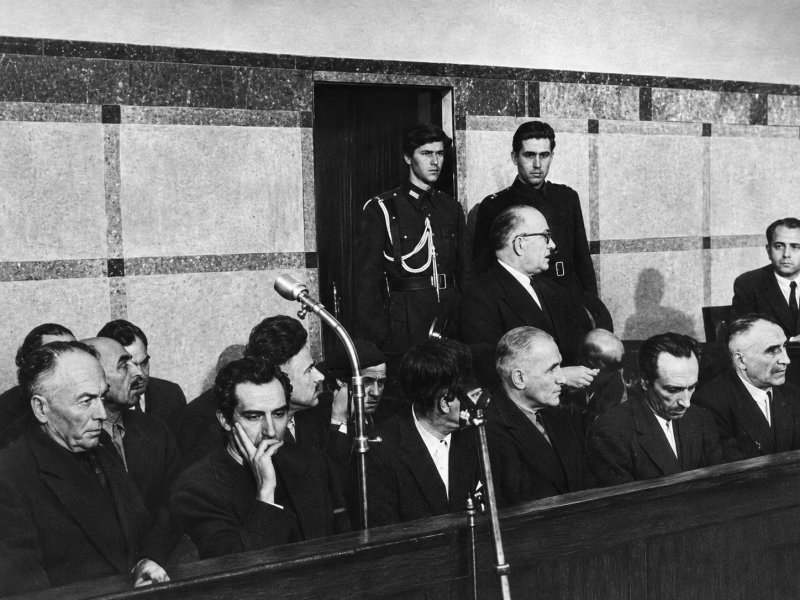 Ion Antonescu trial
On the morning of May 6, 1946, the atmosphere outside number 108 Știrbei Vodă Street in Bucharest resembled that surrounding a major political event. Gendarmes guarded the area, and entry to the courtroom was restricted to those holding invitations. Inside, Ion Antonescu, the man who had ruled Romania between 1940 and 1944, was about to stand trial alongside leading members of his regime.
The proceedings took place in the building of the Eighth District Court, with Alexandru Voitinovici, a magistrate close to the new authorities, presiding over the judicial panel. Antonescu had been arrested on August 23, 1944, following King Michael's decision to withdraw Romania from its alliance with Nazi Germany. He was subsequently transferred into Soviet custody and handed over to the Romanian authorities in April 1946 to face trial.
The charges concerned responsibility for the country's disastrous wartime situation and for war crimes committed under his regime. Among the acts examined were the persecution of Jews and the deportations organized by the Romanian authorities.
The Antonescu regime's responsibility for the Holocaust is documented by the International Commission on the Holocaust in Romania, chaired by Elie Wiesel, as well as by subsequent historical research. British historian Dennis Deletant has shown that political interference in the organization of the trial must be examined separately from criminal responsibility for war crimes.
Yet the way the trial was presented to the public had a distinctly theatrical dimension. An eyewitness, war veteran Neculai Tănase, recalled in an interview published by the newspaper Adevărul that the courtroom was packed with people invited by the authorities. He remembered photographers constantly capturing images of the defendants and the tense atmosphere during the hearings.
The sight of a former military ruler, accustomed to commanding an army, now standing before judges carried obvious propaganda value, particularly since the entire event was being recorded.
One of the most interesting aspects of the trial is its photographic and cinematic documentation. Photographer Emanoil Safir participated in recording the events visually, while cameraman Ovidiu Gologan filmed the trial and the subsequent executions. Safir's photographs are preserved at the National History Museum of Romania, while the film footage entered archival collections. Some of these images were recovered and made publicly accessible only after the collapse of the communist regime.
The trial ended on May 17, 1946. Ion Antonescu was sentenced to death, along with several of his associates. On June 1, Ion Antonescu, Mihai Antonescu, Constantin Vasiliu and Gheorghe Alexianu were executed at Jilava.
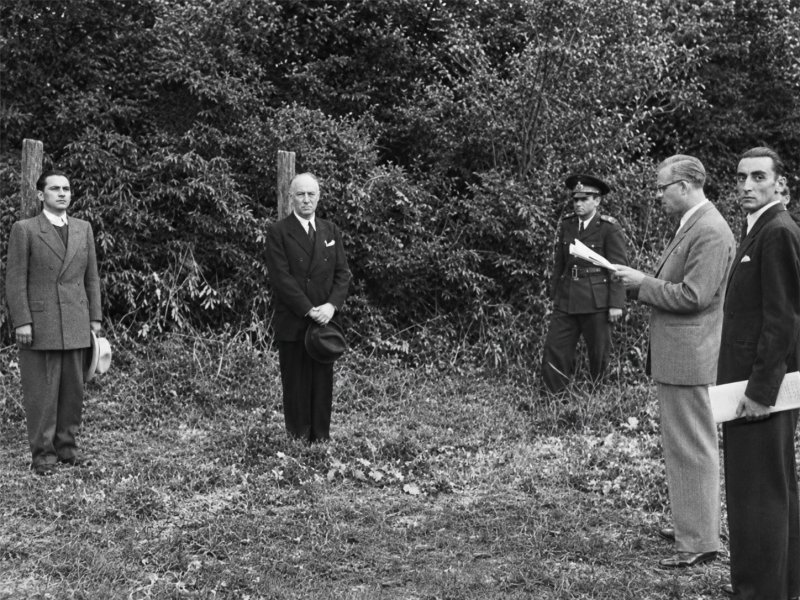 Ion Antonescu execution
From the perspective of legal history, the case remains significant for two separate reasons. The first concerns responsibility for crimes committed during the war, established on the basis of extensive documentary evidence. The second concerns the political circumstances in which the trial took place and its exploitation by the communist-dominated government.
Bucharest had witnessed the trial of a former de facto head of state. And the photographs and films taken in May 1946 would preserve for future generations what those present in the courtroom had seen with their own eyes.
4. Iuliu Maniu's trial in 1947. How an architect of Romania's Great Union was sentenced to life imprisonment
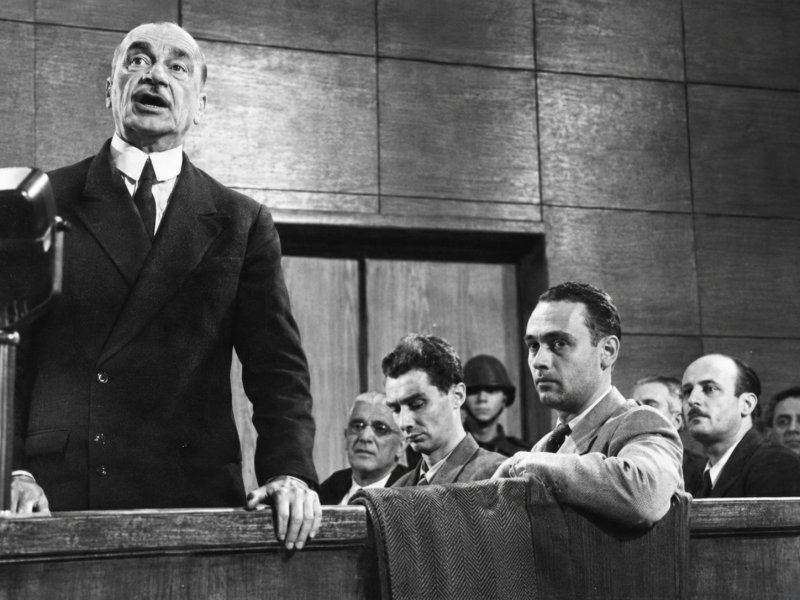 Iuliu Maniu trial
On October 29, 1947, the trial of Iuliu Maniu, former leader of the National Peasants' Party, began in Bucharest. It was a case carrying particularly strong political implications.
Maniu had been one of the leading figures in the union of Transylvania with Romania, had participated in Romanian political life for decades, and had served as prime minister. He was also well known in Western diplomatic circles. Yet he now found himself before the Military Tribunal of Bucharest's Second Military Region, in proceedings organized after the arrest of National Peasants' Party leaders during the summer of 1947.
The immediate pretext was the Tămădău affair of July 14. A group of senior National Peasants' Party figures, including Ion Mihalache, were arrested at an airfield while attempting to leave the country. The authorities presented the incident as evidence of a conspiracy against the state.
A public campaign against the party followed, and by the end of July the National Peasants' Party had been dissolved.
The trial of Maniu and the other defendants took place between October 29 and November 11, 1947. The charges included high treason and organizing activities against the constitutional order. The communist-controlled press portrayed the case in language intended to discredit the political opposition.
In the courtroom, the former National Peasants' Party leader was expected to answer serious accusations in a climate where political condemnation had already preceded the actual hearings.
Historian Ion Calafeteanu has documented the trial's international repercussions by examining reports published in the British press. The case attracted attention because Maniu was a familiar figure in the West, and his situation reflected the rapid political transformations taking place across Eastern Europe.
One detail in the case file reveals a great deal about the machinery of repression. According to the sentencing documents, Iuliu Maniu received several prison sentences amounting to a total of 104 years, in addition to sentences of life at hard labour. It is difficult to imagine a more telling illustration of the era's enthusiasm for punishment: a man approaching the final years of his life was being given prison terms calculated to last several human lifetimes.
Under Judgment No. 1988 of November 11, 1947, Maniu was sentenced to life at hard labour, a punishment subsequently converted into life imprisonment under a severe detention regime. Ion Mihalache also received a life sentence. Among those convicted was Nicolae Carandino, journalist and editor of Dreptatea, a newspaper associated with the National Peasants' Party.
The trial became one of the defining episodes in the suppression of political opposition in Romania. Maniu was imprisoned first in Galați and then in Sighet, where he died on February 5, 1953. Ion Mihalache died in detention at Râmnicu Sărat in 1963.
The proceedings gave the communist regime an opportunity to portray members of the old political elite as enemies of the national interest. For historians who subsequently examined the documents, the charges and judicial procedures formed part of the mechanism through which the authorities eliminated organized opposition.
And for Bucharest in the autumn of 1947, this judicial spectacle had a very tangible consequence: one of the country's most important political parties disappeared from public life, while its leaders entered the political prison system.
5. Lucrețiu Pătrășcanu's trial in 1954. The telephone in the courtroom and the verdict dictated by the party
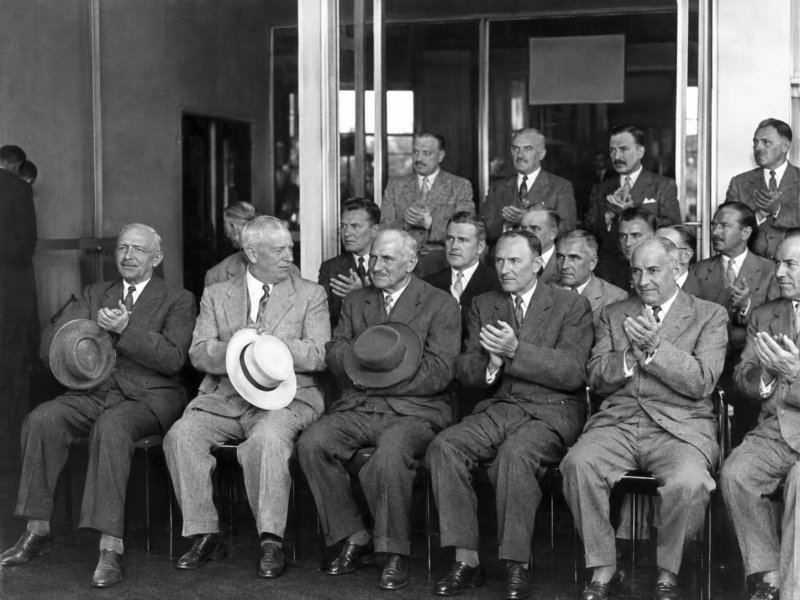 Luca Pătrășcanu trial
Of all the political trials organized in communist Romania, the case of Lucrețiu Pătrășcanu offers perhaps the most disturbing image of a justice system turned into an instrument of the struggle for power.
Pătrășcanu was himself a communist. He had served as minister of justice after August 23, 1944, and participated in the events that led Romania to change alliances during the war. He had studied law, possessed a solid intellectual background and had a personality that distinguished him from many other party leaders.
He was arrested in April 1948, and the investigation dragged on for years. The authorities constructed a case accusing the former minister of espionage and conspiracy against the state. Behind the charges lay rivalries within the communist leadership and leader Gheorghe Gheorghiu-Dej's determination to eliminate a potential opponent.
The trial took place between April 6 and 13, 1954, inside a Ministry of Internal Affairs building in Bucharest. The verdict was delivered on April 14, with one detail that makes the entire affair resemble a scene from a political novel.
A special telephone with a short cord had been installed in the courtroom, allowing interventions during the proceedings. According to research published by the Institute for the Investigation of Communist Crimes and the Memory of the Romanian Exile, listening equipment was also connected to the offices of senior political officials, including Alexandru Drăghici and Iosif Chișinevschi. In other words, the judges were conducting proceedings in a room monitored by representatives of the political leadership.
The audience had been carefully selected. Access was granted to people considered trustworthy, particularly party activists and members of the repressive apparatus. The entire trial had been prepared through interrogations and statements obtained under coercion. Some defendants agreed to repeat before the court the version of events imposed by their interrogators.
Pătrășcanu refused to play the role prepared for him. At the end of the trial, when asked whether he had anything further to say in his defence, he replied with words preserved in the trial records: "I have nothing to say, except that I spit on the accusations brought against me." The statement appears in research devoted to the Pătrășcanu case and in judicial documents examined after the fall of the communist regime.
Those words amounted to a direct rejection of the official script. Pătrășcanu was sentenced to death alongside Remus Koffler. The other defendants received lengthy prison sentences. On the night of April 16–17, 1954, Pătrășcanu and Koffler were executed at Jilava.
The story, however, was to take a turn that might have seemed implausible even in a film script. In April 1968, fourteen years after the execution, Nicolae Ceaușescu used a re-examination of the case to criticize the party's former leadership and remove Alexandru Drăghici from positions of power.
Pătrășcanu was posthumously rehabilitated politically. The Central Committee plenum held between April 22 and 25, 1968, acknowledged serious violations of the law during the investigation and trial. The former communist minister had been convicted and executed by his own regime, only for the same party to subsequently recognize his rehabilitation.
In Bucharest's history, the Pătrășcanu case remains the story of apparently ordinary rooms inside state institutions where the fates of people holding senior positions were decided. A courtroom, a telephone connected to the political leadership and a verdict prepared in advance offer a remarkably concrete picture of the relationship between justice and power during Romania's Stalinist years.
When courtrooms became stages for political power
Taken together, these five trials reveal the rapid transformation of Bucharest's justice system. In 1945 and 1946, special courts prosecuted individuals involved in the politics and propaganda of Romania's wartime regimes. The crimes under investigation were real and serious, while the new authorities also used the trials to consolidate their legitimacy.
During the early postwar trials, the press and the presence of carefully selected spectators helped construct an official narrative. In Pătrășcanu's case, the audience was restricted to individuals considered reliable, while public communication took place through official announcements and the newspaper Scânteia. The courtroom remained the stage, but the audience was chosen by the director.
The archives have preserved enough documents to reconstruct these episodes with a degree of precision that their contemporaries would probably have found surprising. Judgments and transcripts, press photographs and testimonies from former prisoners reveal how charges were prepared and verdicts presented.
In Maniu's case, documents preserved by the National Council for the Study of the Securitate Archives (CNSAS) and used by the Sighet Memorial reveal the scale of the sentences imposed. In Pătrășcanu's case, historical research has reconstructed even the mechanisms through which the party leadership intervened in the proceedings. And in Antonescu's case, archival footage now allows us to observe directly a trial that formed part of the postwar effort to prosecute war crimes.
Through its archives, Bucharest preserves the history of courts in which people were tried for genuine crimes or fabricated accusations, depending on the period and the interests of those in power. The distinction between these situations remains essential, and it is precisely what makes the history of Bucharest's great trials so unsettling.
Inside the courtroom, words could carry the weight of years in prison or a death sentence. And the spectacle could continue in the newspapers long after the accused had been escorted out of the room.
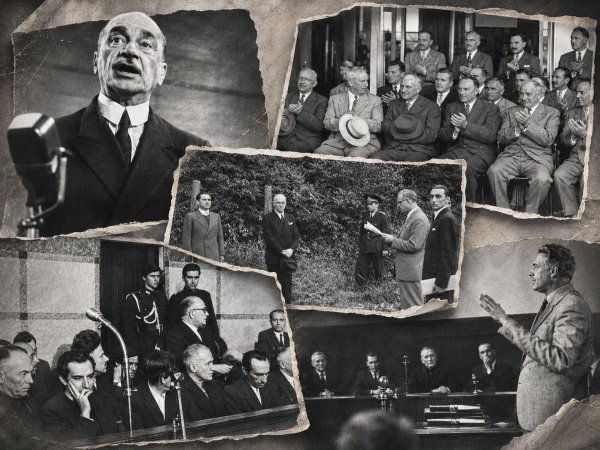
Photographs from contemporary newspapers, restored using artificial intelligence
You may also like: How the communists killed the great Iuliu Maniu: “I do not deviate from my path, I do not change my decisions!”