Stars of Interwar Bucharest: George Calboreanu, from Hamlet to Stephen the Great, 340 roles that could “make even the trams stop”
- Articles
- 16 NOV 26
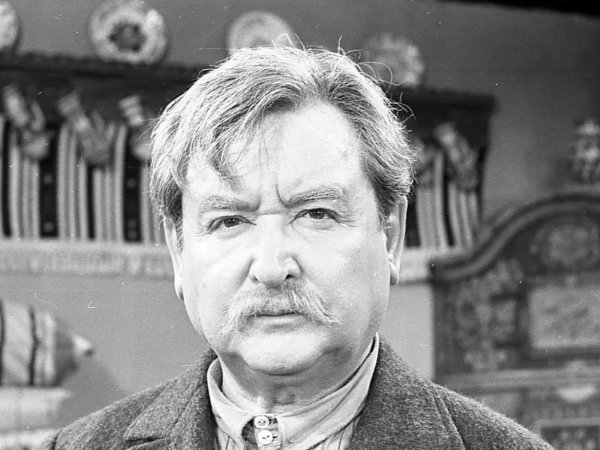
George Calboreanu was one of the great figures of Romanian theatre, an actor whose career spanned almost seven decades and included hundreds of characters performed on stage, in films and on the radio. From Hamlet and King Lear to Julius Caesar, Vlaicu-Vodă and Stephen the Great, Calboreanu demonstrated a remarkable ability to move between very different dramatic registers while maintaining a powerful and unmistakable stage presence. His name became closely associated with the National Theatre of Bucharest, where he made his debut in 1926 and became a permanent member of the company two years later. The Theatre Museum of the National Theatre describes his performance as Stephen the Great in Barbu Ștefănescu Delavrancea’s Apus de soare as one of his most memorable creations. His imposing appearance, deep voice and exceptional expressive force made him one of the most recognizable Romanian actors of the 20th century.
From Turnișor to the Iași Conservatory
George Calboreanu was born on January 3, 1896, in Turnișor, a locality that is today part of Sibiu. Some local sources give January 5 as his date of birth, but major biographical sources, including AGERPRES and Radio România Cultural, record January 3. He came from a modest family and initially followed a completely different path from the theatre.
As a young man, Calboreanu studied at the School of Arts and Crafts in Bucharest and dreamed of going to sea. He even considered leaving for Constanța in order to work on a ship. He eventually returned to Bucharest, where he became involved in music and sang in a church choir. His voice attracted attention, and he tried to enter the world of operetta. However, the examining committee could not decide whether he was a tenor, bass or baritone and ultimately rejected him.
The rejection did not discourage him. Calboreanu subsequently enrolled at the Conservatory in Iași, where he studied under State Dragomir. Among his fellow students were several future names of Romanian theatre, including Costache Antoniu. He also attended courses in Letters and Philosophy, broadening his cultural education at a time when a serious theatrical career was closely connected with general intellectual training.
He graduated from the Conservatory in 1919, having already begun to build the foundations of a career that would soon take him to some of the most important Romanian stages.
His stage debut and the years of training
Calboreanu's early theatrical career was closely connected with Iași. He appeared at the National Theatre in productions that allowed him to demonstrate his versatility, including Fântâna Blanduziei and Caragiale's O noapte furtunoasă, in which he played Chiriac. These early appearances helped establish him as a serious young actor.
In 1920, he joined the National Theatre in Cluj. His performance as Amos in Butoreştii attracted attention and earned him an award that included a trip to Vienna. The experience was important for his artistic development, exposing him to European theatrical traditions and strengthening his professional ambitions.
After Cluj, Calboreanu worked with important theatrical companies in Bucharest, including that of Lucia Sturdza Bulandra. He also joined the Popular Theatre founded under the influence of Nicolae Iorga, where he played Raskolnikov in an adaptation of Fyodor Dostoevsky's Crime and Punishment. The role demonstrated that he was not limited to historical or monumental characters and could also handle psychologically demanding parts.
These years were essential for shaping the actor who would later become one of the major figures of the National Theatre. His repertoire continued to expand, and his ability to transform himself from one character to another became one of the defining features of his career.
His encounter with the National Theatre of Bucharest
George Calboreanu arrived at the National Theatre of Bucharest in 1926, when he was 30 years old. His engagement was connected with Alexandru Davila, one of the most influential figures in Romanian theatre at the time. Calboreanu made his debut at the National Theatre in Vlaicu-Vodă, a production that would become an important milestone in his career.
Two years later, in 1928, he became a permanent member of the National Theatre company. He would remain associated with the institution for the rest of his professional life, building a remarkable repertoire alongside some of the most important Romanian actors of his generation.
During his years at the National Theatre, Calboreanu appeared alongside major performers such as Aura Buzescu, George Vraca, Ion Finteșteanu and Sonia Cluceru. His physical presence was particularly striking. He was a large, imposing man whose deep voice could fill the theatre, allowing him to dominate the stage even in scenes in which he did not have the largest number of lines.
His repertoire was extraordinarily varied. He played Chirică in Omul cu mârțoaga and Spirache Necșulescu in Tudor Mușatescu's Titanic Vals, demonstrating his ability to move from serious historical drama to comedy and social satire. This versatility helped him remain relevant for decades, even as theatrical styles and generations of actors changed.
From Hamlet and Julius Caesar to Stephen the Great
Calboreanu's repertoire included some of the greatest characters in the international and Romanian dramatic tradition. He played Shakespearean roles such as Hamlet and King Lear, as well as Julius Caesar, while also giving memorable interpretations of characters created by Romanian playwrights.
His greatest historical role, however, became Stephen the Great. The Theatre Museum of the National Theatre records that Calboreanu first created the character of Stephen in Maria de Mangop, written by Mircea Dem. Rădulescu in 1953. He later perfected the role in Barbu Ștefănescu Delavrancea's Apus de soare, transforming it into one of the defining performances of his career.
The importance of this interpretation went beyond the spectacular dimension of a historical character. Calboreanu did not portray Stephen merely as a monumental ruler. His performance combined grandeur with human vulnerability, giving the character emotional depth. According to the National Theatre's own historical presentation, this combination of monumentality and humanity made his Stephen one of the most successful embodiments of the character.
The role became so closely associated with Calboreanu that his name and Stephen the Great remained linked in the public imagination long after the actor had left the stage. His interpretation contributed significantly to the enduring place of Delavrancea's play in Romanian theatrical memory.
The voice that could “make even the trams stop”
Among the most evocative descriptions of George Calboreanu's stage presence is a passage published in the theatre magazine Teatrul in 1984. The text described his voice in almost legendary terms, suggesting that it could make trams stop, freeze a game of dice and interrupt even lovers in the middle of a kiss.
The passage should be understood as a literary description rather than a literal account of events. Nevertheless, it captures something essential about Calboreanu's acting style. His voice was one of his greatest assets, and his powerful physical presence made him an actor who could command an entire theatre.
His performances were built around a combination of vocal authority, physical expressiveness and emotional intensity. Whether he played a historical ruler, a tragic Shakespearean hero or an ordinary man caught in comic circumstances, he had the ability to make the character immediately recognizable.
The power of his voice also explains why Calboreanu was particularly well suited to radio. The medium allowed his vocal qualities to become the main instrument of characterization, and several recordings have survived from the later decades of his career.
An actor also present in cinema and on the radio
Although theatre remained the center of Calboreanu's artistic life, he also appeared in Romanian cinema. His film career included a number of productions that helped bring his imposing presence to a wider audience beyond the theatre.
At the same time, radio played an important role in preserving his performances. Radio România Cultural records several broadcasts and recordings featuring Calboreanu, including Apus de soare in 1954, Azilul de noapte in 1955, Volpone in 1956 and Ciclopul in 1970.
Radio was particularly well suited to Calboreanu because of the distinctive quality of his voice. Without the support of costumes, scenery or physical gestures, he could still create characters through vocal rhythm, intonation and emotional force.
His work in theatre, cinema and radio therefore contributed to a legacy that reached well beyond the audiences who had the opportunity to see him perform live. For several generations of Romanians, Calboreanu's voice and interpretations became part of the cultural memory of the 20th century.
343 roles and a difficult final chapter
George Calboreanu's career ultimately included 343 roles, according to Radio România Cultural. The figure illustrates the extraordinary scale of his artistic activity and explains why he remains one of the major names in the history of Romanian theatre.
His work was officially recognized during his lifetime. He received the title of Artist of the People in 1960, the Order of Labour, First Class, in 1953, and the Order of Cultural Merit, First Class, in 1967. These distinctions reflected the importance attributed to his contribution to Romanian culture.
The final years of his life, however, were marked by loneliness and hardship. After the deaths of his wife and son, Calboreanu spent his last years in a nursing home. He was also forced to retire from the stage, a painful experience for an actor whose identity had been inseparable from theatre for most of his life.
A phrase attributed to him from this period, “I am sick of being bored,” became a poignant expression of his suffering after losing the stage. For an artist who had spent decades performing hundreds of characters, the absence of theatre represented much more than retirement: it meant the loss of the environment in which he had defined himself.
George Calboreanu died in Bucharest on July 12, 1986, at the age of 90. He was later buried in the Central Cemetery of Sibiu, the city with which his beginnings remained connected.
His legacy, however, survived his final years. From Hamlet and King Lear to Vlaicu-Vodă and Stephen the Great, the roles he created became part of the history of Romanian theatre. Above all, his interpretation of Stephen the Great in Apus de soare remains one of the performances most strongly associated with the golden age of the National Theatre of Bucharest.
We also recommend: The stars of interwar Bucharest: Actress Lilly Carandino experienced glory on stage and torment in communist prisons