Symbols of Bucharest: From Modern to Berlin and Control Club, the history of the venue frequented by Enescu and Brâncuși
- Articles
- 18 NOV 26
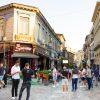
In the heart of Bucharest, at 4 Constantin Mille Street, a single address preserves in the city’s memory stories belonging to radically different eras. More than a century ago, the Modern restaurant operated here, one of the venues frequented by artists, writers, journalists, and intellectuals. Among those who crossed its threshold was Constantin Brâncuși, while the musical world of interwar Bucharest was represented by figures such as Grigoraș Dinicu and George Enescu. After the establishment of the communist regime, the old restaurant disappeared, and the Berlin restaurant was opened in the same space on November 2, 1958. The German-themed establishment became one of the best-known restaurants in socialist Bucharest and was closely connected to relations between Romania and the German Democratic Republic. Radeberger beer, the Bierhalle atmosphere, jazz, and unusual dishes for Bucharest at the time, including turtle soup, all contributed to its reputation. After 1990, the premises underwent further transformations and eventually became home to Control Club, one of the important venues on Bucharest’s alternative music scene. The history of this address thus becomes a genuine chronicle of the changes Bucharest underwent over more than a century.
The Modern restaurant and bohemian Bucharest before the war
The story begins in the period before the First World War, when the Modern restaurant operated on the street that would later bear the name Constantin Mille. According to the book De la Hanul Șerban Vodă la Hotel Intercontinental, written by Ion Paraschiv and Trandafir Iliescu and published in 1979, the establishment opened around 1912–1913.
During the interwar period, Modern established itself as one of the well-known restaurants in central Bucharest. Its location, close to Calea Victoriei and the Sărindar area, where numerous newspaper and magazine offices were located, made it an accessible meeting place for the city’s intellectual and journalistic circles.
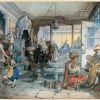
In Bucharest between the two world wars, central restaurants played a role that went far beyond gastronomy. They were meeting places for people working in the press, theater, literature, visual arts, or music. Meals often continued for hours with discussions about cultural, political, and artistic affairs, while some establishments became genuine landmarks of the capital’s bohemian life.
Modern was part of this world. Its clientele included cultural figures, artists, journalists, and members of Bucharest’s bourgeoisie, while the restaurant built its reputation through both its cuisine and its atmosphere.
Constantin Brâncuși’s dinner at Modern
One of the best-known stories associated with the Modern restaurant is the dinner attended by Constantin Brâncuși in 1924. The episode was later recounted by memoirist Vintilă Rusu-Șirianu in his book Vinurile lor and became part of the anecdotal history of Bucharest’s restaurants.
Those present at the table included Brâncuși, Ion Vinea, Nicolae Dărăscu, Camil Ressu, Cezar Petrescu, Păstorel Teodoreanu, and Vintilă Rusu-Șirianu. Păstorel Teodoreanu, who was well known for his interest in gastronomy and wine, is said to have organized the dinner.
The menu consisted of Romanian dishes, including carp in brine, vegetable stew, and grilled pork tenderloin. Brâncuși, known for his straightforward personality, reportedly did not hesitate to express his dissatisfaction with some of the dishes. He was not impressed by the fish, while the vegetable stew was criticized for containing too much carrot and for the way it had been prepared.
The grilled pork tenderloin, however, apparently met with his approval. The episode is significant not so much because of the sculptor’s culinary preferences, but because of the picture it offers of the atmosphere at Modern. The dinner brought together important figures from Romanian literature and the visual arts, while the restaurant became a place where gastronomy and culture naturally intersected.
The account should nevertheless be viewed as a memoir written after the event. It cannot be treated as an exact transcript of the conversations that took place that evening, but it remains a valuable source for understanding the way Modern was remembered in Bucharest’s cultural history.
Grigoraș Dinicu’s music and the connection with George Enescu
Modern was important not only to writers and painters. The restaurant also maintained a strong connection with Bucharest’s interwar musical world.
Grigoraș Dinicu, one of the most celebrated Romanian violinists of the period, performed at Modern. His virtuosity attracted audiences as well as important figures from the musical world. Among those who came to hear him was George Enescu.
Enescu’s presence in this context is one of the stories that contributed to the restaurant’s legend. The great composer and violinist was familiar with Dinicu’s music and appreciated his talent. Modern thus became a meeting point between Bucharest’s restaurant culture and its high-level musical life.
These episodes show that during the interwar period, the restaurant functioned as an informal cultural venue. It was neither a concert hall nor an artistic institution, but it could host musicians and their audiences while writers, journalists, and artists gathered at the surrounding tables.
How the Berlin restaurant appeared
The political changes that followed the Second World War radically altered the fate of Modern. The old interwar world gradually disappeared, and many establishments associated with the bourgeoisie and the cultural elite were transformed or lost their former identity.
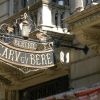
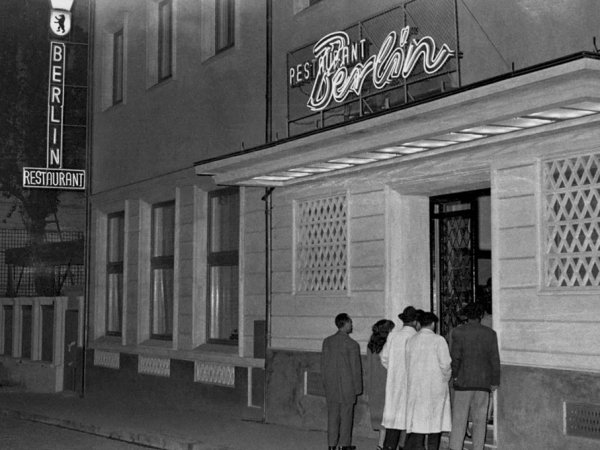
The Berlin restaurant opened in the same building on November 2, 1958. The name was not chosen at random. The establishment had a German theme and was connected to relations between Romania and the German Democratic Republic.
The restaurant operated within an economic and political context in which exchanges between socialist states also had a cultural dimension. The Bucharest Berlin was conceived as a German-themed restaurant, while some of its products and elements of identity were linked to Romania’s relationship with East Germany.
Historical accounts of the establishment mention employees who came from the German Democratic Republic, including chefs and dining-room staff. Imported German products and beverages could be found there, while German beer was one of its main attractions.
For Bucharest residents in the 1960s and 1970s, access to foreign products was limited. In this context, a restaurant where imported beer could be found automatically acquired a special reputation.
Radeberger beer, jazz, and the Bierhalle atmosphere
The Berlin restaurant was known for more than its food. Its atmosphere was one of the key elements of its appeal.
Accounts of the establishment describe a space arranged in the style of a German beer hall, with long wooden tables and an area specifically designed for beer consumption. Radeberger was one of the brands available there, including during periods when such products had become difficult to find elsewhere.
Music was another element that contributed to the restaurant’s appeal. Jazz bands performed at Berlin, and among the musicians associated with the venue was Richard Oschanitzky, one of the important figures in Romanian jazz.
The atmosphere upstairs was different. Cocktails, subdued lighting, and soft background music created a more intimate setting than the dining room downstairs. For some customers of the period, Berlin thus became one of the few places in Bucharest where an imported drink could be combined with a cosmopolitan atmosphere.
The 1974 renovation and the unusual menu
In 1974, the Berlin restaurant underwent extensive renovations. The work lasted approximately one year, and the establishment reopened in 1975 with an image more strongly inspired by German themes and the aesthetics of the German Democratic Republic.
The new interior was accompanied by a varied menu. Customers could order schnitzels, sausages, Berlin-style salad, steaks served with dumplings, and other dishes associated with German cuisine.
The most spectacular item, however, was turtle soup. The menu offered two versions, a regular one and one called “Lady Curzon.” The latter was inspired by a recipe that had become known in British and international cuisine and was associated with the use of sherry.
The presence of turtle soup in a Bucharest restaurant in the 1970s may seem almost unbelievable today. At the time, however, the dish was regarded as a delicacy in certain Western culinary traditions and could be found in high-end restaurants.
The Berlin menu thus illustrated an attempt to create a dining experience different from that offered by the ordinary restaurants of socialist Bucharest.
From a communist-era restaurant to Control Club
After 1989, the Berlin restaurant ceased to exist, and the premises underwent further changes. The building nevertheless remained part of Bucharest’s cultural center, even though both its public and its function changed radically.
In the 2000s, Control Club emerged as a new presence at the address, becoming a venue dedicated to concerts, alternative music, electronic music, and nightlife. The club became one of the best-known locations on Bucharest’s independent music scene, while its new identity was very different from that of the restaurants that had previously operated in the same place.
The transformation did not, however, completely erase the building’s past. Some architectural and decorative elements from the former Berlin restaurant were preserved or incorporated into the contemporary design. As a result, the building still offers those interested in Bucharest’s history clues about its earlier uses.
One address containing a century of Bucharest history
4 Constantin Mille Street is a rare example of urban continuity in which the same address has been associated with three profoundly different cultural eras.
Modern belonged to interwar Bucharest, a city in which central restaurants served as meeting places for writers, artists, and musicians. Brâncuși dined here with important figures from Romanian culture, while the music of Grigoraș Dinicu attracted the attention of George Enescu.
Berlin later represented socialist Bucharest and its relationship with the German Democratic Republic. Radeberger beer, the Bierhalle-style dining room, jazz, cocktails, and the turtle soup menu created a distinctive gastronomic and cultural identity.
Today, Control Club belongs to a different generation and represents a different form of cultural consumption. Concerts and music events have replaced the restaurant tables, but the venue’s role as a place where people gather around music and entertainment has, in a sense, remained unchanged.
The story of this address demonstrates that Bucharest’s history is not found only in palaces, churches, or monuments. Sometimes it survives in seemingly ordinary urban spaces where functions change, generations succeed one another, and each era leaves behind its own tastes, sounds, and memories. From Brâncuși and Enescu to Radeberger beer and finally Control Club, 4 Constantin Mille Street remains one of the addresses that brings together, in a single location, several chapters of Bucharest’s cultural and urban history.
We also recommend: Symbols of Bucharest: The Golden Apple, from the house of Princess Elisabeth of Romania and the Journalists’ Union to the legendary venue that burned down twice