Symbols of Bucharest: The Golden Apple, from the house of Princess Elisabeth of Romania and the Journalists’ Union to the legendary venue that burned down twice
By Bucharest Team
- Articles
- 22 JUN 26
Few places in Bucharest have managed to gather around them as many stories, memories, and controversies as the former Golden Apple restaurant, located at 163 Calea Victoriei. For entire generations of Bucharest residents, the name “Golden Apple” meant more than a simple restaurant. It was a place of meetings, festive meals, evenings with music, and conversations held away from curious eyes, in a special atmosphere that was part of the charm of the Capital.
A famous address of old Bucharest
However, the history of this place is much older than the period during which it operated as a restaurant. Behind the name “Golden Apple” there is, in fact, a building of outstanding historical value, erected during the interwar period and connected to important names in the history of the Romanian royal family.
Today, although the venue no longer exists and the building has gone through years of degradation and fires that destroyed a large part of the historical monument, Golden Apple continues to remain in the collective memory of the people of Bucharest as one of the symbols of a vanished era.
The house that later became the Golden Apple restaurant
The building at 163 Calea Victoriei was built in 1925 for Marie Angèle Polizu-Micșunești, a member of a well-known family of the Romanian aristocracy. The building stood out through its elegance and its location in one of the most prestigious areas of Bucharest, Calea Victoriei being, since the 19th century, the preferred boulevard of the political, economic, and cultural elites.
An important moment in the history of the building came in 1927, when the property was purchased by Princess Elisabeth of Romania, the daughter of King Ferdinand I and Queen Marie, who had meanwhile also become Queen of Greece. After the acquisition, the building was modified and extended according to the project of architect George Matei Cantacuzino, one of the most important personalities of Romanian architecture of the 20th century.
This period represented one of the most elegant stages in the existence of the building. The House of Princess Elisabeth was a representative space for the Bucharest aristocracy of the interwar period, a place that reflected the refinement of a society undergoing full cultural and economic development.
The transformations that the building was to go through in the following decades were, however, going to radically change its destination and image.
From an aristocratic residence to the headquarters of important institutions
After the period in which it belonged to Princess Elisabeth, the building changed its role in the life of the Capital several times. In the following years, the building hosted the Great Industry Club, an organization that brought together representatives of Romania’s great entrepreneurs and businessmen of that period.
The choice of such a building for such a club was not accidental: its positioning on Calea Victoriei and its imposing architecture offered the prestige necessary for an institution frequented by the economic elites of the time.
After the establishment of the communist regime and the social changes that took place after the Second World War, the destination of the building changed once again. Beginning with the 1950s, it housed for many decades the Journalists’ Union, an institution that transformed the former aristocratic palace into a meeting space for journalists and representatives of the cultural and public life.
Thus, even before becoming a restaurant, the building already had a rich history and a special status in the landscape of Bucharest.
The appearance of the Golden Apple restaurant and its years of glory
After the political and economic changes following the year 1989, the building entered a new stage of its existence. For a period, the building hosted the Millionaires’ Club, a symbol of the transition period and of the new business world that appeared in Romania during the 1990s.
Later, the space was transformed into the Golden Apple restaurant, a venue that quickly became well known in Bucharest. The restaurant was appreciated for its Romanian specificity, for its atmosphere inspired by old traditions, and for the fact that it offered a different setting compared with many other modern restaurants that appeared in the Capital.
Golden Apple became a meeting point for businessmen, public figures, artists, and Bucharest residents who appreciated a venue with personality. Numerous stories were built around it, and for many loyal customers, the restaurant represented a part of the bohemian Bucharest of former times.
According to information published in the press, the current politician Cristian Popescu Piedone began his professional career working at Golden Apple, which contributed even more to the notoriety of this venue.
Despite its popularity, the transformation of the historical building to adapt it for its function as a restaurant was viewed critically by some specialists and observers of architectural heritage, who considered that the changes made affected the original character of the building.
The attempt at rebirth and the reopening in 2018
After a period of decline, the name Golden Apple attempted to return to the Bucharest gastronomic landscape. On December 6, 2018, the restaurant was reopened in a format that aimed to recover the atmosphere of former times.
The administrators at that time presented the project as a bringing back to life of a place loaded with history. The building, erected in 1925, was highlighted through a restored decoration, antique-looking furniture, decorative heritage objects, traditional Romanian dishes, and live music evenings.
The reopening attracted former customers of the venue, personalities from the artistic world, and people who had an emotional connection with this space. For a short time, Golden Apple seemed able to regain its place among the traditional restaurants of Bucharest.
Abandonment, degradation, and the fires that destroyed the monument
Unfortunately, the story of the rebirth was short-lived. In the years that followed, the restaurant ceased its activity, and the building was abandoned. Without maintenance and conservation works, the former venue began to deteriorate rapidly.
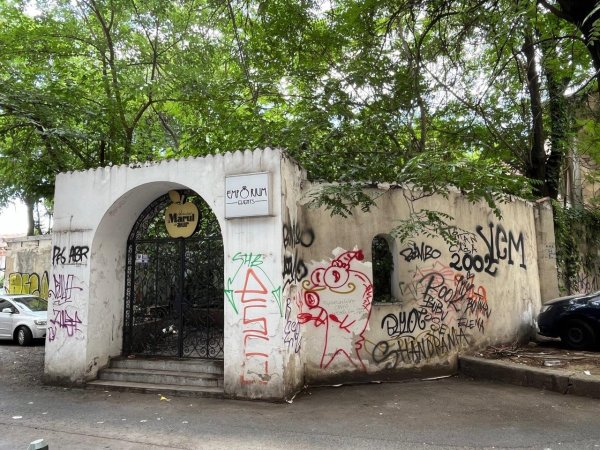
The images that appeared in recent years show an abandoned space, in an advanced state of degradation, accessible through a passage from Calea Victoriei, which strongly contrasts with the elegance and prestige that it had once possessed. In 2024, observers of Bucharest’s heritage and gastronomic history described the place as a ruin of a disappeared era.
The situation became dramatic after the fires that affected the building. A powerful fire destroyed a large part of the building, and in August 2025 a new fire broke out at the former Golden Apple restaurant, causing the intervention of firefighters and the issuance of a RO-ALERT message for the population in the area. Following the successive destruction, only certain structural elements of the historical monument remained, such as the columns at the main entrance.
The gradual disappearance of this building became, for many, an example of the fragility of Bucharest’s architectural heritage and of the difficulties encountered in protecting historical buildings that are privately owned or in complicated legal situations.
The legacy of a venue that marked the history of Bucharest
The story of Golden Apple is, essentially, the story of Bucharest itself: a city in which buildings change their roles along with the eras and in which places filled with memory can pass from brilliance to abandonment within a relatively short period.
From the aristocratic residence of Princess Elisabeth, to the headquarters of the Great Industry Club and the Journalists’ Union, then to the Millionaires’ Club and to one of the most well-known restaurants of the Capital, the building at 163 Calea Victoriei reflected almost a century of social, political, and cultural transformations.
Even though the Golden Apple restaurant no longer exists today, its name remains associated with a period when Bucharest had venues with personality, where gastronomy intertwined with history, conversation, and social life. In the memory of many Bucharest residents, Golden Apple continues to exist not as a ruin on Calea Victoriei, but as a symbol of an elegant, cosmopolitan, and story-filled Bucharest.
We also recommend: „The Red Snake”, between Glory and Ruin: How the Favorite Tavern of 20th-Century Bucharest’s Great Artists Met Its End