The “Female Pickpockets” of Interwar Bucharest: Who Were the Three Women Who Terrorized the Capital 100 Years Ago?
- Articles
- 19 NOV 26
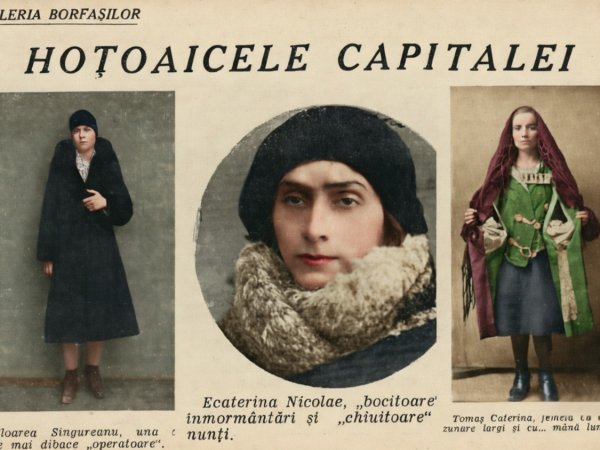
In Bucharest in 1932, crowds in markets, shops, trams, and other places where large numbers of people gathered provided ideal opportunities for pickpockets. Among them were women who had turned theft into a profession. Some worked in teams, while others relied on disguises or deliberately created confusion around their victims. A report published by W. Șerban in the magazine Ilustrațiunea Română in November 1932 attempted to penetrate this little-known world. The journalist followed the trail of several women who were known to the police and who had repeatedly been sent to Văcărești Prison. Among the characters he presented were Floarea Singureanu, who was also known under other names, and Ecaterina Nicolae, a thief who specialized in stealing at weddings and funerals.
Floarea Singureanu, the thief who operated in shops
The first of the women followed by W. Șerban was Floarea Singureanu, whom the article says was also known as Marica Ionescu and Elena Stamate. The reporter used an unusual method to obtain an apparently candid conversation: he presented himself as a former “colleague” from Văcărești Prison, hoping in this way to gain her trust.
The resulting portrait is that of a woman who had allegedly turned shoplifting into a carefully organized activity. According to the account published in Ilustrațiunea Română, one of her most important jobs involved the theft of more than 20 meters of silk. The scheme involved at least three people and relied on distracting the shop assistant.
Floarea allegedly entered a shop together with Ștefana Dumitrescu. The two behaved like undecided customers, asking the shop assistant to bring out numerous pieces of fabric so they could examine them. While his attention was focused on the merchandise, Floarea supposedly hid the silk beneath a loose coat, which the reporter described as a cape-like garment.
She then allegedly went outside near the shop window and handed the stolen fabric to a third accomplice, who quickly disappeared. According to the article, the stolen material was sold for 7,000 lei, a significant amount of money at the time. However, the episode is known today only from the 1932 journalistic account, and the exact value of the money and the circumstances of the theft cannot be independently verified through currently accessible sources.
What impressed the reporter was not only the story of the theft, but also his impression that prison had not fundamentally changed the woman’s behavior. During their conversation, Floarea reportedly told him that she was keeping house. Nevertheless, the journalist observed that she watched him carefully and suggested that she might return to her old “profession.”
W. Șerban’s description should be approached with caution. He creates a powerful psychological portrait influenced by the criminological ideas popular in the interwar press. He portrays Floarea as a criminal for whom stealing had almost become a reflex. Today, however, such descriptions cannot be regarded as psychological or criminological assessments in the modern sense, but rather as the observations of a journalist writing in the 1930s.
Ecaterina Nicolae, the thief who infiltrated weddings and funerals
The second woman presented in the report was Ecaterina Nicolae, whose method of operation was entirely different. While Floarea Singureanu was associated with shoplifting, Ecaterina allegedly preferred places where large numbers of people gathered and where emotion or confusion made it easier to approach potential victims.
According to the account published in 1932, she would infiltrate funerals and behave as though she were a relative or acquaintance of the deceased. When approaching the coffin, she allegedly played the role of a grieving woman, and the reporter claimed that this appearance allowed her to move among the mourners without arousing suspicion.
When the crowd became larger, the woman would allegedly identify a victim and take advantage of the confusion to steal their belongings. She would then disappear before the victim realized what had happened.
At weddings, her strategy was the opposite. According to the article, Ecaterina became a cheerful and sociable woman. She mingled with the guests, joined in the celebrations, and approached people without appearing suspicious. This change in behavior allegedly allowed her to select her victims.
W. Șerban again used a fabricated identity to meet her. He arrived at her home under the pretext that he was looking for a seamstress who supposedly lived in the attic. The meeting quickly became tense when the reporter suggested that he knew her from a funeral in the Dealul Spirii area.
The woman allegedly became immediately cautious, suspecting that her visitor might have connections to the prison world or the police. Eventually, however, the conversation supposedly turned into a genuine “confession.”
The most spectacular episode Ecaterina reportedly told him about concerned a theft committed at a funeral. According to her account, she had taken not only the money intended for the priest and gravedigger, but even the ring from the deceased person’s hand. This is one of the most unusual claims in the report and should be treated strictly as a statement attributed to the woman by the journalist, rather than as a fact independently confirmed by a surviving court file.
At the end of their meeting, Ecaterina allegedly insisted that she had become a “respectable woman” and no longer practiced theft. The reporter, however, remained skeptical, concluding his account with the popular saying that a person may change their appearance, but not their habits.
Văcărești, the place where their paths crossed
A common element in these stories is Văcărești Prison. For Bucharest’s interwar criminal underworld, the penitentiary had become one of the places where people convicted of theft and other offenses were sent. In the report, the experience of Văcărești itself becomes a means of recognition between the characters.
The reporter builds his entire investigation around the idea that these women were familiar “customers” of the police and had passed repeatedly through the prison system. In Floarea Singureanu’s case, the supposed shared experience at Văcărești is precisely what enables the journalist to obtain information about her past.
Văcărești, however, had a much longer history than its role as a prison. The former monastery, founded at the beginning of the 18th century by Prince Nicolae Mavrocordat, was converted into a state prison in the 19th century. In the decades that followed, the name Văcărești became associated with political prisoners and intellectuals, as well as ordinary criminals.
For the women described by W. Șerban, Văcărești represented, in the journalist’s narrative, not merely a place of imprisonment but almost a space of belonging. The reporter takes advantage of this familiarity in order to enter a world that would have been difficult for an ordinary observer to access.
Crowded Bucharest and the world of pickpockets
The story of these women also reveals a Bucharest very different from the city known today. The interwar capital was a rapidly developing city, with shops, markets, crowded public transportation, restaurants, cinemas, fairs, and numerous public events. All these places provided opportunities for theft.
Pickpockets primarily relied on people’s lack of attention. A commotion created inside a shop, a funeral, a wedding, or any other gathering where participants were focused on an event could create ideal conditions for a quick theft.
In the case of the women described by W. Șerban, what stands out is their alleged use of social roles. Floarea entered a shop appearing to be an ordinary customer, while Ecaterina could present herself as a grieving woman or, conversely, as a cheerful participant at a wedding. Deception was, according to the reporter, just as important as manual dexterity.
At the same time, the article reflects the interwar press’s taste for colorful characters and sensational stories. Terms such as “operator,” physical descriptions, and the emphasis placed on the women’s “private lives” transform the report into a mixture of journalistic investigation and crime literature.
What remains of the “female pickpockets” story nearly a century later
Nearly a century later, Floarea Singureanu and Ecaterina Nicolae do not appear as figures whose biographies have been extensively documented in the general historiography of Bucharest. They have survived mainly through W. Șerban’s report published in Ilustrațiunea Română in November 1932 and through later reproductions and references to that article.
This is precisely why their story is valuable primarily as a document of everyday life and of the way the interwar press portrayed urban crime. The report shows how a particular category of petty crime operated and how inventive thieves could be in exploiting crowds and appearances.
Floarea Singureanu remains in the article’s memory as the woman associated with shop thefts, allegedly capable of concealing large quantities of fabric and working together with accomplices. Ecaterina Nicolae appears as the “female pickpocket” who turned weddings and funerals into places of operation. Ștefana Dumitrescu is mentioned as an accomplice in one of the thefts attributed to Floarea.
Beyond the sensational elements of the stories, the report offers a rare glimpse into Bucharest nearly 100 years ago: a crowded city in which shops and social gatherings could become scenes of petty crime, while the police maintained their own lists of familiar offenders. The story of the “female pickpockets” therefore remains both a curiosity of interwar Bucharest and an example of how carefully press sources must be read when reconstructing the past nearly a century later.
We also recommend: Symbols of Bucharest: From Modern to Berlin and Control Club, the history of the venue frequented by Enescu and Brâncuși