What Bucharest residents read on trams and at home in the first half of the 20th century
By Eddie Țone
- Articles
- 16 NOV 26
A Bucharest morning in the 1930s might begin with a newspaper bought on the way to work and end with a novel read at home by lamplight. Between those two moments lay an entire world of information. A minister caught up in a scandal, an actress photographed in a provocative dress, the latest sports results, or the next instalment of a novel that had begun a week earlier. Curious Bucharest residents had plenty to choose from, and the city's printing presses worked with an enthusiasm that only those responsible for meeting newspaper deadlines regarded with a certain amount of concern.
Newspapers were read on trams, browsed in cafés, and discussed in offices. Illustrated magazines found their way onto living room tables, while inexpensive books allowed office clerks to enjoy European literature without sacrificing too much of their salaries. In Bucharest homes, reading also had a social dimension. A magazine might pass from parents to children, while a political article could spark a discussion that continued the following day, sometimes with even more arguments and even less chance of agreement.
By the late 19th century and throughout the interwar period, Bucharest had already developed a diverse publishing market. Major daily newspapers competed for readers, humour magazines mocked politicians, and society publications featured the celebrities of the day. Together, they formed a map of the city's tastes, from its passion for literature to the very human fascination with other people's lives.
A Bucharest where reading the newspaper had become a daily habit
By the end of the 19th century, Bucharest's press had reached an impressive scale for its time. According to the Romanian Academy Library, approximately 40 publications appeared in the capital, including 20 daily newspapers. The city therefore offered enough information for two neighbours to read different papers and reach completely opposite conclusions about the same parliamentary session.
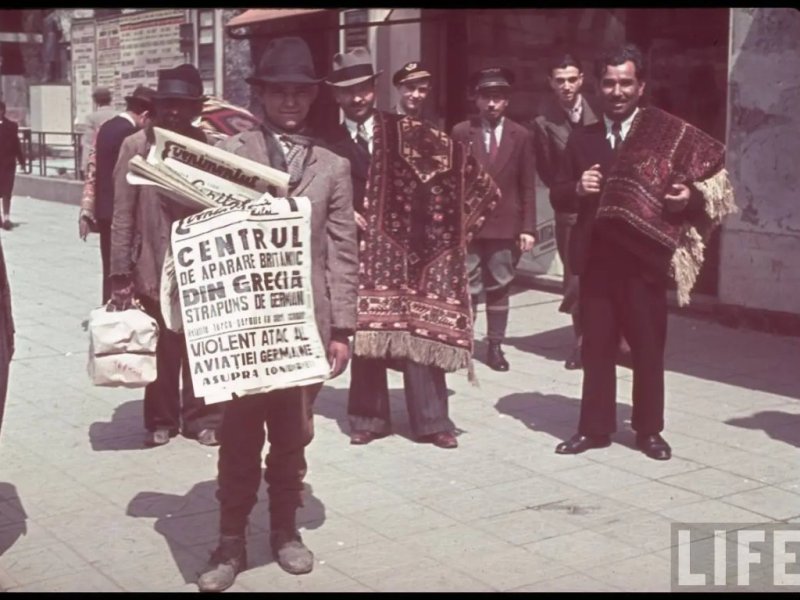 Newspaper salesman in interwar Bucharest / Photo: LIFE
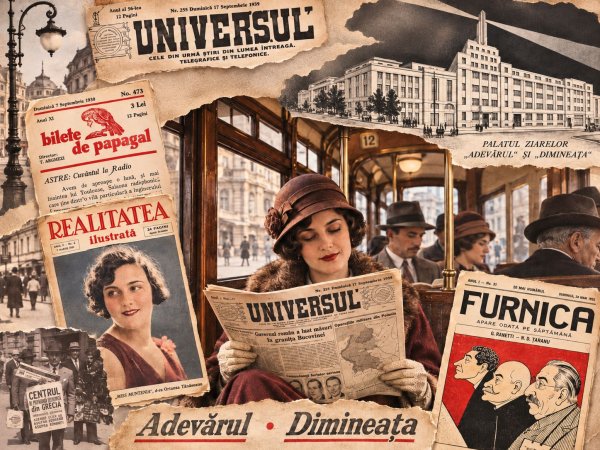
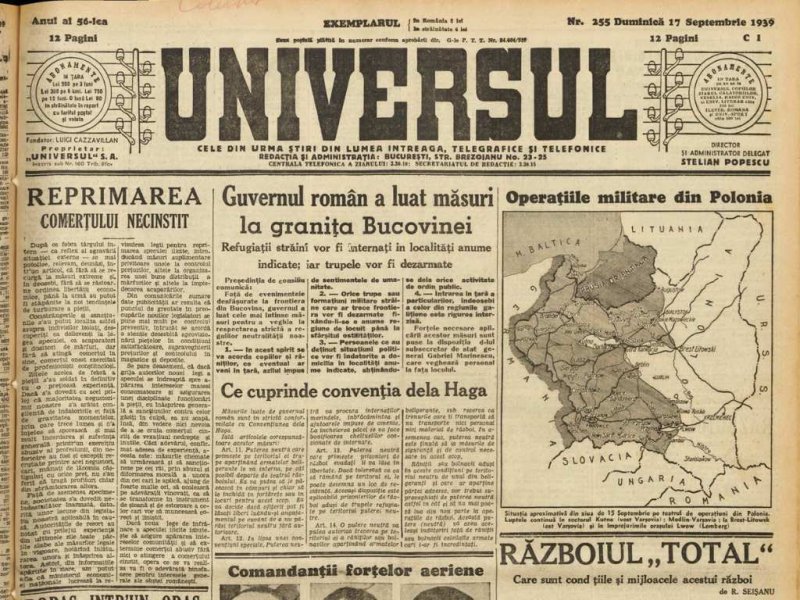
One of the dominant titles was Universul, founded in 1884 by Italian journalist Luigi Cazzavillan. The newspaper quickly gained readers through its coverage of current affairs, international news, and everyday events.
From the beginning, Universul had a structure that would seem remarkably familiar today. Its pages contained news received by telegraph, reports from the capital, and coverage of court proceedings. There was even a section dedicated to the Bucharest Stock Exchange. Readers could move from an international event to local administrative problems with just a few shifts of their gaze.
A study published in the journal București – Materiale de Istorie și Muzeografie shows that the first issue also included a section entitled "Romanul foileton" (The Serialised Novel), evidence that literature had found its place in newspapers from the earliest years of Bucharest's modern press.
According to the Romanian Academy Library, Universul would eventually reach a daily circulation of approximately 80,000 copies. Its success was also fuelled by the supplements Universul literar and Universul ilustrat, which attracted readers interested in subjects beyond the politics of the day.
Another major competitor was Adevărul, which began publication in Bucharest in 1888. Under Constantin Mille's leadership, the newspaper established itself through its democratic orientation and interest in social issues. In 1904, Mille also launched Dimineața, initially as a morning edition associated with Adevărul.
The names were well chosen. In the morning, Bucharest residents could pick up a newspaper called Dimineața (The Morning). And those with sufficient faith in the press could also buy Adevărul (The Truth).
Beyond the inevitable joke, competition between publications encouraged the development of news journalism, and Bucharest residents became the audience of an industry fighting for their attention every single day.
Sărindar Street, where the news was made
A significant part of Bucharest's newspaper industry was concentrated on Sărindar Street, now Constantin Mille Street, near Calea Victoriei.
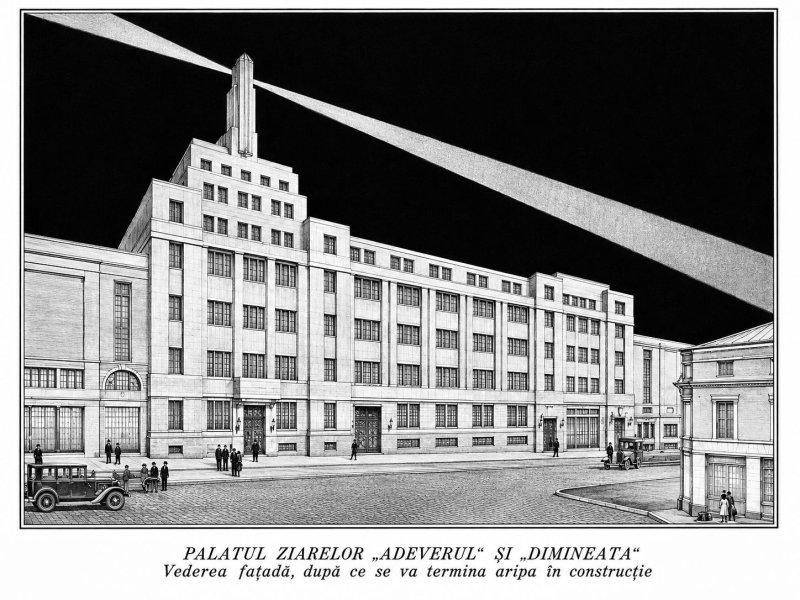 Adevărul Palace
This was the location of Palatul Adevărul (The Adevărul Palace), inaugurated in 1898 and since demolished, where editorial offices and printing facilities occupied a central place in the city's activities. As the publications expanded, Constantin Mille enlarged the property, purchasing premises that had previously belonged to a neighbouring sack factory.
Linotype machines were installed in the new complex, allowing text to be typeset mechanically for printing. This represented considerable progress compared with the painstaking work of typesetters who arranged individual metal letters by hand.
Sărindar Street thus became one of the centres of Bucharest's publishing industry. Important publications had their headquarters in the area, and the proximity of their editorial offices brought together journalists, printers, and administrative staff.
News travelled from here across the city in the form of freshly printed pages. Readers encountered them at newspaper stands, in public establishments, or through subscriptions. Distribution was an essential part of the business. An excellent piece of information published in a newspaper that reached its readers too late lost much of its value. For daily newspapers, time had become a commodity just as important as paper.
Interestingly, the entire publishing enterprise behind Adevărul and Dimineața also had a turbulent political history. In December 1937, Octavian Goga's government banned both newspapers as part of its authoritarian and antisemitic policies.
For Bucharest residents, their disappearance meant a sudden transformation of the city's information landscape. A newspaper that had been part of daily life for decades vanished from the market through a political decision.
What people read on the tram
Tram travel offered readers a particular opportunity. The time spent between two stops could be used to read an article or leaf through a small publication.
There is, however, a difference between what a tram journey made possible and what can actually be demonstrated about passengers' reading habits. Newspaper archives provide extensive documentation of the publications available at the time, while the precise preferences of readers travelling on Bucharest's trams are much harder to reconstruct.
The physical format of printed publications nevertheless offers a few clues. A large daily newspaper could be awkward to handle in a crowded vehicle. Booklets, small literary publications, and compact magazines, on the other hand, were easier to carry.
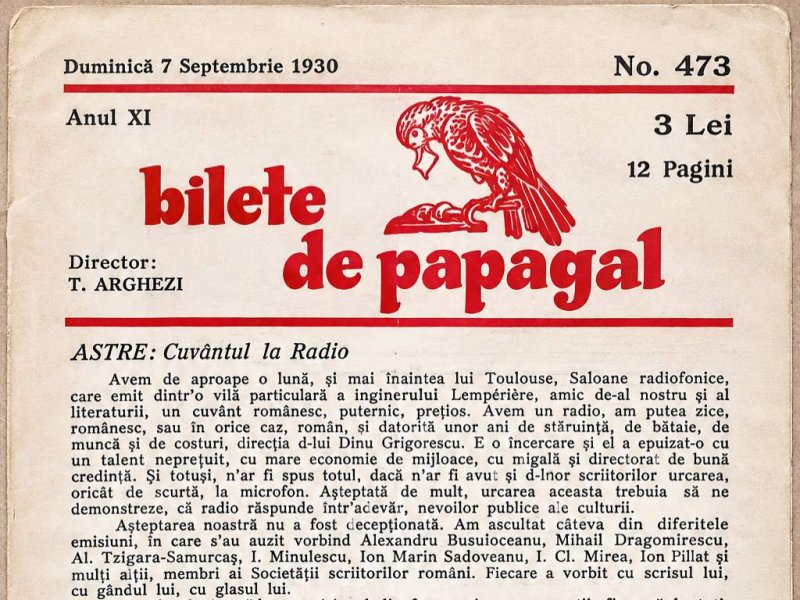
A particularly delightful example is Bilete de papagal, the publication launched by Tudor Arghezi on 2 February 1928. The newspaper had just four pages, each measuring approximately 32 by 12 centimetres, an unusually narrow format suited to short texts and quick reading.
Arghezi conceived the publication as a space open both to established writers and to those just beginning their careers. He wrote the first two issues entirely himself.
Its small dimensions were an unusual editorial feature, while the title itself carried something of the playful spirit of literary Bucharest.
An issue of Bilete de papagal could easily be read during a short journey. It was, essentially, a little dose of literature that fitted into a coat pocket.
Serialised novels and the pleasure of waiting for the next instalment
For readers in the early 20th century, the serialised novel offered a distinctive experience. The story appeared in instalments, usually in the pages of a newspaper, and its continuation depended on the publication of the next issue.
The practice originated in the European press of the 19th century, where novels published in episodes had become a means of building reader loyalty. In Romania, the model was adopted by newspapers seeking to combine daily news with literary entertainment.
Universul had a section dedicated to serialised fiction as early as 1884. For readers, the advantage was obvious: they bought the newspaper for the day's news and received another instalment of a story along with it. For publishers, the advantage was even clearer. A story interrupted at a tense moment gave readers an additional reason to buy the next issue.
Popular literature also circulated independently, through inexpensive books and booklets. Adventure novels, sentimental stories, and translations of foreign authors attracted audiences looking for accessible fiction. Readers could also discover classic literature through the publishing collections that were developing during the same period.
Biblioteca pentru toți, the collection that made literature affordable
In 1895, Bucharest bookseller Carol Müller and writer Dumitru Stăncescu launched Biblioteca pentru toți (Library for Everyone), one of the most significant publishing initiatives in Romania. The first volume contained stories by Hans Christian Andersen, translated by Stăncescu. It cost just 30 bani.
For comparison, a newspaper at the time cost between 5 and 15 bani, according to a history of the collection presented by Radio România and cultural publications dedicated to the subject.
Müller had been inspired by the model of German popular book collections, particularly the famous Universal-Bibliothek published by Reclam. The idea was simple and highly effective: valuable literature could reach a large audience through affordable volumes printed in substantial quantities.
During the collection's early years, some volumes appeared in print runs of 7,000–10,000 copies, remarkable figures for the Romanian market at the time. In 1899, the project was taken over by publisher Leon Alcalay, who ensured its continuation. By 1918, the collection had reached its 1,000th volume, and by 1934 it had exceeded 1,300 titles.
The books covered a wide variety of subjects. Romanian literature held an important place, but readers could also find foreign authors, popular science works, and travel books.
An interesting detail concerns the very place where the initiative began. Carol Müller's bookshop, located on Calea Victoriei, had become a meeting place for literary figures, and the discussions held there helped shape the publishing project.
Bucharest therefore had a direct connection with one of Romania's longest-running book collections. Biblioteca pentru toți made it possible to gradually build a personal library, and a volume purchased every now and then could turn an ordinary bookshelf into a small European library.
Society magazines and the fascinating pastime of following celebrities
During the interwar period, illustrated publications experienced remarkable growth. Photography had become a major component of the press, and readers wanted to see the people they read about.
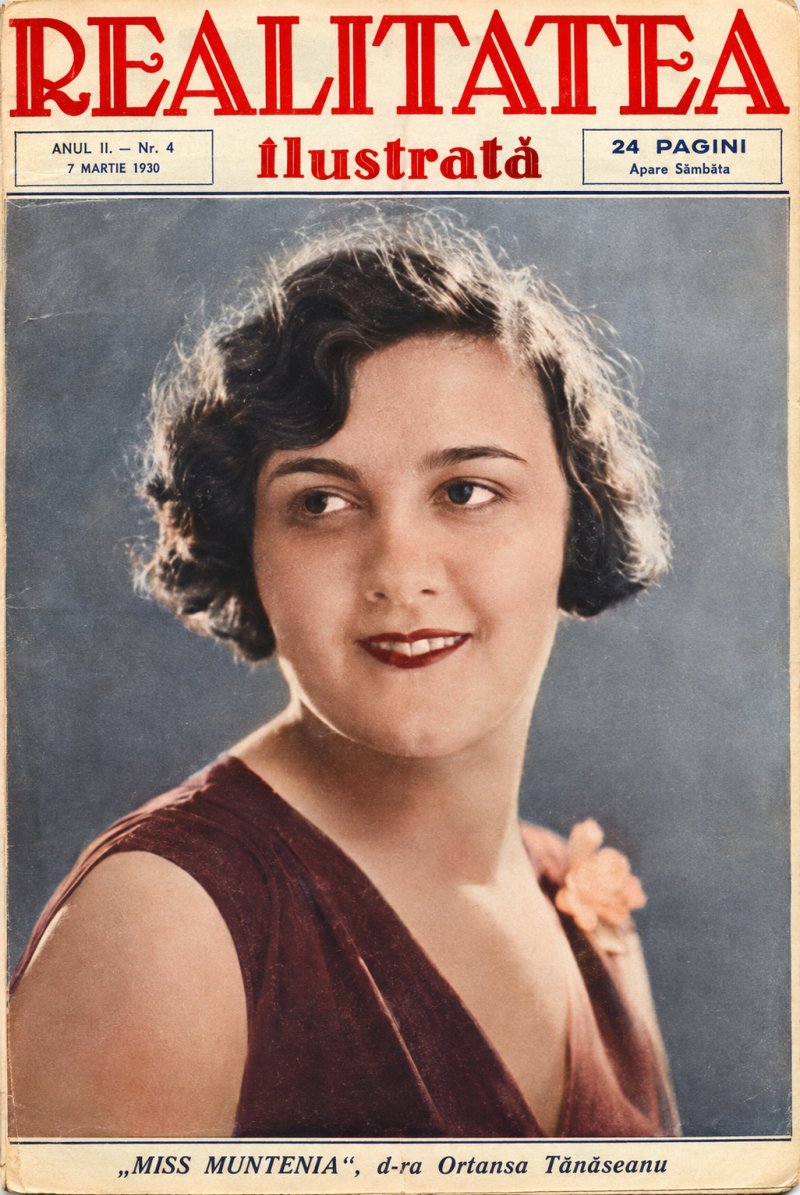
One of the best-known magazines was Realitatea ilustrată, launched in Cluj in 1927 and relocated to Bucharest in 1928 under the umbrella of the Adevărul publishing group.
The magazine combined current affairs with general-interest features, photographic reports, and society news. Its pages featured personalities from the arts and images of the period's social life. One example documented by the George Enescu Foundation is the way the great composer appeared in the publication, in a context that allowed readers to discover aspects of his personality beyond his musical career.
For Bucharest audiences, illustrated magazines opened a window onto the world of cinema and the lives of famous personalities. The cover had become extremely important, and an attractive photograph could persuade someone to buy a magazine before even discovering which articles it contained.
Another publication belonging to the same editorial category was Ilustrațiunea Română, which offered readers photographic reports and coverage of current events. An issue dated 10 February 1932, for example, featured the portrait of a blonde woman on its cover and carried a price of 10 lei, a detail illustrating just how important imagery had become in the strategy of illustrated magazines.
Society magazines catered to readers interested in cinema and contemporary celebrities, at a time when visual culture was beginning to occupy an increasingly prominent place in everyday life.
Bucharest residents could discover what was happening in their own capital, but also which subjects were attracting attention among Western audiences. Hollywood was beginning to enter Romanian living rooms through the printed page.
Fashion magazines and the concerns of urban households
A separate category consisted of magazines dedicated to fashion and domestic life. The collections of the Romanian Academy Library preserve titles such as Moda și Casa, Moda nouă ilustrată, and Moda șic Ilustrată, publications that demonstrate the existence of a publishing market interested in clothing and family life.
There were many female readers interested in fashion trends, and these magazines introduced them to the styles of the period. Illustrations made it possible to study cuts and garment details at a time when clothes made by dressmakers or at home were still very common.
Western fashion exerted a strong influence on Romanian urban society, and specialist publications helped spread new styles. A dress seen in a magazine could become the starting point for a visit to a dressmaker. The result depended on her skill, the materials available, and, naturally, the budget.
Specialist magazines also offered a practical advantage. Unlike daily newspapers, which quickly became outdated, they could be kept and consulted later. In a household, older issues could remain useful for the patterns they featured or for articles containing practical information.
Furnica, the magazine that stung politicians
Humour had an established place in the Bucharest press, and one of its best-known satirical publications was Furnica (The Ant), founded in 1904 by George Ranetti and N. D. Țăranu. The magazine published epigrams and satirical articles, frequently accompanied by caricatures. Politicians and members of the social elite were favourite targets, while the editors approached the customs of the time with considerable irony.
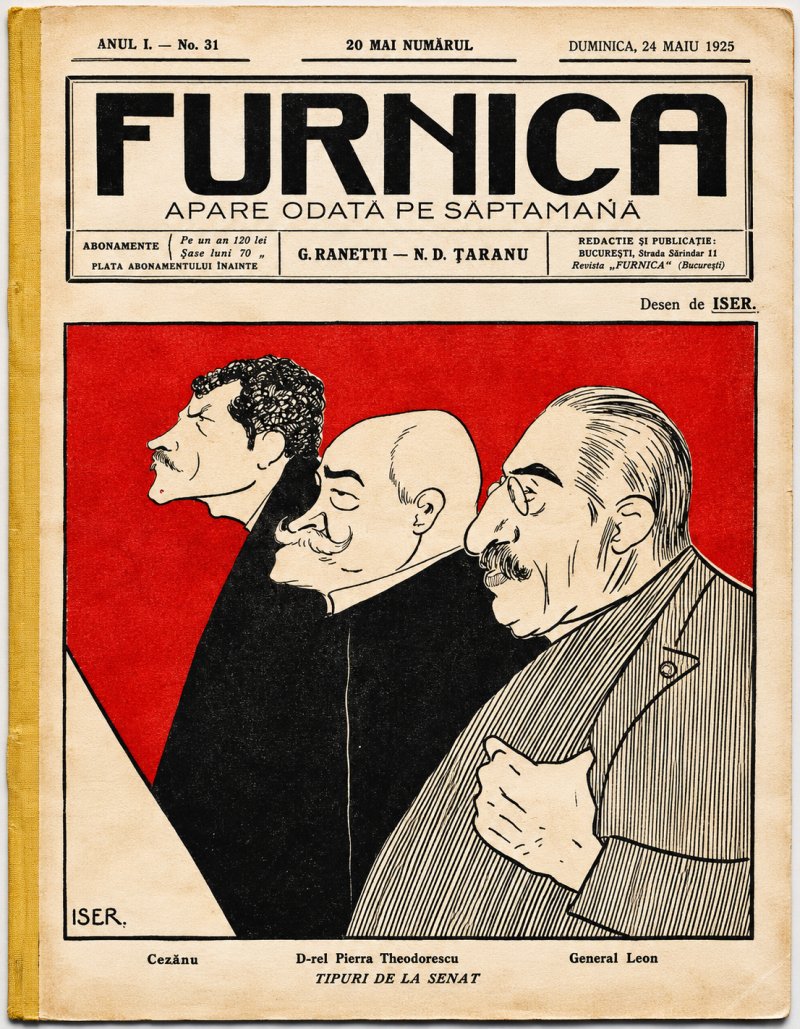
In the first years following the First World War, Furnica mocked inflation and profiteering, corruption among public officials, and the behaviour of politicians. A study by researcher Corina Hațegan/Mașca, published in 2019 under the auspices of an institute of the Romanian Academy, examines how the magazine reflected the social problems of 1919–1920.
The drawings themselves were particularly important. Among the caricaturists who contributed to Furnica were Ary Murnu and Francisc Șirato, artists whose work added a visual dimension to political commentary. And the magazine's editors occasionally came up with initiatives that deserved to become newspaper stories in their own right.
During its first year of publication, Ranetti and Țăranu opened an establishment in Cișmigiu called Cârciuma Furnica (The Ant Tavern). At the opening, customers were treated to free food and drinks, and the owners declared themselves bankrupt by the end of the day. The story, recorded in the magazine's history, says quite a lot about the spirit of the two journalists.
Almanacs, reading material that stayed in the home
Alongside daily newspapers and magazines, the Romanian publishing industry also produced almanacs, publications designed to remain useful for longer periods. An almanac could bring together informative articles and literary texts in a single volume intended to be kept and consulted over time.
One concrete example is Almanahul presei române (The Romanian Press Almanac), whose 1926 and 1928 editions are preserved in the digital collections of the Central University Library in Cluj-Napoca. An almanac was consumed at a different pace from a newspaper. A daily paper reported recent events, while an annual volume could be picked up and read repeatedly.
In homes where publications were kept, almanacs found their place alongside books, sometimes becoming sources of information for family members or simply something to browse. They also reflected publishers' interest in printed products that would remain relevant beyond the day of purchase. Almanacs thus complemented Bucharest's publishing market, occupying a space somewhere between books and magazines, in a format particularly suited to reading at home.
Caragiale, Arghezi, and the writers who entered the pages of newspapers
Bucharest's press had close ties with literature, and some of Romania's most important writers worked in editorial offices or published in periodicals. Ion Luca Caragiale was involved in humorous press projects, including Moftul Român, the publication now associated with his satire of society.
Caragiale had a keen eye for the literary material generated by Bucharest's public life. Political speeches, the behaviour of minor officials, and conversations in urban settings provided an endless source of inspiration.
Tudor Arghezi took a different approach with Bilete de papagal, cultivating short pieces and rapid literary commentary. His publication also had an unusual production arrangement. The first issues were printed in a workshop set up in the courtyard of his home, on the site where the Tudor Arghezi Memorial House stands today.
The newspaper ended its first series in August 1929, after 460 issues, and was briefly revived in 1930.
Writers appeared in newspaper pages, commented on current affairs, and participated in public debate, while readers could follow their work weekly or even daily, long before their next book appeared.
Libraries and reading beyond the home
The circulation of books throughout Bucharest was also supported by libraries, institutions that provided access to volumes beyond the purchasing power of individual readers. An important landmark was the Carol I University Foundation Library, inaugurated in 1895 on the site of today's Central University Library in Revolution Square.
The institution became a space dedicated to study at a time when the development of higher education and Bucharest's cultural life was increasing demand for books. Reading in a library, however, was quite different from reading on a tram or in a café. Visitors came looking for a particular volume or to conduct research, and they had access to an organised environment designed for study.
Bookshops also played a cultural role. The example of Carol Müller's bookshop on Calea Victoriei shows how such a place could become a meeting point for writers and publishers. Meanwhile, inexpensive books contributed to the development of private libraries. A purchased book could be kept for many years, given as a gift, or lent to acquaintances.
What reading habits reveal about Bucharest residents of the past
The diversity of publications shows that interwar Bucharest had readers with very different interests. Someone interested in politics could buy a daily newspaper with a particular editorial stance. Theatre enthusiasts had Rampa, a publication launched in 1911 and dedicated to artistic and cultural life. Those interested in literature could follow specialist magazines or collections of inexpensive books.
The satirical press attracted readers eager to recognise the personalities of the day in caricatures, while illustrated magazines brought familiar faces from cinema and the arts into people's homes.
The publishing market reflected differences in education and income among the city's inhabitants. Access to reading depended on literacy, the price of publications, and the amount of free time available. The Bucharest of passionate readers coexisted with a city in which part of the population had far fewer opportunities to buy books or newspapers.
Nevertheless, the scale of the publishing market demonstrates that the press had become a substantial economic activity, while interest in reading was strong enough to support publications with significant circulation figures.
Perhaps the most interesting detail is how books and newspapers found their place in the city's daily routines. A newspaper bought in the morning could fuel discussions at work. A caricature in Furnica might provoke laughter in a café. An issue of Realitatea ilustrată could remain on the living room table, within reach of the entire family.
And somewhere, in a Bucharest home, a reader who had reached the end of an instalment of a serialised novel had to wait for the next issue of the newspaper. A form of literary impatience that technology has considerably changed, but one that readers today would still recognise immediately.
You may also like: How Bucharest's First Newspaper Kiosks Came to Be. The story starts at the entrance to Cișmigiu Park