Did you know... the Palace of Parliament in Bucharest is the second-largest administrative building in the world?
By Bucharest Team
- Articles
- 11 NOV 26
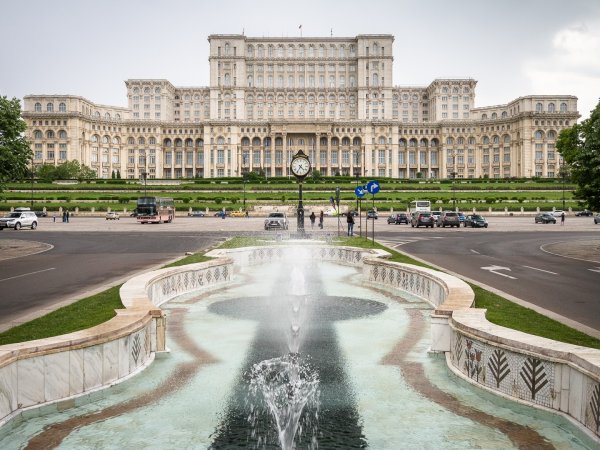
The Palace of Parliament in Bucharest is one of Romania’s most impressive and controversial buildings. Constructed in the heart of the capital during the communist era, the building became the seat of the Romanian Parliament after 1989 and one of Bucharest’s best-known architectural landmarks. Its dimensions are so extraordinary that the building holds several international records and is listed by Guinness World Records. However, the claim that the Palace of Parliament is “the second-largest administrative building in the world” needs to be treated with some caution. Some sources and older rankings have placed the building second in certain classifications, depending on the criteria used. Today, Guinness World Records describes it as the largest building in the world used for civilian administration, while the Chamber of Deputies lists a floor area of approximately 365,000 square metres and places it first in this category.
A project born from the megalomania of the communist regime
Construction of the Palace of Parliament began in 1984 at the initiative of Nicolae Ceaușescu, as part of one of the most extensive urban redevelopment projects in Bucharest’s history. The building was intended to become the centre of the new political and administrative core of the socialist capital and to dominate an enormous urban complex known as the Civic Centre.
The construction project affected a substantial area of the old city. Numerous houses, streets, churches and other buildings were demolished, while entire neighbourhoods disappeared. Guinness World Records notes that more than 30,000 homes and numerous religious buildings and monuments were destroyed in order to create the Palace and the monumental avenue that was supposed to connect the new centre with Union Square.
The architectural project was coordinated by architect Anca Petrescu, who was only 25 years old when she won the competition for the building’s design. Hundreds of specialists subsequently participated in developing the architectural solutions, while construction itself mobilised a huge workforce. According to the Chamber of Deputies, more than 100,000 people contributed to the works, and during peak periods more than 20,000 people worked in three shifts around the clock. Between 1984 and 1990, approximately 12,000 military personnel also participated in the construction.
The dimensions that turned the building into a world record-holder
The figures best explain why the Palace of Parliament is so difficult to compare with other administrative buildings. Guinness World Records gives the building’s floor area as approximately 340,000 square metres, while the Chamber of Deputies states a total floor area of around 365,000 square metres. The differences between these figures are partly explained by the different calculation methods and criteria used by various sources.
The building is approximately 270 metres long and 240 metres wide and rises around 86 metres above ground level. It also extends deep below the surface, reaching approximately 92 metres underground, according to Guinness World Records. The structure contains 12 above-ground floors and eight underground levels, which largely explains the extraordinary scale of the complex.
The Palace is remarkable not only for its floor area but also for its enormous volume. A catalogue published by the Joint Research Centre of the European Commission gave the building an area of approximately 330,000 square metres and a volume of 2.55 million cubic metres, placing it third in the world by volume. This illustrates why the building’s position can vary depending on the criterion used: a structure can rank first in one classification and lower in another.
Marble, crystal and Romanian timber
Another element that contributed to the Palace of Parliament’s reputation is the enormous quantity of materials used in its construction and decoration. According to the Chamber of Deputies, the building was constructed largely with materials produced in Romania. These included approximately one million cubic metres of marble, 550,000 tonnes of cement, 700,000 tonnes of steel, two million tonnes of sand and approximately 900,000 cubic metres of timber.
The interior was designed to create the same impression of monumental grandeur. The official Chamber of Deputies source mentions approximately 3,500 tonnes of crystal, 200,000 cubic metres of glass, 2,800 chandeliers and approximately 220,000 square metres of carpets. A significant proportion of the marble, timber and other materials came from Romania, which was presented by the designers as a demonstration of the country’s natural resources and industrial capabilities.
The extraordinary dimensions also came at an enormous cost. The building required huge material, human and financial resources, and its completion continued even after the fall of the communist regime. Although the project had been commissioned by Nicolae Ceaușescu’s dictatorship, the building was subsequently adapted for use by the democratic institutions of Romania.
From the “House of the Republic” to the seat of Parliament
During the communist period, the building was known as the House of the Republic and was part of the larger Civic Centre project. The development was intended to concentrate the country’s central institutions in a monumental setting and to provide the regime with an architectural symbol comparable, in terms of scale and ambition, to the major political monuments of the 20th century.
After the 1989 Revolution, the future of the building became uncertain. Its enormous size and maintenance costs made it impossible to ignore the issue, but demolishing the structure would itself have been an extremely complicated and expensive operation. Eventually, the building was preserved and transformed into a complex used by the institutions of the democratic Romanian state.
Today, the Palace of Parliament houses the Chamber of Deputies and the Senate of Romania, as well as other institutions and public-use spaces. The building at 2–4 Izvor Street has therefore become an unusual example of architecture originally conceived for an authoritarian regime and later reused by the institutions of a democracy.
The heaviest building in the world
The Palace of Parliament is remarkable not only because of its floor area. Guinness World Records recognises it as the heaviest building in the world, estimating its mass at approximately 700,000 tonnes. This record is explained by the enormous quantities of marble, steel, bronze, timber and other materials incorporated into the structure and its interior finishes.
According to the same source, the building contains approximately one million cubic metres of marble, 700,000 tonnes of steel and bronze, 3,500 tonnes of crystal and 900,000 cubic metres of timber. These figures make the Palace of Parliament an almost unique example of contemporary architecture, where monumentality is not merely a visual impression but something that can also be measured through the sheer quantity of materials used.
Another record associated with the building is its status as the largest palace ever constructed for a socialist state and its leadership. Guinness World Records states that the building was constructed largely between July 1984 and 1989 and contains approximately 1,100 rooms.
Why is it sometimes ranked second?
The confusion surrounding the Palace of Parliament’s position in international rankings has a simple explanation: not all sources measure the same thing. Some classifications consider total floor area, while others look at volume, built-up area or only buildings used specifically for administrative purposes. In addition, published figures may vary depending on how the main building and its auxiliary structures are defined.
A European Commission research document published as part of a European research project described the Palace of Parliament as the second-largest building in the world by floor area, with approximately 330,000 square metres, and as the third-largest by volume. By contrast, current sources from the Chamber of Deputies and Guinness World Records use different descriptions and criteria, with the Palace of Parliament being presented as the world leader in the category of buildings used for civilian administration.
Therefore, the statement that the Palace of Parliament is “the second-largest administrative building in the world” can be found in various materials about the building, but it should not be treated as an absolute fact without specifying the criterion involved. According to current sources, the safest description is that the Palace of Parliament in Bucharest is one of the largest administrative buildings in the world and is recognised by Guinness World Records as the largest building in the world used for civilian administration.
Beyond the rankings, the Palace of Parliament remains one of Bucharest’s most spectacular buildings. Its enormous dimensions, the quantity of materials used, the controversial history of its construction and its transformation from a symbol of the communist regime into the seat of Romania’s Parliament give it a unique status. The building represents both an extraordinary engineering achievement and an architectural testimony to one of the most dramatic periods in the recent history of the Romanian capital.
We also recommend: The Palace of Parliament, between history and myth: What are the most credible stories about the People’s House?