How Bucharest's First Newspaper Kiosks Came to Be. The story starts at the entrance to Cișmigiu Park
- Articles
- 15 JUN 26
If you walk past the entrance to Cișmigiu Park from Bulevardul Regina Elisabeta today, you'll find an old wooden box with its shutters down and faded advertisements peeling off the sides. People walk past it without a second glance. Few know it's the oldest newspaper kiosk in Bucharest, and that the entire story of street press in this city started, sometime in the late nineteenth century, right here.
First came the newspaper, then the kiosk
To understand why the kiosk appeared, you need to know what was happening with newspapers before it did. On April 8, 1829, Ion Heliade Rădulescu published in Bucharest the first periodical in Romanian with a consistent print run: Curierul Românesc. The paper wasn't sold on the street. It was distributed through the bookseller Iosif Romanov and reached, for the most part, boyars and educated men. Four pages, initially in Cyrillic script, sometimes with sections in French.
A few decades later, the press had multiplied. New publications kept appearing, and editorial offices clustered mostly around the Sărindar area, a corner of the city that had gradually become the beating heart of Bucharest journalism. And it was there, at the end of the nineteenth century, that the city's first newspaper kiosk appeared. It was owned by a man named Nae Basarabescu who, as the story goes, borrowed the idea from Paris and brought it back to Bucharest. He made a killing, naturally.
1870 and the kiosk at Cișmigiu
Among the sources that discuss this topic, one specific year keeps coming up: 1870. That's when, near the entrance to Cișmigiu, what several sources describe as the first newspaper kiosk in the capital was set up. The timing made sense: the park had just become the favorite promenade of Bucharest's bourgeoisie, people were spending more and more time outside, and they wanted to read the latest edition over a coffee in the shade.
The kiosk stayed. Its shape changed over the years, renovated haphazardly at various points, but its position never did. Today, more than 130 years later, it still stands at the park entrance on Bulevardul Elisabeta — shuttered, covered in graffiti, carrying a history almost no one remembers.
How newspapers were sold before kiosks existed
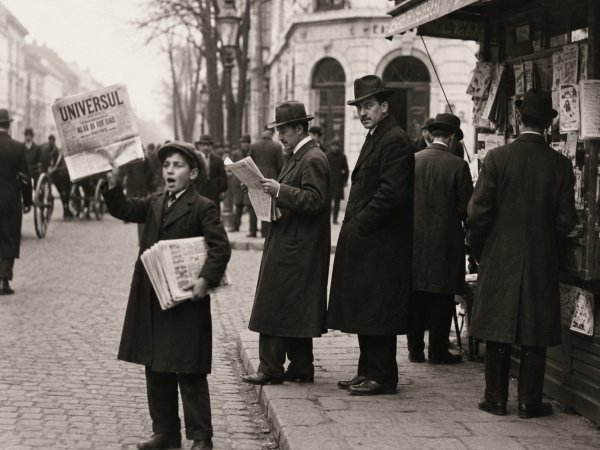
Before fixed selling points appeared, newspapers moved through the city differently. There were street vendors who shouted out headlines as they walked, bookshops that kept copies at the counter, home delivery subscriptions. The whole system ran on individual initiative, with no particular infrastructure behind it.
The kiosk changed that. It gave people a fixed spot where they knew they could pick up the morning paper. It created a ritual: you leave the house, pass by Cișmigiu or the press street, pick up the gazette, move on. A ritual that lasted over a century and that, now, barely survives.
What became of them
Newspaper kiosks flourished especially after 1990, when the press exploded and hundreds of stands appeared on Bucharest's pavements. At their peak, around 1,500 people in Bucharest alone worked selling newspapers. Then, one by one, they started to disappear. Some were demolished by local mayors who found them unsightly. Others turned into selling points for clothes, cigarettes or food, losing any real connection to the press entirely.
The one at Cișmigiu survived physically, but it too stands with its shutters down. It's the last kiosk of its kind from nineteenth-century Bucharest, from the time of King Carol I, and it's not listed on any heritage register.
Also recommended The story of Claymoor, the first society journalist of pre-war Bucharest. No one escaped the pen of Mișu Văcărescu