The story of Claymoor, the first society journalist of pre-war Bucharest. No one escaped the pen of Mișu Văcărescu
- Articles
- 19 MAR 26
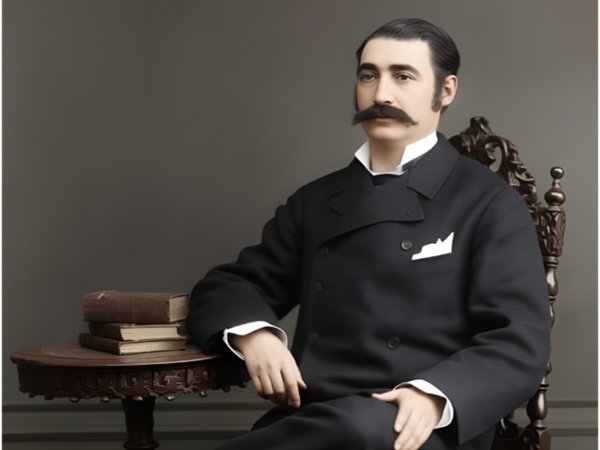
In old Bucharest, before the city became the bustling metropolis of today, social life was a spectacle in itself. Balls, soirées, promenades on the Șosea or elegant dinners formed a refined universe, in which appearances, elegance, and conversation were elevated to the rank of art. At the center of this effervescent world stood a fascinating, almost legendary character: Mihail (Mișu) Văcărescu, known under the pseudonym Claymoor. Considered the first society journalist of pre-war Bucharest, Claymoor was not just a simple chronicler of high society life, but a true image-maker, an arbiter of elegance and taste. For a quarter of a century, he recorded with meticulousness and charm every important event from the high-life world, transforming the social chronicle into a form of literature.
Noble origins and a cosmopolitan education
Claymoor was born into one of the most prestigious families in the Romanian lands, being a descendant of the old Văcărescu family. He was the grandson of Ienăchiță Văcărescu and the son of Iancu Văcărescu, a well-known bon-viveur of the era. This aristocratic heritage opened, from childhood, the doors of a privileged world for him.
His education in Paris offered him not only a solid culture, but also a typically Western refinement. Returning to the country, Claymoor benefited from a vibrant intellectual environment, participating in literary soirées organized by his family, where personalities such as Ion Heliade Rădulescu, Cezar Bolliac, Dinicu Golescu, or Vasile Alecsandri would gather.
At the same time, he was not a stranger to the worldly pleasures of the era. Parties, balls, and elegant gatherings were part of his daily life. Thus, from a young age, Claymoor became an insider of Bucharest’s high-life, a privileged observer of an exclusive world.
The journalistic career and the consecration at “L’Indépendance Roumaine”
Claymoor’s journalistic activity unfolded over approximately 25 years, during which he wrote almost daily. The publication that consecrated him was “L’Indépendance Roumaine”, where he signed his famous society chronicles in the column “Carnet du High-life”.
Throughout his career, he published over 8000 society chronicles, an impressive performance that demonstrates not only his discipline, but also his passion for this field. In addition, he edited works such as “La vie à Bucarest” (1882–1883), the magazine “La lanterne mondaine” and the “Almanach du high-life”.
Claymoor was omnipresent. He kept a rigorous journal in which he planned each appearance and did not miss any important event, even when they overlapped. Thanks to the prestige of his family, he was invited everywhere: to lavish balls, elegant dinners, weddings, baptisms or simple social gatherings.
The society chronicle – an art of detail and elegance
Claymoor’s chronicles were written in impeccable French, which he mastered at a native level. His style was unmistakable: apparently frivolous, but in reality extremely elaborate, full of nuances and subtleties.
His descriptions had a strong visual dimension. He managed to transform each event into a vivid tableau, in which the characters, the décor and the outfits were presented with impressive meticulousness. Dresses became works of art, jewelry – symbols of refinement, and the atmosphere – a story in itself.
Claymoor had the rare ability to observe details that others ignored. His analysis was complex: he described clothing like a tailor, jewelry like a jeweler, and menus like a connoisseur of gastronomy. At the same time, he knew how to cover potential scandals or indiscretions with a layer of elegance, preserving the image of a world that was always sparkling.
His prodigious memory and rich vocabulary allowed him to avoid repetition, each chronicle being unique, with different expressions and images.
Fascination with the eternal feminine
One of the defining elements of Claymoor’s style was the way in which he described women. They occupied a central place in his chronicles, being presented in an idealized, almost poetic light.
Women were, in his vision, graceful, delicate, compared to ancient statues or famous paintings. They were “fairies”, “cameos” or “amazons”, each appearance being transformed into a visual and emotional spectacle.
This constant attention given to women brought him both admiration and irony. He was often caricatured and became the subject of rumors regarding his personal life. However, nothing affected his reputation as a refined chronicler and a keen observer of feminine sensitivities.
Influence on public taste and openness to modernity
Claymoor was not only an observer, but also an opinion maker. Through his chronicles, he influenced the tastes and preferences of the Bucharest elite. Even those who criticized him were forced to acknowledge his discernment and artistic sensitivity.
He wrote not only about balls, but also about theatrical premieres, exhibitions or sporting events. He admired artists and did not hesitate to express his opinions about them. For example, he appreciated Jean-Antoine Watteau or Ion Andreescu, and about George Enescu or actors such as Pascali, Romanescu or Constantin Nottara he wrote with admiration.
A famous comparison is the one between Ion Luca Caragiale and Émile Zola, proposed by Claymoor and later preserved by George Călinescu. He was also among the first to promote cinema, writing about the success of the Lumière brothers and contributing to bringing this invention to Bucharest in 1896.
An intense lifestyle and a constant presence in the life of the city
Claymoor did not allow himself breaks. For him, the notion of vacation in the classical sense did not exist. When the season of Bucharest balls ended, he continued his activity elsewhere. He went to the mountains or to the seaside, where he himself became an organizer of events: picnics, dinners, elegant gatherings.
He frequented luxury cafés and restaurants, practiced horse riding on the Șosea and was an accomplished dancer. His life was a continuous movement, a permanent search for beauty and spectacle. He was present everywhere, always attentive, always ready to transform reality into a story.
The death of a chronicler and the end of an era
Claymoor’s end was as symbolic as his life. He died “on duty”, on the steps of the editorial office of “L’Indépendance Roumaine”, where he had come to deliver a new chronicle. His disappearance meant more than the loss of a journalist. With him, an entire world was fading – that of elegant Bucharest, of lavish balls and of a society that lived by strict rules of refinement.
Claymoor remains in the memory of the city as a unique character, a consummate aesthete and a privileged witness of a bygone era. Through his writings, he managed to preserve a world that would otherwise have remained only a vague memory. Today, his story is not just about a journalist, but about the power of words to give life to an era and to keep it alive over time.
We also recommend: Stories from pre-war Bucharest: grand balls, luxury, Western influences and La Belle Époque