How houses were sold in interwar Bucharest
By Eddie Țone
- Articles
- 11 NOV 26
In 1930s Bucharest, anyone with a house to sell pinned their hopes on a tiny rectangle of newsprint, squeezed between an advertisement for a furniture dealer and a notice from a gentleman looking for work. There, among lines printed in letters so small that readers needed good eyesight and considerable patience, properties worth hundreds of thousands of lei changed hands. An apartment with central heating could inspire admiration, a villa in the northern part of the capital promised respectable social standing, and a house with a garden represented, for many Bucharest residents, a dream worth saving for over many years.
Property owners chose their words carefully. Every word cost money. Newspapers charged for classified advertisements according to their length, so descriptions had the precision of telegrams sent by people determined to save a few pennies. The address mattered enormously, amenities had to fit into a handful of lines, and a well-chosen word could turn an ordinary home into an attractive proposition.
A look through the yellowed pages of the newspapers Universul and Dimineața reveals a surprisingly familiar property market. Expensive apartments, enormous differences between neighborhoods, owners eager to sell quickly, and buyers interested in every detail. Bucharest already had all the ingredients of the modern real estate business. The only thing missing was the ultra-wide-angle photography that can make a modest kitchen look like a ballroom.
Classified advertisements: where Bucharest put its houses up for sale
In the April 10, 1933 edition of Universul, page 12 is largely devoted to the "Classified Advertisements" section. The advertisements are arranged in narrow columns, each containing its own offers and identification codes.
Among them is a category titled "Sales and Purchases of Buildings, Estates, Forests, Land, and Leases." The length of the heading tells us everything about the newspaper's commercial ambitions. Within the same section, readers could find a home in Bucharest or an agricultural estate, each awaiting its own prospective buyer.
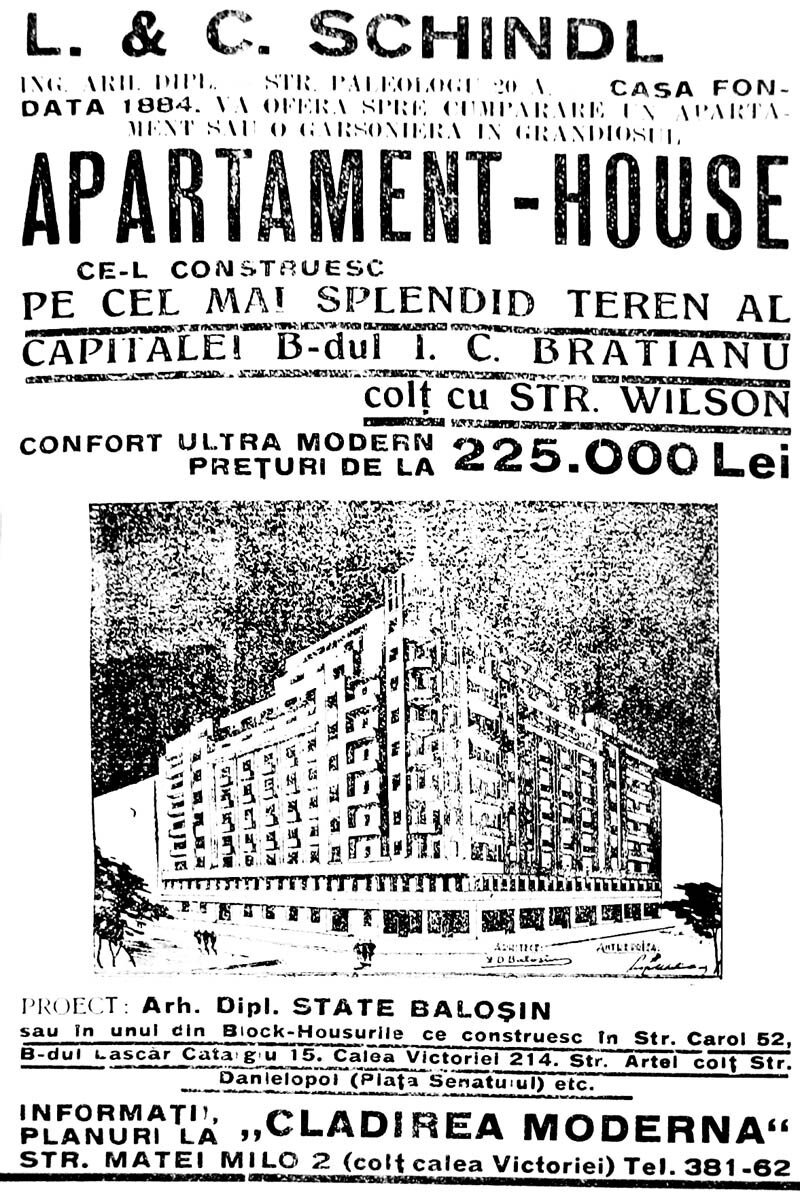 Interwar apartment classified ads / Photo via hartablocuri.ro
The "Classified Advertisements" section in Universul, April 10, 1933, page 12. The original reproduction is available in the digital collection of the "Ovid Densusianu" Hunedoara-Deva County Library.
Above the section, the newspaper's editors published a perfectly straightforward commercial notice. Advertisements had to contain at least ten words, and placing one inside a border doubled the price.
There is something rather delightful about the economics behind this rule. The owner of a villa could save a few lei by removing an adjective, but adding a border to make the advertisement stand out would double the cost. Paying extra for visibility already followed a precise formula long before property platforms existed, a practice that would survive for many years, including in the classified advertisements of communist-era newspapers.
The newspaper also specified that addresses in the capital had to include the sector number. Location was essential to buyers because, at the time, a Bucharest address conveyed both geographical information and clues about the future owner's social standing.
Estate agents and other intermediaries participated in transactions alongside private owners. Newspapers, however, remained one of the main meeting places for supply and demand. Readers discovered a property over their morning coffee and pursued the matter by visiting the advertised address or contacting the person who had placed the notice.
How much did an apartment cost in 1935? Hundreds of thousands of lei for modern comforts
One specific example, identified in a collection of reproductions of advertisements from Universul, concerns an unoccupied three-room apartment offered for sale in September 1935. The asking price was 650,000 lei, an enormous sum at the time.
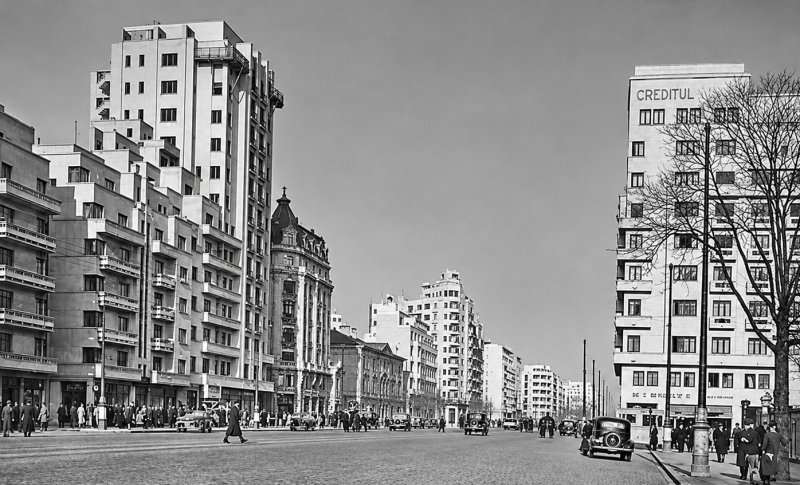 Carlton building collapsed after the 1940 earthquake
The information was recorded by a collector who published reproductions of property advertisements dating from 1931 to 1939. Since a complete, independently verifiable transcription of the advertisement is unavailable, the price and date should be regarded as information documented through a secondary source. Further details about the property would need to be checked against the original newspaper.
Even with that qualification, the price reveals something about Bucharest's apartment market during the 1930s. Modern homes were expensive assets, and a property's location within a newly constructed building could significantly influence its valuation.
Another advertisement reproduced in the same collection lists a luxury apartment at 295,000 lei. A meaningful comparison would require knowing the precise year, floor area, and location of each property. Above all, the difference between these two examples demonstrates how misleading it would be to calculate an average property price from a handful of unrelated listings.
Nor can salaries from that period be mechanically converted into present-day equivalents. There were substantial differences between the income of a modest civil servant and that of a well-paid professional. And the price printed in a newspaper was the seller's asking price, which might have differed from the amount eventually recorded in the sale contract.
Nevertheless, one fact emerges clearly from the economic press of the period. Demand for newly built homes had become strong enough to attract substantial investment.
On August 7, 1935, the newspaper Curentul published an article about a new wave of construction in the capital. It presented an analysis by the Institute for Economic Research, according to which replacing older housing with new apartments commanding higher rents was stimulating the construction industry. Monetary instability was also encouraging people with capital to invest in property.
Bucharest real estate had therefore become a means of protecting wealth. Apartments could generate rental income, while new buildings promised better living conditions than the city's older housing stock.
What did a "modern" apartment mean in interwar Bucharest?
The word "modern" carried considerable commercial weight in the 1930s. Today's buyers take running water for granted. In interwar Bucharest, however, it could be a selling point worth highlighting in an advertisement. The same applied to private bathrooms and the heating systems installed in new buildings.
In the modern apartment blocks of the period, central heating was a powerful selling point. Instead of individual wood- or coal-burning stoves, residents enjoyed a heating system serving several apartments or the entire building. Naturally, such comfort also came with maintenance costs, a detail that an enthusiastic seller probably preferred to leave for the face-to-face discussion.
A lift was another indication of modernity, particularly in the taller apartment buildings constructed along the city's major central thoroughfares.
The layout mattered, too. Apartments designed for wealthy buyers might include spacious reception rooms, separate service areas, and circulation routes intended for domestic staff. A maid's room was a standard feature of certain bourgeois homes, reflecting the social customs of the period.
There was also the question of new properties versus older ones. A recently completed building offered different maintenance prospects in a city where many nineteenth-century houses were still occupied.
The real estate advertisements of the period capture this transition between two worlds: the Bucharest of households organized around private courtyards and the Bucharest of income-producing apartment buildings, where the individual apartment was becoming a property product in its own right.
Cotroceni, Dorobanți, and the neighborhoods where an address spoke volumes about its owner
For a wealthy Bucharest resident looking to buy a villa, location mattered just as much as architecture. Cotroceni had developed into a residential district, with streets lined by houses and plots suited to individual homes. Around Cotroceni Palace, proximity to major state institutions lent the neighborhood a particular prestige.
The Bucharest Municipality Museum preserves, for example, a photograph dating from around 1930 showing houses under construction in the Ana Davila residential development. The image documents the expansion of housing in an area that would become one of the city's most desirable neighborhoods.
In the northern part of the city, the Filipescu residential development represented another model of residential planning, intended for buyers with considerable financial resources.
Its story began before the First World War, when Alexandru I. Filipescu sought to subdivide his family's estate into building plots. In 1911, he submitted a plan for opening new streets, and archival documents record the ensuing negotiations with the municipality.
The project provided for generous plots and building regulations that favored detached villas. The owner was expected to cover infrastructure expenses and transfer the newly created streets to the municipality. An exclusive neighborhood, after all, needed roads along which its residents could drive their automobiles.
The architecture of the houses subsequently built in the area reflected the social standing of their occupants. For affluent families, purchasing a villa in northern Bucharest was an investment in both comfort and a prestigious address.
From houses with courtyards to apartments in income-producing buildings
As the city expanded, apartments became an increasingly common feature of the property market. Income-producing apartment buildings were developed as commercial investments, primarily through the rental of individual residential units. By building upwards, investors could generate revenue from relatively small plots of land, while tenants benefited from living close to the city center.
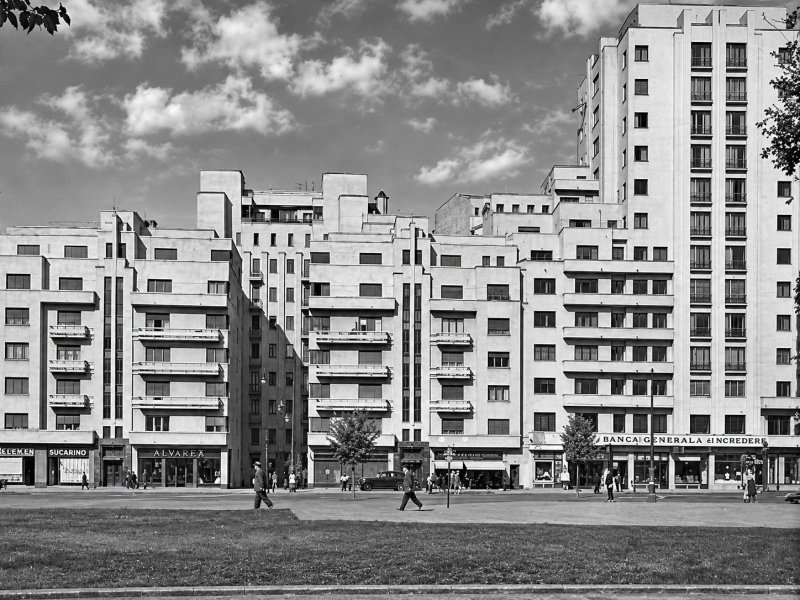 Interwar buildings in Bucharest
The major boulevards became attractive locations for such investments. The area between Piața Romană and University Square, along with the central streets surrounding Calea Victoriei, offered opportunities for constructing buildings with modern apartments.
But the increase in construction also had a less appealing side. A study published in 1966 in București. Materiale de Istorie și Muzeografie records that the number of dwellings in the capital, including its administratively subordinate communes, rose from 70,537 in 1930 to 123,717 in 1941.
The increase was substantial and indicates how rapidly the city was changing, with property investment continuing despite economic instability.
The study's author nevertheless identified a striking contrast between the supply of housing in central areas and the difficulties faced by middle-income residents. High rents meant that some apartments remained vacant while other families lived in overcrowded conditions.
Bucharest could simultaneously have modern apartments waiting for tenants and residents who could barely afford a roof over their heads. It was a contradiction only partially revealed by the property pages, with their abundance of attractive offers.
Sellers in a hurry and the art of saying everything in ten words
The language of classified advertisements had a peculiar charm, born of a very practical constraint. In the April 10, 1933 edition of Universul, the rule requiring advertisements to contain at least ten words, together with the extra charge for a border, helps explain the page's telegraphic style.
Advertisements frequently dispensed with articles and grammatical connectors, putting the property itself and the essential transaction details front and center.
Verbs often appeared at the beginning, in direct forms such as "SELLING" or "WANTED." Capital letters became a means of attracting attention, while descriptions were reduced to concrete information.
With space at such a premium, the adjective "modern" represented an investment in advertising, while "comfort" could summarize an entire explanation of a property's amenities.
The urgency of a sale was another theme perfectly suited to short advertisements. Words such as "urgent" or "bargain" could suggest that an owner was willing to conclude a transaction quickly or negotiate the asking price.
Just a few words could hint at an entire family or financial situation, although the real reasons for selling often remained unknown. The urgency expressed in an advertisement might be genuine or simply a commercial tactic.
Buying a house and the complicated fortunes of the Romanian leu
In interwar Romania, property prices need to be understood against the backdrop of monetary and economic change. The Great Depression of 1929–1933 affected incomes and people's ability to repay debts, while problems involving credit attracted the attention of lawmakers. The Law of April 7, 1934, concerning the settlement of agricultural and urban debts, sought to address some of the difficulties that had accumulated during the crisis.
For indebted property owners, such measures had direct consequences. A house was a valuable asset, but it could also serve as collateral for loans. At the same time, property investment had become attractive to people with available capital who wanted to protect themselves against monetary instability.
In its August 1935 article, Curentul observed that many investors favored construction projects precisely because they wanted to place their money in real estate. Land and buildings offered the advantage of being tangible assets. They could be used, rented out, or resold. At a time when confidence in the stability of money had been shaken, property seemed an appealing option.
Naturally, the property market had risks of its own. A property's value depended on its location and the condition of the building, while finding the right buyer remained essential.
A property advertisement could reveal as much as a short autobiography
The most fascinating aspect of interwar classified advertisements emerges when property descriptions are read as social documents. A house with rooms for domestic servants points to a particular way of life. An apartment equipped with modern utilities reveals aspirations toward urban comfort. A property situated in a planned villa neighborhood suggests a preference for residential surroundings removed from the commercial bustle of the city center.
Within the few lines of an advertisement, the buyer's ambitions met the limits of their financial means. Direct language and practical vocabulary were part of a business in which readers had to be persuaded within an extremely restricted space. The owner paid for every word, while the buyer tried to decipher the property's true value from a handful of carefully chosen phrases.
Anyone browsing these advertisements today will also notice changes in the city's geography. Streets have been renamed, building numbers have changed, and structures once considered architectural novelties have either become part of the city's built heritage or disappeared altogether.
An apartment advertised as modern in 1935 might now be a historic home valued for its original features. A villa that an owner was once desperate to sell may, generations later, be marketed precisely because of its age.
Interwar Bucharest left its stories in archives, photographs, and buildings that survived the city's transformations. But it also left them in the classified pages of newspapers, tucked between job advertisements and furniture promotions.
There, we find a city preoccupied with the same questions that drive today's property market. How much is a good address worth? Is a modern apartment worth the money? How quickly can a house be sold?
And somewhere, in an old edition of Universul, a property owner was hoping that the few lines paid for out of his own pocket would bring him a buyer before the following day's newspaper reached the streets.
You may also like: What salaries Romanians had during the interwar period. From ministers and university professors to unskilled laborers, postal workers, and agricultural workers