What did Bucharest smell like 100 years ago? From elegant ladies’ perfumes to freshly baked bread, stove smoke and the stench of the old Dâmbovița
By Eddie Țone
- Articles
- 08 NOV 26
Bucharest in the 1920s had an excellent reputation for elegance, at least among those who could afford to live on Calea Victoriei and spend their afternoons at Capșa. Gentlemen wore impeccably tailored suits, ladies were discovering French perfumes, and automobiles were beginning to replace horse-drawn carriages. But the city also had an olfactory personality that was rather difficult to ignore. Just a few streets away from the luxury shop windows, the air could smell of horse manure, coal smoke or rubbish left too long in the summer heat. And when the wind blew from the wrong direction, the fragrance of European civilisation came face to face, with very little ceremony, with the realities of Bucharest’s poorer neighbourhoods.
So what did Bucharest smell like a century ago? The answer can be found in the memories of those who knew it, in contemporary newspapers and in municipal records documenting an issue that had an unfortunate habit of returning every morning. The city existed between two worlds. One bought its perfumes in Paris; the other dumped its rubbish at the edge of the street. Sometimes, the two worlds met on the very same road.
Calea Victoriei and 40 tonnes of French perfume
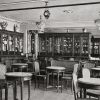
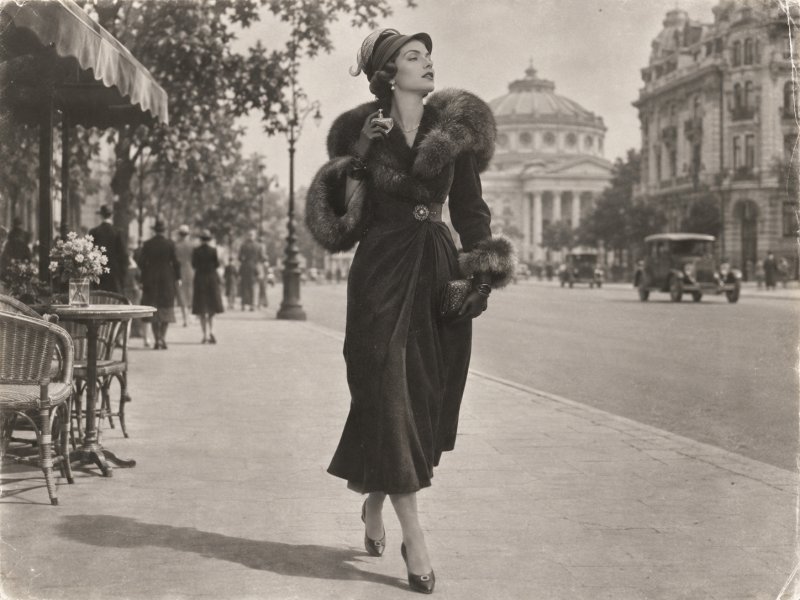 AI generated image, for illustration purpose
In the early 1920s, Bucharest was rediscovering its social life after the First World War. Shops were filling up with imported goods, Parisian fashion was once again attracting the attention of high-society ladies, and cosmetics were becoming an increasingly visible part of urban commerce.
A detail from a study of Bucharest’s commercial history, published in the journal București. Materiale de Istorie și Muzeografie, says quite a lot about the capital’s appetite for luxury. In 1923, Romania imported 40 tonnes of French perfume. The figure refers to imports across the entire country, but it appears in an analysis of Bucharest’s commercial development after 1919, when the capital had become one of the main markets for such products.
Forty tonnes of perfume in a country that had only just emerged from a war! The figure becomes even more striking when you discover that, during the same period, newspapers were mocking the difficulty of obtaining certain everyday food products.
In 1920, the satirical magazine Furnica published a poem entitled “Luxury Goods”, in which the author turned the meaning of the expression on its head. Sophisticated merchandise was plentiful, while basic necessities had become genuine rarities. Good bread and fresh eggs were among the examples. Modern commerce, it seems, had its own priorities.
Perfume was also a marker of social status. In the world of drawing rooms and formal receptions, a woman’s choice of fragrance revealed something about her tastes and financial means.
Queen Marie herself provided a famous example. The sovereign favoured Mon Boudoir, a perfume created by the French house of Houbigant. In 1923, the Queen’s image appeared in an advertisement for the brand, a document preserved in the collection of Bucharest’s Perfume Museum.
Naturally, the elegance of the Royal Palace was a considerable economic distance from the life of an ordinary family. For many women in Bucharest, hygiene and beauty products remained purchases that required careful budgeting. Nevertheless, the prominence of perfume in interwar advertising shows just how much the city had changed since their grandparents’ time.
Capșa, where coffee met chocolate and literature
On Calea Victoriei, Casa Capșa offered one of Bucharest’s most agreeable experiences for the nose. The confectionery had established its reputation back in the nineteenth century, when Grigore Capșa brought techniques and recipes he had learned in France to the Romanian capital.
The establishment’s story began in 1852, when the Capșa family opened its first confectionery shop. In 1868, Grigore Capșa founded his own business, and by 1886 the establishment also included a café. During the interwar years, it had become one of the favourite gathering places of Bucharest’s intellectuals.
Inside, the aromas of coffee and chocolate belonged to a commercial world in which a product was expected to impress even before the first sip or bite. European confectionery had brought an entire culture of refined desserts to Bucharest.
Writers such as Liviu Rebreanu and Tudor Arghezi gathered there, while the poet Ion Barbu was known for his habit of arriving in the morning and remaining at the café for hours.
Capșa also served as the city’s unofficial newsroom. Political events were debated, information was exchanged, and literary reputations were made or destroyed. A coffee could last as long as a parliamentary session, with the advantage that the dessert was probably better.
In 1920, the confectioner created the Joffre cake, associated with the visit to Romania of French Marshal Joseph Joffre. The chocolate dessert remained one of the establishment’s best-known creations.
Beyond its fashionable social history, Capșa illustrates how Bucharest’s tastes were changing. The old tradition of Oriental sweets continued to exist, but Western-style confectionery was gaining ground in the city centre.
Mornings smelled of freshly baked bread. Bucharest had more than a hundred bakeries
For ordinary Bucharest residents, one of the most familiar aromas came from neighbourhood bakeries. The city already had a substantial network of such establishments before the First World War.
On 15 June 1910, Minerva magazine published a remarkably precise statistic. The capital had 86 bakeries and 17 shops specialising in white bread, making a total of 103 establishments employing 860 people.
Their owners came from different communities. They included Romanians and Aromanians, Greek and Albanian entrepreneurs, as well as German and Italian bakers. Bucharest’s bread had a cosmopolitan commercial history hidden beneath its golden-brown crust.
The smell of baking dough was one of the everyday signs of activity in such places. The ovens and the fact that production often took place close to the sales area made a bakery an immediately recognisable feature of the street.
The Minerva article, however, also provides some much less romantic information. The authorities had stepped up sanitary inspections, and bakers were required to comply with stricter cleanliness regulations. According to the report, premises deemed unsanitary had been vacated.
Inspections also covered the weight of the bread. When a loaf was more than 50 grams underweight per kilogram, the goods could be confiscated and distributed to the poor. This was a fairly persuasive administrative method for merchants tempted to save flour at their customers’ expense.
Alongside bakeries, interwar Bucharest had numerous simigerii, shops selling pretzels and other baked goods. Pretzels and savoury pastries were part of the city’s street-food culture, with pastry vendors particularly common in busy areas.
Matache Market and the coffee merchants. The aromas of a city that shopped every day
Markets were among Bucharest’s busiest commercial spaces, and Matache Market remains a representative example of everyday life during the interwar period.
In a recollection published in Istorie și Civilizație, a former resident of Berzei Street describes the small shops near his home, including Bagdikian’s café and sweet shop. Nearby stood a confectionery with its own production workshop, as well as Matache Market.
The account refers to Bucharest before the Second World War, particularly the 1930s, offering a very concrete picture of neighbourhood commerce. It was a world of specialised shops, where shopping involved repeated visits to local merchants.
Coffee had a significant place in the city’s life. A study of coffee culture published in the Bulletin of the Ștefan Procopiu Museum of Science and Technology mentions the Armenian merchant Avedis Carabelian, a supplier to the Royal Household.
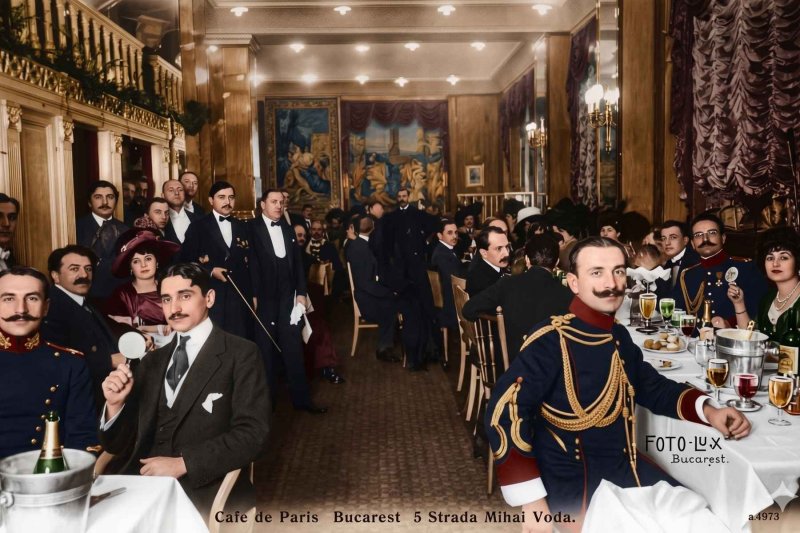
Coffee merchants sold imported coffee, while the roasting and grinding of beans gave commercial neighbourhoods one of their characteristic aromas. It was a smell associated with trade and long conversational breaks, at a time when coffee was already a deeply rooted social ritual.
In the markets, the olfactory experience was considerably more complicated. Selling fresh food required daily handling and constant cleaning. Given the technology available at the time, preserving perishable goods was particularly difficult in summer. And then there was the waste generated by the merchants’ activities.
The city thus offered a fairly simple lesson in food retailing. The pleasant aroma of fresh produce and the smell of decaying leftovers often came from exactly the same activity, just a few hours apart.
Stables and horses. The less fragrant side of elegant transport
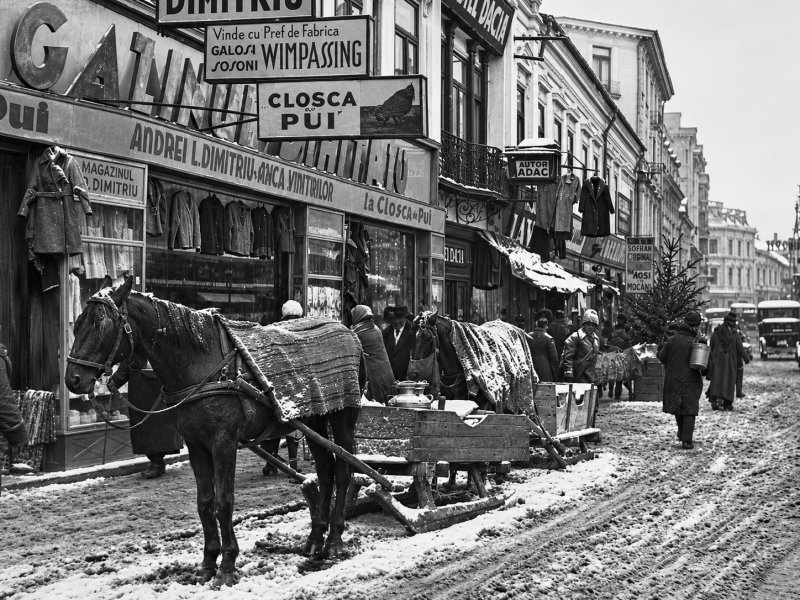
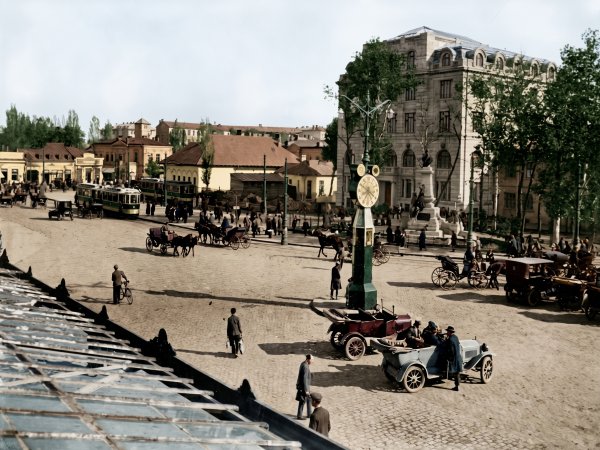
In 1926, a Bucharest resident could encounter a modern automobile and a horse-drawn carriage on the same street. The transition to motorised transport was gradual, and the old transport system continued to occupy a significant part of urban space.
Historical data published in București. Materiale de Istorie și Muzeografie shows that in 1920, the capital’s statistics recorded 2,550 automobiles of various types and 1,152 horse-drawn cabs. Horses therefore remained a familiar presence on the streets. And a city with that kind of traffic needed stables and workers to care for the animals.
Horses produced substantial quantities of manure every day, while their urine ended up on cobblestones or in stables. The resulting smells were an inevitable consequence of animal-powered transport. On hot days, the problem became even more unpleasant. The romance of a carriage ride, then, had a very practical limit. Passengers could enjoy the elegant movement of the carriage, while pedestrians walking behind the horse received an entirely different sensory experience.
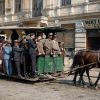
Horse-drawn trams operated in Bucharest until 6 June 1929, when the Bucharest Municipal Tramway Company permanently withdrew them from service. The date is confirmed by the official history of Bucharest’s public transport system. Their disappearance also brought a change to street hygiene. Nevertheless, horse-drawn cabs and carts continued to circulate, and the city still had plenty of reasons to keep its brooms close at hand.
An entertaining detail appears in an article published in Realitatea ilustrată in 1933, cited in a study of Bucharest’s transport history. The author described the decline of horse-drawn cabs and the increasingly poor condition of some of the carriages still in service.
The elegant transport of earlier times was visibly growing old under pressure from the automobile. Meanwhile, petrol and exhaust fumes were beginning to add their own smells to the capital’s streets.
The Dâmbovița, the river that sent Bucharest residents to the doctor
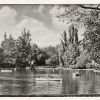
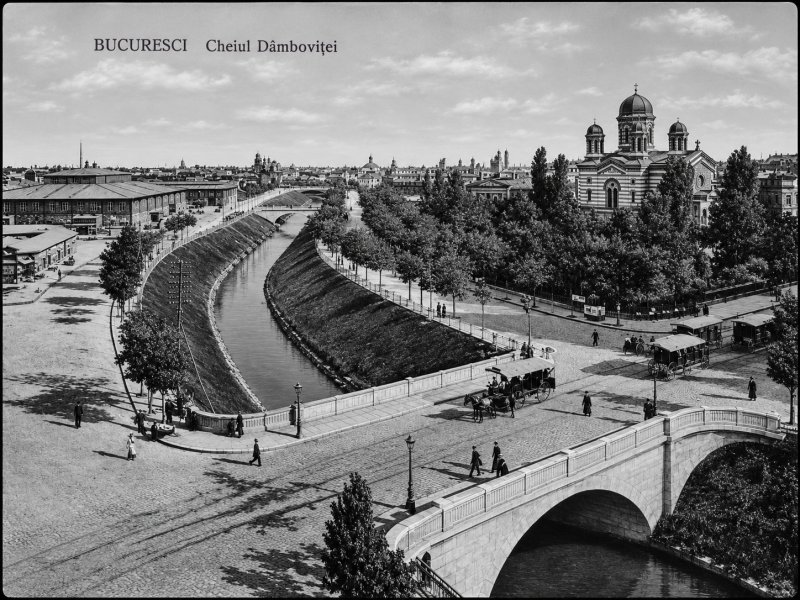 Dâmbovița river, in the interbelic period
The Dâmbovița occupies a chapter of its own in the history of Bucharest’s smells. Unfortunately, not a particularly pleasant one.
One clarification is necessary. By the 1920s, much of the Dâmbovița had already been channelled and regulated following engineering works carried out in the final decades of the nineteenth century. The image of a river winding between houses and receiving the city’s rubbish directly belongs mainly to an earlier period. Nevertheless, pollution and wastewater disposal continued to concern the municipal authorities well into the twentieth century.
In old Bucharest, the river had been used simultaneously as a source of water and a means of waste disposal. It was a combination with predictable public-health consequences.
In his book București și bucureșteni de ieri și de azi (Bucharest and its residents, yesterday and today), published in 1945, Victor Bilciurescu recalled the situation at the end of the nineteenth century. Household waste and even animal carcasses ended up in the Dâmbovița. Despite this, people continued to bathe in the river.
Ion Ghica had earlier mocked the quality of Bucharest’s water in a passage that became famous. The writer claimed that the water had acquired such a powerful laxative effect that residents preferred other drinks, including beer.
Behind the humour lay a serious medical problem. Contaminated water encouraged digestive illnesses and epidemics, forcing the authorities to seek solutions for drinking-water supplies and waste disposal.
In a study devoted to the regulation of the Dâmbovița, the Bucharest Municipality Museum notes that bans on dumping rubbish into the river had been issued as early as the eighteenth century. Contemporary documents even record penalties for property owners who polluted the riverbed. One of the more forceful measures came in 1813, during the reign of Prince Caragea, when the river was ordered to be cleaned following a plague epidemic.
Much later, beginning in the 1880s, extensive river-regulation works were undertaken. The river was given an engineered channel, while the city continued to expand its water-supply and sewerage infrastructure. Between 1930 and 1932, the authorities removed more than 46,000 cubic metres of alluvial deposits from the Dâmbovița’s bed, according to historical records of municipal engineering works.
The Dâmbovița had already become quite different from the river described by memoirists of the previous century. But its old reputation demonstrates how closely the city’s smells had once been connected to the health of its inhabitants. Even so, the Dâmbovița’s foul stench would persist well into the 1980s, when river redevelopment works finally addressed this major olfactory nuisance in a capital aspiring to modern standards of urban life.
Stove smoke and the beginnings of industrial Bucharest
Another component of Bucharest’s air came from domestic heating systems and industrial activities.
During the first decades of the twentieth century, many homes continued to be heated by stoves. Burning wood and coal released smoke, while the intensity of the smell depended on the fuel and weather conditions.
In winter, when heating became a daily necessity, countless chimneys discharged combustion fumes above the houses. For people living at the time, the smell of smoke was an ordinary part of the cold season.
At the same time, Bucharest was becoming an increasingly important industrial centre. During the interwar years, the Malaxa Works developed in the eastern part of the city, starting with locomotive repairs before eventually moving into locomotive manufacturing. Metallurgy and other branches of manufacturing expanded economic activity beyond the old craft workshops.
In industrial districts, fuel combustion and metalworking could introduce smells into the atmosphere that were quite different from those of residential neighbourhoods. Factories thus added a new element to Bucharest’s olfactory landscape.
Railway stations also contributed to this transformation. Steam locomotives burned coal, and the smoke they produced was a familiar feature of railway transport. Within a few decades, the city had moved from the dominance of horse-drawn transport towards increasingly mechanised traffic. The air reflected the change faithfully. The smell of stables gradually gave way to petroleum products and industrial smoke.
Technological progress brought its own inconveniences, and the noses of Bucharest residents were among the first to notice.
Rubbish, City Hall’s great concern. Why the outskirts smelled different from the centre
To understand the differences between neighbourhoods, we must also look at the history of municipal sanitation services. In a study of urban hygiene, the Bucharest Municipality Museum describes a city that slowly moved from household-managed cleaning to organised public services.
During the first half of the nineteenth century, rubbish collection was carried out using carts hired by the municipality, and collections sometimes took place only twice a week. Piles of waste were transported beyond inhabited areas or dumped on vacant land.
In 1873, the administration began organising the removal of dust and mud from the streets more systematically. Sprinkling roads with water during summer was also included among the contracted duties. This was a justified concern, since unpaved roads produced dust during dry periods, while rain turned some streets into muddy surfaces that were difficult to cross.
In 1902, Mayor Ioan Procopie Dumitrescu presented a report on the sanitation service, which was organised into districts. Rubbish was collected using horse-drawn vehicles, while outlying neighbourhoods received less frequent attention.
This brings us to the fundamental differences between the elegant city centre and Bucharest’s poorer districts. The administration invested more in maintaining major thoroughfares, whereas in peripheral areas waste could remain near homes for much longer.
The First World War disrupted municipal services. In August 1916, City Hall issued an ordinance urging property owners and tenants to clean not only their premises but also the section of street in front of their homes, as far as the middle of the roadway. After the war, sanitation services gradually resumed and were reorganised. Nevertheless, old problems persisted, especially in areas where municipal infrastructure had developed more slowly.
Beyond the unpleasant smells, dirt was a public-health concern. As early as 1863, physician Anastasie Fătu had proposed establishing a sanitary police force, while physician Iacob Felix later became involved in modernising public-health legislation. The sanitary laws of 1874 and 1910 marked significant stages in regulating public hygiene.
Interwar Bucharest had therefore inherited decades of municipal concerns and unfinished improvements. The city was modernising, but the benefits also depended on which street you happened to live on. Some neighbourhoods were discovering modern comforts, while others continued to struggle with problems that earlier generations knew all too well.
What remains of the smells of old Bucharest?
There is a reason why interwar photographs often create such a pleasant impression. They preserve elegant façades and vintage automobiles, but leave out the dust stirred up by traffic and the smells lingering behind the shops.
Memoirs and sanitary records complete the picture. In Bucureștii de altădată (Bucharest in bygone days), Constantin Bacalbașa described commercial life and the habits of Bucharest society during the final decades of the nineteenth century. George Costescu, in Bucureștii Vechiului Regat (Bucharest of the Old Kingdom), published in 1944, reconstructed the city’s development and the difficulties of modernising its infrastructure. Such accounts reveal how quickly habits could change and how slowly certain urban problems were resolved.
A century ago, Bucharest had French perfumes in its elegant shops and fresh bread in its neighbourhood bakeries. Around the markets lingered the aromas of food trading, while near the stables the smell of animals was part of everyday life. Stoves and factories added smoke, while rubbish left on the streets served as a reminder of the limitations of the city’s sanitation infrastructure.
Every neighbourhood had its own combination of smells, shaped by economic activities and living conditions. Differences could be noticeable even between two neighbouring streets.
But perhaps the most interesting detail remains the contrast between the elegance so carefully cultivated by interwar society and the very practical difficulties of everyday life. The capital was buying perfumes from Paris and building modern boulevards while its municipal administration continued searching for solutions to the city’s dust and rubbish.
Photographs have preserved the beauty of old Bucharest. But to understand its everyday life, we must also recover the smells that cameras, fortunately for those who lived at the time, left outside the frame.
You may also like: The Little Paris Museum, the French-styled Bucharest and the most beautiful journey through time in the Center of the Capital