Bucharest Stories: In 1935, the Capital’s Unemployed Received a Loaf of Dark Bread Twice a Week
- Articles
- 05 NOV 26
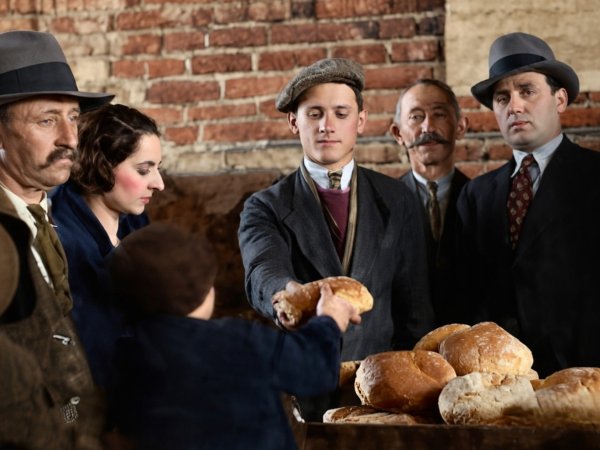
In the spring of 1935, in an area on the outskirts of Carol Park, interwar Bucharest revealed one of the sides that the central streets, with their elegant shop windows, hotels, and cafés, managed to conceal. On a sloping street lined with small houses that reminded one chronicler of a mountain town, hundreds of unemployed people gathered twice a week to receive a basic form of assistance: bread. The account published in Ilustrațiunea Română on April 17, 1935, captures a scene whose simplicity makes it particularly striking. Around 500 unemployed people registered on the municipality’s lists came on Wednesdays and Saturdays to receive a loaf of bread. For these people, an item that was part of the daily routine for many Bucharest residents had become assistance that could only be obtained after hours of waiting and crowding. The scene was not an isolated one. Historical research into unemployment in Bucharest between 1929 and 1937 shows that the municipality had assistance programs for people who had lost their jobs, although the available resources were limited compared with the scale of the problem. Documents preserved by the Museum of the Municipality of Bucharest show that aid could take the form of food, money, or firewood, while the number of beneficiaries varied from one year to another.
The economic crisis had reached Bucharest homes
To understand why a loaf of bread had become so important, it is first necessary to look at the economic context. Romania was experiencing the severe effects of the Great Depression, which had begun in 1929, and the shock was strongly felt in industry and urban areas. Recent research into the period indicates that between 1929 and 1933, approximately 300,000 people in Romania’s urban and industrial areas lost their jobs. In Bucharest, social studies from the period recorded a gradual deterioration in workers’ living standards.
The situation meant more than simply losing a salary. For families living from one day to the next, losing a job could lead to a drastic reduction in food consumption, mounting debts, and an inability to pay rent or heating costs. In a report drawn up in Bucharest in 1932, Veturia Mănuilă, who was responsible for organizing certain forms of assistance for unemployed people, noted that workers’ incomes had fallen considerably compared with the years before the crisis.
At the same time, Bucharest was a city undergoing rapid development and one where social contrasts had become increasingly visible. In 1930, the capital had hundreds of thousands of inhabitants, while its housing stock still included numerous modest buildings made of wattle and daub, adobe, wood, or other precarious materials. Historical studies of the city’s development show how significant the differences were between modernized areas and the poorer neighborhoods where living conditions remained difficult.
It was within this contradictory Bucharest that the scene described by the Ilustrațiunea Română chronicler must be placed. The picturesque sloping street near Carol Park, with an almost mountainous atmosphere, became twice a week a place where poverty was impossible to hide.
Five hundred people waited for the municipality’s bread
According to the April 1935 report, workers who had lost their jobs and people who had come from rural areas but had already become part of urban life were registered on the municipality’s lists to receive bread. Distribution took place on Wednesdays and Saturdays, and the number of beneficiaries mentioned in the article was approximately 500.
To receive the assistance, each person had to appear on the list of beneficiaries and present their card. The procedure was strictly administrative, but behind the registers and cards were families that had come to depend on this minimal form of support.
The chronicler described the crowds that gathered around the distribution point from the early hours of the morning. The street itself changed its appearance. An area normally described through the beauty of its houses and its almost mountainous character became, on distribution days, a place of waiting and tension.
It was not simply a queue for bread. The report conveys the sense of a community pushed to its limits by deprivation. People had to wait for a food item that did not provide enough nourishment for an entire week, but represented only part of their basic needs.
Research into administrative records confirms that such forms of assistance were real and that the Bucharest municipality allocated money to support unemployed people. In the 1934–1935 budget year, for example, Sector II Negru had a fund specifically intended to assist those without work. The money came from the sector municipality’s budget, contributions from the Central Unemployment Committee of the Municipality, and other sources.
Thus, the 500 people described in the 1935 report represented only part of the capital’s wider social problem. Yet they were numerous enough that, twice a week, an entire street was transformed into a visible expression of poverty.
Dark bread had become an essential form of assistance
In interwar Romania, bread was far more than an ordinary food item. It occupied a central place in the population’s diet, while the difference between white and dark bread was also connected to consumers’ financial means. Data concerning food prices in Bucharest in 1934 indicate an average price of 7.75 lei for one kilogram of white bread and 5.55 lei for one kilogram of dark bread.
For the unemployed people described in the report, the bread distributed by the municipality should not be viewed merely as a quantity of food. It was also evidence that the administration was attempting to limit the most severe consequences of poverty at a time when the social protection system was still far from the form it would take in later decades.
Documents analyzed by researcher Petre Daiche for the period 1929–1937 illustrate the limited scale of assistance compared with the number of people without work. Across the municipality, the highest number of unemployed people assisted by local administrations during 1930–1936 was 3,643, recorded in 1931, while the lowest figure was 1,477, recorded in 1930. Between 1931 and 1936, a total of 13,771 unemployed people received assistance, for whom a total fund of more than 24.6 million lei was spent.
Consequently, the 500 people described in the 1935 report represented only a fraction of the unemployment problem. They were nevertheless numerous enough that, twice a week, an entire street became a stage for visible poverty.
The queue began before the distribution
One of the most powerful images in the original article is that of the people waiting before the distribution began. The report emphasizes the crowding and tensions that emerged as people climbed a wooden staircase toward the room where the bread was handed out.
Seen from the perspective of today, the scene can be difficult to imagine. For the people living through it, however, every loaf could make a direct difference to the family meal. This explains the dramatic tone of the report, which describes hunger, nervousness, and the struggle to reach the counter as quickly as possible.
Inside the room with its unplastered walls, a clerk had a large register in front of him and distributed the loaves. The procedure was simple: the name was called, the beneficiary answered, presented the card, and received the bread.
The first individual character identified by the journalist is Gheorghe Aba, a tanner who had been unemployed for almost a year. The report portrays him as a weakened man wearing loose-fitting clothes who takes his loaf and leaves quickly. Behind this scene was, according to the account, a family facing such severe food shortages that the child had begun chewing on his father’s belt out of hunger.
It is one of those journalistic images that go beyond a simple statistic. Instead of merely presenting a figure for unemployment, the reader of 1935 was shown a man, a family, and a loaf of bread being taken home.
Municipal assistance could not solve the unemployment problem
The distribution of bread was a survival measure, not a solution to unemployment. The fundamental problem remained the absence of jobs. A worker who received food twice a week did not regain his income or economic security as a result.
In Bucharest, specialized structures existed to support unemployed people, and the administration attempted to combine different forms of assistance. Documents preserved for Sector II Negru indicate that assistance included food, vouchers for firewood, and money, while beneficiaries were divided into categories according to their family circumstances. Separate categories existed for single people, married people without children, and families with one to three children, four to six children, or at least seven children.
These criteria show that the administration was aware that unemployment did not affect every household in the same way. A man without children and a father of six had very different needs, even if neither had a job.
Nevertheless, the available resources remained insufficient. Historical studies of the Great Depression in Romania emphasize that municipal administrations faced serious financial difficulties in organizing social assistance, at a time when local revenues were under pressure and the population’s needs were increasing.
A portrait of a vulnerable Bucharest
The report published in Ilustrațiunea Română is valuable precisely because it captures a reality that is difficult to find in the official photographs of interwar Bucharest. The capital of the 1930s is often associated with modern architecture, restaurants, cinemas, grand boulevards, cultural life, and its cosmopolitan atmosphere.
Behind this image, however, was a city in which thousands of people were feeling the effects of the economic crisis. For some, unemployment meant only a difficult period. For others, it could mean the gradual loss of every resource available to the family.
The street near Carol Park described in April 1935 thus becomes a small portrait of vulnerable Bucharest. The mountain-town-style houses, the wooden staircase, the unfinished room, the clerk’s register, and the 500 loaves of bread form an almost cinematic image.
Above all, the story shows how fragile a worker’s existence could become once his salary disappeared. That spring, for approximately 500 people, two days of the week had a particular significance: Wednesday and Saturday were the days when they had to go to the municipality to collect the bread that might end up on their family’s table.
Decades later, the scene remained preserved in the pages of a magazine. It speaks not only about bread, but also about unemployment, poverty, dignity, and the limitations of public assistance at a time when Bucharest was modernizing rapidly but was unable to protect all of its inhabitants. Administrative records and historical research confirm that behind the chronicler’s literary depiction lay a real and persistent social problem.
We also recommend: Bucharest stories: La Banditu’ Tavern Told the Time in the Apărătorii Patriei Neighborhood in Interwar Bucharest