The great fires of Bucharest. How inns, churches and entire neighborhoods disappeared in the flames
- Articles
- 03 NOV 26
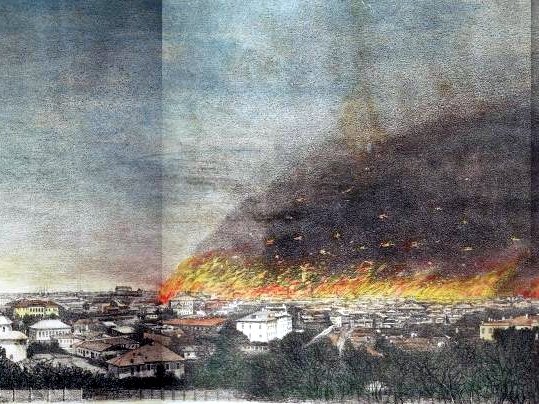
On March 23, 1847, Easter Sunday, a devastating fire destroyed approximately 1,850 buildings in Bucharest and claimed 15 lives. Shops, inns, churches and homes across the city center went up in flames. It was one of the worst disasters in the Romanian capital's history, but it was neither the first nor the last time fire would permanently change the city.
Over the centuries, fires destroyed princely residences, erased important landmarks and forced authorities to reconsider how Bucharest was built. In 2015, the Colectiv nightclub tragedy showed that the danger of fire was far from a thing of the past. This time, the scale of the disaster was measured not in buildings lost, but in human lives.
The fires of 1712 and 1718. When the Princely Court burned
At the beginning of the 18th century, Bucharest was particularly vulnerable to fire. Many houses were built of wood, roofs were covered with wooden shingles, and narrow streets allowed flames to spread quickly from one building to another.
In August 1712, a fire damaged the Princely Court itself. Historical records indicate that the roofs of houses belonging to the ruler's sons burned, along with other nearby structures.
Six years later, in February 1718, a much more powerful fire devastated central Bucharest. Flames once again engulfed buildings within the Princely Court, while contemporary accounts suggest that vaulted structures were among the few to survive.
The destruction is documented in historical accounts of the Old Princely Court, including material published by the Archdiocese of Bucharest.
These fires contributed to the deterioration of the old princely residence. However, the complex's gradual disappearance had several causes, including abandonment and subsequent changes to the city.
The fire of 1739. Homes, shops and churches destroyed
On February 27, 1739, another major fire caused extensive damage in Bucharest. Historical records list 16 large houses, 49 medium-sized houses, 77 small houses, nine shops and five monastic cells among the buildings destroyed.
Several religious buildings were also affected, including the Saint Sava Monastery and the church at Colțea. In total, historical sources mention five churches damaged by the fire.
In 18th-century Bucharest, losing a monastery meant much more than losing a place of worship. Such institutions often supported schools, accommodation, commercial activities and other services essential to the surrounding community.
Details of the 1739 fire appear in research published in Revista Monumentelor Istorice, the Romanian Journal of Historic Monuments.
The fire of 1804. The blaze that devastated the merchants' quarter
In August 1804, a major fire swept through Bucharest's commercial center. Beginning in the Șelari area, the flames spread through the market district, destroying homes, shops and inns.
Among the affected buildings were the Saint George Inn and the Șerban Vodă Inn, two important landmarks in the city's commercial life.
Historical estimates vary considerably. Some sources mention between 500 and 600 houses and shops destroyed, while other contemporary accounts suggest much greater losses. These differences reflect the difficulty of assessing damage in a city without modern administrative records.
The disaster prompted authorities to introduce measures intended to reduce the risk of future fires. Prince Constantin Ipsilanti ordered chimneys to be cleaned, restrictions on hay storage and the widening of certain streets to prevent flames from spreading so easily.
These measures are discussed in the study “Fires, epidemics and natural disasters in Bucharest (1774–1834)”, published by the Bucharest Municipality Museum.
One of the inns affected by the fire would eventually disappear, and the National Bank Palace was later built on its site. Its story is part of Bucharest's wider history of vanished inns and the buildings that replaced them.
The fire of 1812. How the princely residence on Dealul Spirii disappeared
In December 1812, a fire destroyed the New Princely Court, a residence built during the reign of Alexandru Ipsilanti on Dealul Spirii.
The palace was one of Bucharest's important buildings. It contained administrative rooms, ceremonial spaces and private apartments intended for the ruler. Following the fire, the complex was never rebuilt.
Its ruins became known as Curtea Arsă, meaning “the Burned Court,” a name that remained part of the city's collective memory for many years.
Count Auguste de Lagarde, who witnessed the fire, described the flames engulfing the palace and the intense light produced by the blaze. Unlike some other devastating fires, this one did not spread across the entire neighborhood, as efforts to contain it prevented further destruction.
The event is documented by the Bucharest Municipality Museum and is also discussed in the historical study prepared for the city's updated urban planning documentation.
The Great Fire of 1847. The Easter Sunday that destroyed central Bucharest
On March 23, 1847, Easter Sunday, a fire broke out near Saint Demetrius Church and spread at a speed that proved almost impossible to control.
According to a well-known historical account, the fire may have started when a child fired a pistol and burning material landed in an area where hay was stored. This remains an explanation passed down through accounts from the period, rather than a cause established through a modern investigation.
Strong winds helped the flames spread. Large sections of central Bucharest were affected, including Lipscani, Șelari, Franceză Street, the Old Princely Court, Colțea and Saint George.
Historical estimates indicate that approximately 1,850 buildings were destroyed or damaged and 15 people lost their lives. Hundreds of shops, numerous inns and several churches were among the losses.
One of the landmarks affected was the Constantin Vodă Inn, built during the reign of Constantin Brâncoveanu. The fire contributed to its deterioration, and the building eventually disappeared from Bucharest's urban landscape.
The inn's history illustrates how the Great Fire accelerated the disappearance of buildings that had once played an important role in the capital's commercial and social life.
The 1847 disaster also changed the way authorities approached urban planning. Reconstruction created opportunities to alter streets and buildings, while fire prevention became an increasingly important concern.
Figures describing the scale of the disaster are recorded in the Romanian Journal of Historic Monuments.
The Colectiv fire of 2015. The tragedy that changed Romania
On October 30, 2015, a fire broke out at the Colectiv nightclub, located at 7 Tăbăcarilor Street, inside the former Pionierul factory complex. It became one of the deadliest tragedies in Romania's recent history.
That evening, the band Goodbye to Gravity was performing at the launch of its album Mantras of War. Pyrotechnic effects used during the concert ignited flammable materials near the stage, and the fire spread rapidly.
Twenty-seven people died on the night of the disaster. Others subsequently died in hospitals in Romania and abroad. The death toll eventually reached 65, including a survivor who died in 2017 and was later included in the commemorative count.
Unlike the great fires of earlier centuries, Colectiv did not destroy an entire neighborhood or hundreds of buildings. Instead, it exposed serious failures in fire safety, the authorization of public venues and the healthcare system's ability to treat patients with severe burns.
The tragedy triggered widespread protests and led to the resignation of the government headed by Prime Minister Victor Ponta. It also sparked a national debate about institutional accountability and public safety.
Eleven years after the fire, its consequences continue to affect victims' families and survivors. Questions surrounding building permits, fire safety compliance and the treatment of severe burn patients remain part of the public debate.
How fires changed Bucharest's building regulations and public safety
In old Bucharest, flames spread quickly because of the materials used in construction, the small distances between buildings and the lack of effective firefighting equipment.
Repeated disasters gradually pushed authorities to introduce rules concerning street widths, building placement and fire prevention. Specialized firefighting services also emerged in a city where, for a long time, church bells had been used to warn residents of approaching danger.
One symbol of this development is the Fire Tower, or Foișorul de Foc, built between 1890 and 1891. The tower was used to monitor the city and detect fires at a time when spotting smoke from above could make the difference between a quick response and a major disaster.
Today, the risks are different, and fire safety legislation is far more complex. Modern regulations cover evacuation routes, construction materials, protective systems and the conditions under which certain buildings must obtain fire safety authorization.
Yet the Colectiv tragedy demonstrated that having regulations in place does not, by itself, guarantee that they will be followed.
Walking through Bucharest's Old Town today, it is difficult to imagine how many buildings that stood here two or three centuries ago disappeared in fires. Streets such as Lipscani, Șelari and Franceză preserve historic routes and names, but many of the original structures were replaced after fires, earthquakes or major urban transformations.
From the blazes that destroyed princely residences and commercial districts to the Colectiv tragedy, Bucharest's history shows just how profoundly fire can change a city. Sometimes, entire buildings and streets disappear. At other times, the consequences are measured in lives lost and questions that society continues to struggle to answer.