The History of Bucharest’s First Coffeehouse and the Mystery of Old-Fashioned Șerbet
By Eddie Țone
- Articles
- 05 NOV 26
Back when Bucharest had muddy streets, merchants counted their money in gold ducats, and rulers depended on the goodwill of the sultan, a former Ottoman Janissary embarked on a surprisingly modern business venture for the year 1667. He opened a coffeehouse. His name was Kara Hamie, and his establishment stood roughly where the imposing Palace of the National Bank of Romania stands today. An amusing coincidence, considering that, a few centuries later, Bucharest residents would end up paying prices for a cup of coffee that might have given even a merchant from the Phanariote era something to think about.
Coffee was brewed in a cezve, or traditional Turkish coffee pot, and served in small cups, following the Oriental custom. People gathered around it to chat, exchange news, and discuss the affairs of the city. Several generations later, the coffee ritual would become increasingly associated with one of the great indulgences of Romanian households: șerbet, a sweet, fragrant paste served in small quantities alongside cold water.
There is one qualification worth making: the recipe for any șerbet that might have been served at Kara Hamie's coffeehouse remains unknown, and there is currently no documentary evidence that such a delicacy was ever on his menu. Fortunately, Romanian culinary history has preserved old șerbet recipes, including some recorded by Bucharest confectioners. They reveal quite a lot about the tastes of a city that spent several centuries somewhere between the Turkish coffee pot and the French pâtisserie.
1667: A Former Janissary Opens Bucharest’s First Known Coffeehouse
The first Bucharest coffeehouse documented in works of urban history dates back to 1667, during the reign of Radu Leon, who ruled Wallachia between 1664 and 1669. Its owner was Kara Hamie, a former Janissary whom historians of coffeehouse culture describe as having served in the guard of the imperial palace in Constantinople.
Much of the merchant's personal story remains unknown. The historical sources consulted preserve his name, his previous occupation, and the existence of his coffeehouse, but provide little information about his life. His choice of location, however, tells us something about his commercial instincts.
The coffeehouse stood near the Princely Court, in the area where Șerban Vodă Inn would later be built. This was Bucharest's commercial and administrative centre, with a constant flow of people and goods. Anyone hoping to find out what was happening in the city had every reason to pass through.
Today, the site is occupied by the Palace of the National Bank of Romania, built between 1884 and 1890 to designs by French architects Albert Galleron and Cassien Bernard. Șerban Vodă Inn, erected in the 17th century, was demolished to make way for the new banking headquarters.
There is a small chronological detail here: in 1667, Șerban Vodă Inn had yet to be built. Historians therefore use its later location as a retrospective geographical reference when identifying the site of the first coffeehouse.
Information about the appearance of Kara Hamie's establishment is scarce. No plans, furniture inventories, or sufficiently detailed contemporary descriptions survive to allow an accurate reconstruction. Any image showing colourful cushions and merchants smoking around a low table is therefore an artistic interpretation inspired by Ottoman coffeehouses of the period.
One interesting detail, however, appears in the research of Silvia Colfescu, the author of several works devoted to old Bucharest. In 1691, Kara Hamie's coffeehouse was sold to another Turk, Kavaz-Bașa.
The establishment thus had a documented history spanning more than two decades, in a city where fires and political upheavals could overturn commercial fortunes almost overnight.
Why Coffee Caught On in a City Accustomed to Wine and Inn Life
In the 17th century, Bucharest was under the political and cultural influence of the Ottoman Empire. Merchants travelled between the Romanian Principalities and Constantinople, while Oriental goods reached the city's markets along with the customs of the people who brought them.
Coffee was already part of a well-established urban culture in the Ottoman capital. Historians of the Ottoman Empire date the first famous coffeehouses in Constantinople to the mid-16th century, approximately a hundred years before the first documented coffeehouse in Bucharest.
The drink offered an obvious social advantage. It could be enjoyed during lengthy conversations, while its stimulating effect was particularly welcome among people with business to discuss. Throughout the Ottoman world, coffeehouses had become meeting places where news circulated and political events were debated.
Even the name travelled with the custom. The Romanian word cafenea derives from the Turkish kahvehane, formed from kahve, meaning coffee, and hane, meaning house or establishment.
Bucharest residents adopted the word and adapted the institution to their own city, displaying their practical willingness to borrow anything that made life a little more enjoyable.
In such establishments, coffee was prepared in the Oriental manner, using very finely ground beans brewed in a cezve. The resulting drink was strong and concentrated, with the characteristic grounds gradually settling at the bottom of the cup.
The small cups served a purpose. Coffee was sipped slowly, and conversations could continue long after the cup was empty. The habit of spending time over coffee would remain a constant feature of Bucharest life, even as the furniture and prices changed dramatically.
Coffeehouses Become Places for Political Debate. The Authorities Begin to Worry
Initially, Bucharest's coffeehouse owners were mainly merchants who had arrived from the Ottoman world. As the custom spread, the number of establishments increased, attracting an increasingly diverse clientele.
During the reign of Constantin Brâncoveanu, between 1688 and 1714, coffeehouses gained ground. Silvia Colfescu mentions several such establishments along Podul Beilicului, a thoroughfare later known as Calea Șerban Vodă.
A few decades later, documents mention Gheorghe Cafegiul, who ran his establishment on the street leading towards the butcher shops near Scaune Church. Bucharest therefore already offered the opportunity to enjoy a coffee close to the meat market, where the bustle of trade provided plenty of material for conversation.
By the late 18th century, coffeehouses had become important enough to attract the attention of the authorities.
During the Austrian occupation of 1789–1791, the Divan, the princely council, prohibited political discussions in coffeehouses, threatening owners with the closure of their establishments.
The measure reveals something about the atmosphere of the time. Before the emergence of the modern press, coffeehouses provided access to news and commentary. A merchant might hear about changes on the throne, a civil servant could pick up the latest rumours, and a particularly talkative customer had the opportunity to explain, with remarkable confidence, exactly what the authorities ought to be doing.
The ban confirms that such conversations had acquired enough significance to cause political unease. Bucharest had already discovered its taste for debates over coffee.
Another interesting detail concerns public bathhouses. Some had rooms specifically set aside for coffee, where customers could rest and chat after bathing. The custom came from Ottoman culture, in which public baths also played a significant social role.
Cafeneaua Veche on Covaci Street and the Confusion Between Two Beginnings
The history of Bucharest's coffeehouses contains a complication frequently encountered in tourist presentations. Kara Hamie's establishment, documented in 1667, is sometimes confused with the famous Cafeneaua Veche, or Old Coffeehouse, on Covaci Street. The two, however, belong to different historical periods.
Cafeneaua Veche stands at number 16, near Sfântul Anton Square. Silvia Colfescu mentions a document from 1781 referring to the building, while numerous contemporary accounts give 1812 as a landmark year in the coffeehouse's commercial history.
The building survived the transformations of Bucharest's historic centre and appears in a photograph taken by Ludwig Angerer in 1855. The image is particularly valuable because it captures the neighbourhood after the great Bucharest fire of 1847, which destroyed a substantial part of the city centre.
In Angerer's photograph, the coffeehouse appears near the Old Princely Court Church, in an urban landscape still bearing the scars of the fire.
In November 2022, the establishment on Covaci Street reopened after renovation under the name Cafeneaua Veche 9.
Bucharest's coffeehouse history therefore has two distinct landmarks. Kara Hamie is associated with the city's first documented coffeehouse, while the building on Covaci Street represents one of the oldest surviving architectural reminders of Bucharest's coffeehouse culture.
Șerbet, Old Bucharest’s Little Sweet Indulgence
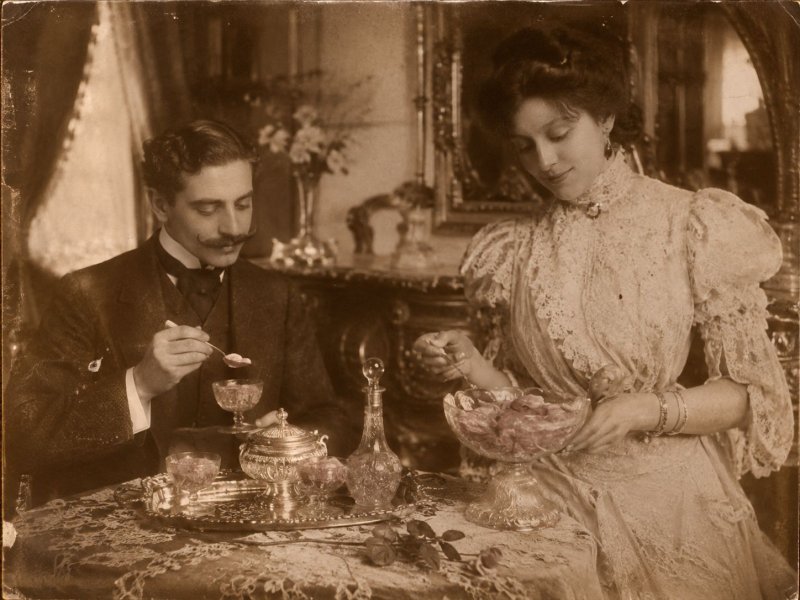
In Bucharest's wealthier households, hospitality followed its own set of rules. Guests were welcomed with fruit preserves or șerbet and cold water, while in homes that had adopted Oriental customs, coffee naturally became part of the ritual of receiving visitors.
Romanian șerbet was a concentrated confection made by boiling sugar and working the syrup until it formed a smooth paste. It was eaten in small amounts, usually with a teaspoon, accompanied by a glass of water.
In Ottoman tradition, the term şerbet primarily referred to a sweet drink made with water and aromatic ingredients. In Romania, however, the word came to refer mainly to the creamy, sugar-based paste familiar from old cookbooks.
The two preparations belong to the same culinary family, but their difference in consistency deserves attention. Otherwise, anyone attempting to reproduce Romanian șerbet using a Turkish drink recipe could end up with something entirely different.
The confection was flavoured with natural ingredients, and the varieties depended on the season and the skill of the person preparing it. Roses enjoyed a particularly privileged position, thanks especially to their fragrance, which could transform a small quantity of sugar into a dessert intense enough to be enjoyed in the tiniest portions.
In traditional households, making șerbet required patience. The syrup had to be boiled to the correct consistency and then vigorously worked, a process that changed its texture and colour. The finished confection could be stored in jars and served to guests later.
To a modern Bucharest resident accustomed to buying desserts by the kilogram, the ritual of serving a single teaspoon of șerbet might seem rather stingy. But the preparation was extremely concentrated, and the gesture was as much about hospitality and the pleasure of conversation as it was about satisfying a sweet tooth. The custom of treating guests to șerbet survived in Bucharest well into the 1970s and 1980s.
Who Invented Bucharest’s Șerbet, and Where Did the Original Recipe Disappear?
Șerbet has Oriental roots, and its preparation spread throughout the Romanian lands through centuries of contact with the Ottoman world. It would, however, be risky to attribute any single recipe to Bucharest's earliest coffeehouses.
The historical information identified about Kara Hamie's establishment contains no menus or preparation instructions. Consequently, any supposed original recipe dating from 1667 remains a hypothesis unsupported by documentary evidence.
There is, however, a fascinating explanation for the disappearance of many old recipes. Confectioners guarded their professional secrets with a determination worthy of an intelligence agency.
The testimony comes from a Bucharest confectioner himself, Emil Frederic, who published Manual practic de cofetărie pentru cofetari și particulari (Practical Confectionery Manual for Confectioners and Home Cooks) in 1928, through the Cultura Românească publishing house.
Frederic recalled his apprenticeship and the masters' habit of concealing their recipes. Some worked behind closed doors, away from the eyes of their employees. Others kept the weights used on their scales in their pockets, making it difficult for apprentices to discover the quantities of the ingredients.
Such trade secrets might be passed down within a family or entrusted to a reliable associate. If the master died and the recipe had never been written down, the possibility of reproducing it exactly disappeared with him.
Frederic even gives the example of his former employer, the confectioner Fialkowski, who prepared certain products in a separate room. The irony is that Frederic himself eventually published a manual explaining the production techniques. Thanks to him, some of the methods used by earlier confectioners have survived.
The 1928 Rose Șerbet Recipe Preserved by Confectioner Emil Frederic
Among the historical recipes identified, the one published by Emil Frederic in 1928 deserves particular attention. It comes from a confectioner who worked in Bucharest and provides precise information about the preparation technique.
Rose șerbet was made in two stages. First, the fragrant juice was extracted from the petals. It was then incorporated into sugar syrup boiled to the required consistency.
To prepare the extract, Frederic recommended using one kilogram of rose petals. The petals were gradually heated in a vessel, with small additions of water and constant stirring, until they began to release their juice. Once cooled, they were squeezed in small batches, and the resulting liquid was reserved for the șerbet.
For each kilogram of sugar, the author specified approximately 600–650 grams of liquid for the initial dissolving and boiling of the syrup. For the rose-flavoured version, he recommended up to 150 grams of aromatic juice, added during the stage when the consistency was adjusted.
The boiling process required close attention. The confectioner checked the concentration using the traditional method of testing the syrup between moistened fingers. After boiling, the syrup was allowed to cool partially and then vigorously stirred with a wooden rod until it began to turn white and thicken.
The colour could be adjusted, and additional rose juice could be used to enhance the flavour. Finally, an acidic ingredient was added according to the recipe's instructions.
From a culinary perspective, the vigorous stirring is essential. It encourages the formation of extremely small sugar crystals, which give șerbet its smooth consistency. The syrup gradually develops an opaque, creamy texture.
This is a documented recipe from 1928, preserved through the publication of Frederic's manual and later republished by food journalist Simona Lazăr. It provides concrete evidence of the șerbet made in Bucharest's interwar confectioneries, although it belongs to a period much later than Kara Hamie's coffeehouse.
Sanda Marin and a Șerbet Recipe You Can Still Make Today
Another useful historical recipe appears in Carte de bucate (Cookbook), the celebrated work by Sanda Marin, first published in 1936.
Her version of rose șerbet uses 250 grams of rose petals, one litre of water, and one kilogram of sugar, with a small addition of citric acid.
The petals are boiled in water until the volume of liquid has decreased considerably. After cooling, the juice is strained, and part of it is used to dissolve the sugar and prepare the syrup.
Next comes the delicate stage of boiling the mixture until it reaches the correct consistency. Once partially cooled, the syrup is worked with a wooden rolling pin. When it begins to change colour, the acidic solution is gradually added. The finished șerbet is then transferred to jars.
The method explains why making șerbet required experience. Excessive boiling could cause the mixture to harden, while insufficient working could leave the syrup too runny or result in uneven crystallisation.
Sanda Marin thus provides an accessible version of a confection that already had a long history in Romanian gastronomy.
For a modern reproduction, the proportions and technique described in the book should be followed, using a sugar thermometer instead of the traditional finger test. This is also the safest way to monitor the boiling of extremely hot syrup.
From the Turkish Coffee Pot to the Literary Coffeehouses of Calea Victoriei
Between Kara Hamie's coffeehouse and the sophisticated establishments of the 19th century, Bucharest underwent a considerable transformation.
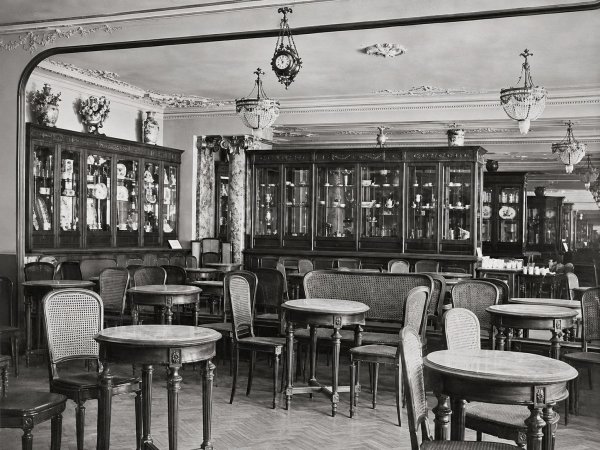
Oriental fashions gradually began to share the stage with Western influences. New foods and sweets appeared on coffeehouse tables, while interior designs increasingly followed Viennese and Parisian models.
One of the notable figures of the period was Fialkowski, the owner of a coffeehouse near the old National Theatre, on Câmpineanu Street, at its intersection with Calea Victoriei.
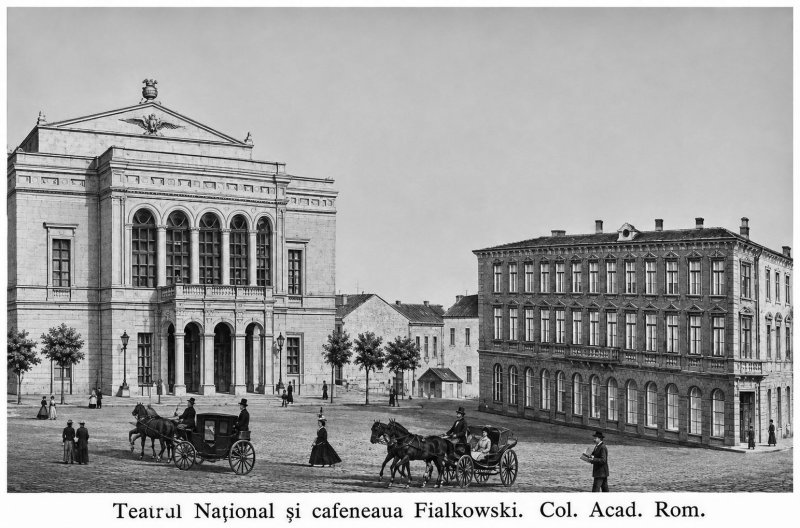
The establishment attracted writers and cultural figures. Alexandru Odobescu and Nicolae Filimon were among the personalities associated with the coffeehouse. According to works devoted to the history of Romanian coffeehouses, Alexandru Macedonski wrote some of his youthful poems there.
By the second half of the 19th century, such establishments had become genuine meeting places for the city's intellectual circles.
An advertisement published in 1857 by Wilhelm Ungar, the proprietor of the Hotel de Londres on Podul Târgului de Afară, illustrates the changing tastes of the period. The merchant promoted his new coffeehouse by comparing its elegance to that of Europe's great establishments.
The ambition was clear. Bucharest was beginning to aspire to the refinement of Western coffeehouses, and proprietors understood the commercial advantages of acquiring such a reputation.
Later, Casa Capșa would become one of the symbols of Bucharest's culinary culture.
The history of the Capșa family also preserves a story involving roses. Food journalist Simona Lazăr recounts an episode concerning the merchant Vasile Capșa, who, after an unsuccessful business venture in Crimea, reportedly began making rose petal preserves in Bulgaria. The story is interesting for what it suggests about the movement of recipes across the region's trading networks, although its details come from retrospective historical accounts.
As Bucharest developed a taste for French confectionery, Oriental-style șerbet gradually began to seem old-fashioned. Emil Frederic observed this shift in the years following the First World War.
The confection nevertheless survived in private homes, where recipes passed from one generation to another, preserving something of the rituals of hospitality from earlier times.
What Remains Today of the First Coffeehouse and Bucharest’s Old Customs?
All that remains of Kara Hamie's coffeehouse is a historical record, a name, and an approximate location in Bucharest's Old Town. The building has disappeared, and the food and drinks it once served can only be studied through comparison with documented culinary practices of the period.
Coffeehouse culture, on the other hand, has survived every transformation of the city. Bucharest residents have kept their habit of meeting over coffee, even if the traditional Turkish coffee pot has largely given way to modern espresso machines.
Șerbet followed a different path. It became associated primarily with memories of traditional households and family recipes. Preparing it takes time and careful technique, while its intensely sweet flavour belongs to a culinary tradition quite different from today's prevailing tastes.
Perhaps the most appealing detail in this entire story lies in the contrast between two worlds. In 1667, a former Janissary was selling coffee in a Bucharest shaped by Oriental influences. In 1928, a Bucharest confectioner trained in some of the world's leading culinary centres was publishing methods for preparing șerbet, just as the dessert was beginning to look outdated.
More than two and a half centuries of changing culinary tastes, fashions, and urban customs separate the two men.
The first coffeehouse has vanished from the cityscape, but its owner's name has survived. The original recipes of the 17th century remain unknown, yet the șerbet recipes recorded by Emil Frederic and Sanda Marin can still be prepared today.
And if a Bucharest resident were to offer guests a teaspoon of rose șerbet today, followed by a glass of cold water and a cup of Turkish-style coffee, the gesture would carry several centuries of history. With one small difference: in today's Bucharest, the guest would probably ask whether there was a little milk for the coffee, too.
You may also like: Symbols of Bucharest: Casa Capșa, “the only intellectual venue” of the interwar period