The mystery of the tunnels beneath Cișmigiu. Urban legend or strategic reality? What lies beneath Bucharest’s oldest park
By Eddie Țone
- Articles
- 07 NOV 26
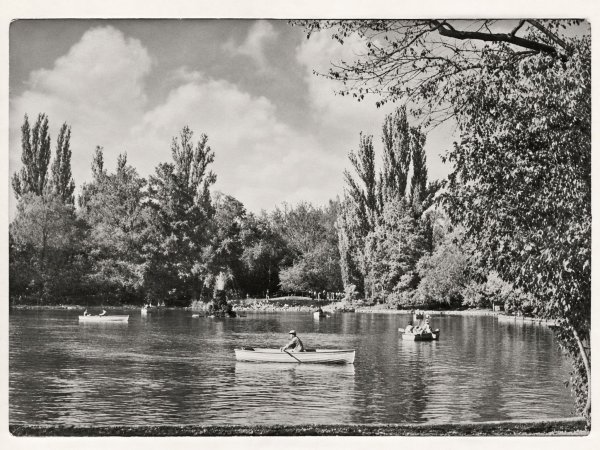
On the surface, Cișmigiu is one of the few places in Bucharest where time seems to have reached a special arrangement with the people who spend it there. Pensioners play chess, couples claim the benches overlooking the lake, and ducks go about their business like property owners who graciously tolerate visitors. A few metres below, however, the city's stories describe an entirely different world. Underground galleries, concealed exits, escape routes for aristocrats, and secret passages supposedly connecting palaces hundreds of metres apart. Legend or genuine reality?
For decades, the underground world beneath Cișmigiu has fuelled the imagination of Bucharest residents. Some accounts describe a tunnel linking Kretzulescu Palace to the Dâmbovița River. Others mention a connection to Schitu Măgureanu Church or even an extensive network reaching into the historic city centre. In 2013, the story acquired an official dimension when Mayor Sorin Oprescu announced the discovery of underground sections and his intention to restore them.
But how much truth is there in these accounts? Bucharest certainly has historic underground structures, some of which served defensive purposes. The problem arises when a cellar becomes, with each retelling, a kilometre-long escape tunnel, and a poorly documented gallery turns into a veritable secret highway for the aristocracy.
The story begins with a park built over a former marsh
To understand the mystery of Cișmigiu's underground passages, we need to return to a time when Bucharest had a rather complicated relationship with water.
In the 18th century, the area now occupied by the park was dominated by marshland known in historical documents as Balta lui Dura Neguțătorul, or Dura the Merchant's Pond. Bucharest at the time had numerous ponds and waterways, while the absence of a modern sewage system turned certain neighbourhoods into places where investing in a decent pair of shoes was a risky financial decision.
In 1779, Prince Alexandru Ipsilanti ordered the installation of public fountains to supply the city with water. Dumitru Siulgi-bașa, the official responsible for supervising the fountains, lived near one of them. His position was associated with the title of mare cișmigiu, or chief overseer of the fountains. This is where the park's name comes from.
The transformation of the marsh into a public garden was initiated during General Pavel Kiseleff's administration and took shape under the rule of Gheorghe Bibescu. In 1847, landscape architect Wilhelm Mayer was commissioned to develop the site. The work gradually transformed the area into a public promenade, with the garden's official opening generally dated to 1854.
Why do these details matter to the tunnel story? Because the ground beneath Cișmigiu was shaped by water over a very long period. Creating the park involved excavation and changes to ground levels. Historical documents concerning work in the garden mention clearing ponds and channels, as well as removing mud to reshape the landscape.
In the documentary archive presented by the Arhiva de Arhitectură project, a report on the work carried out in Cișmigiu explicitly describes removing mud and using excavated soil to terrace the garden.
This is a valuable detail, demonstrating that work below ground level has long been part of the site's history. However, hydraulic channels and galleries designed for people to walk through are two different types of structures. That distinction becomes essential when trying to establish what really happened.
Kretzulescu Palace, the building at the centre of the mystery
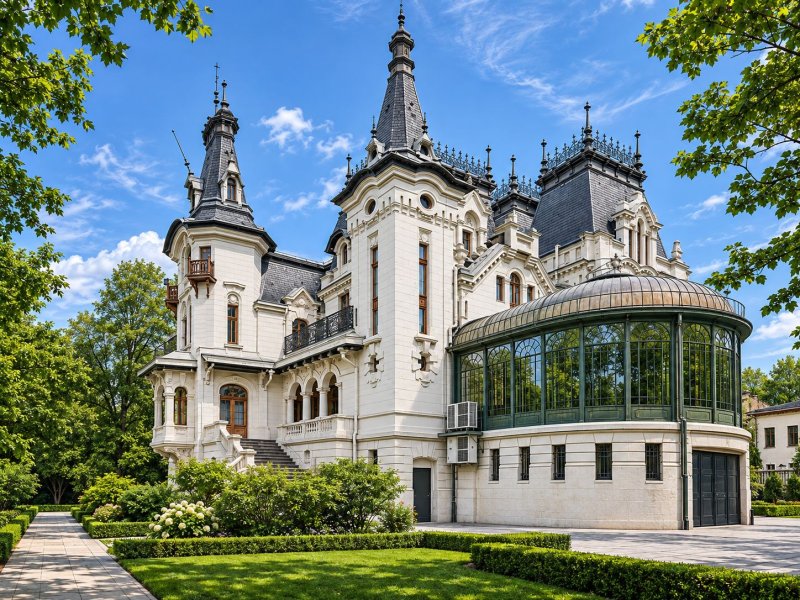 Kretzulescu Palace
At the northern edge of Cișmigiu, towards Știrbei Vodă Street, stands Kretzulescu Palace. It is one of those Bucharest buildings that seem to belong to a city with considerably more confidence in architectural ornamentation.
The present palace was built between 1902 and 1904, designed by architect Petre Antonescu at the initiative of Elena Kretzulescu. Its owner came from an influential aristocratic family and wanted a residence worthy of her social standing.
Antonescu would go on to become one of Romania's leading architects, with his name also associated with projects such as Bucharest's Arch of Triumph.
Kretzulescu Palace displays influences from French Renaissance and Baroque architecture. Its terraces and relationship with the surrounding garden contribute to its striking appearance. The history of the building and its owner was also documented in a book devoted to the palace, discussed by Dilema veche magazine in 2022.
It is precisely this building that features in one of the most persistent stories about Cișmigiu's underground passages.
According to these accounts, an underground gallery supposedly began near the palace, crossed part of the garden, and continued towards the Dâmbovița River. Other versions suggest a connection to Schitu Măgureanu Church.
Naturally, such connections would have had an obvious purpose for an aristocratic residence. During periods of political instability, an escape route could provide a considerable advantage.
But this is where a chronological problem emerges. The present palace dates from the beginning of the 20th century, whereas some stories place the area's underground galleries in the 18th century or even earlier. If an older passage existed, it would have had to belong to an earlier building and perhaps have been incorporated into the property later.
The hypothesis is historically plausible. Documenting it, however, is another matter entirely.
The Schitu Măgureanu connection. What Radio Romania International reported
One of the more interesting accounts of Cișmigiu's underground passages appeared on 28 July 2014 in an article by journalist Steliu Lambru for Radio Romania International, entitled Subteranele Bucureștilor (The underground passages of Bucharest).
The article discusses the existence of historic underground structures in the capital and explicitly mentions a connection between Schitu Măgureanu Church, located northwest of the park, and Kretzulescu Palace. The distance between the two landmarks is approximately 100 metres.
The claim deserves attention because it appears in a journalistic feature devoted to urban history, which also includes commentary from an architecture specialist. However, in the case of this particular passage, the article describes the connection without providing a technical plan of the gallery, archaeological dating, or documentation of an investigation covering its entire route.
The account therefore offers an interesting historiographical clue, but leaves the question of physically identifying the passage unresolved.
Schitu Măgureanu Church has a history of its own dating back to the 18th century. The proximity of old religious and aristocratic properties makes the existence of cellars or underground spaces associated with various buildings plausible.
What remains to be established is whether a continuous gallery actually existed between the two locations, how old it was, and what purpose it served.
After all, there is quite a difference between saying that two buildings had basements and proving that those basements were connected by a walkable passage. Roughly the difference between having two metro stations and having an actual metro line running between them.
Augustin Ioan and the historical explanation for escape tunnels
The same Radio Romania International article features Professor Augustin Ioan, a specialist in architectural history and theory at the Ion Mincu University of Architecture and Urbanism. His explanation shifts the discussion towards much firmer historical ground.
Medieval and early modern Bucharest had a different status from the great fortified cities of Central Europe. Under Ottoman domination, the ability to fortify urban centres in Wallachia was limited, while the threat of violent political upheaval made rapid escape a genuine concern for members of the elite.
Augustin Ioan refers to the tradition of underground escape routes and offers the example of Ghica Palace in the Tei neighbourhood, where he says he personally saw such structures. According to the professor, some were even large enough to accommodate a horse-drawn carriage, perhaps the most revealing detail in the entire discussion about Bucharest's tunnels.
On the one hand, we have an architect's firsthand testimony concerning underground escape routes at a historic residence. On the other, we have accounts of Cișmigiu, for which the published documentation remains considerably more limited.
In the same interview, Augustin Ioan also mentions the tradition of a supposed passage associated with Prince Alexandru Ipsilanti, along with stories about underground access to Cișmigiu. His wording, however, preserves the distinction between what he personally observed and what survives as historical anecdote.
“La Cetate”, where the legend acquires a secret entrance
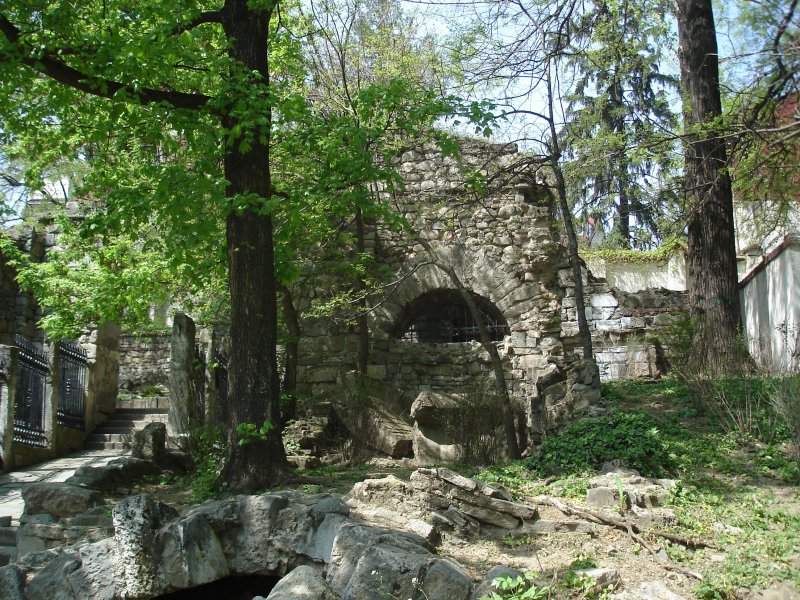 La Cetate / Photo: Wikipedia
Some stories about Cișmigiu's tunnels point to a particular place in the garden known as “La Cetate”, meaning “At the Fortress”.
Accounts published over the years describe the ruins of a religious building here, associated with a monastery supposedly founded by a member of the Văcărescu family and dated in some texts to 1756. According to the same version, the entrance to a passage connecting the Kretzulescu Palace area to the Dâmbovița River was located near the ruins. The entrance was supposedly sealed later, while part of the gallery allegedly collapsed.
The story was repeated by Antena 3 in an article published in January 2016 and by Evenimentul zilei in May 2020. There is, however, a problem.
The articles reproduce the information about the monastery and tunnel without identifying, in the materials examined, a founding document, a plan of the gallery, or the results of archaeological research establishing the passage's route and age.
The attribution of the ruins to a monastery dating from 1756 should therefore be treated with caution. The presence of old walls or ruin-like structures provides a starting point for investigation, not automatic proof of an underground network, particularly in a historic garden whose landscape has been repeatedly altered and redesigned.
“La Cetate” remains one of the most intriguing elements of the mystery precisely because it gives the story a physical landmark, although one that needs to be checked against historical maps and heritage records.
Sorin Oprescu and the 19–20 underground sections announced in 2013
Perhaps the most spectacular relatively recent episode in the story occurred in April 2013. Sorin Oprescu, Bucharest's mayor at the time, declared that the authorities had discovered a tunnel starting in Cișmigiu Park and reaching the banks of the Dâmbovița River.
According to a report published by B365 on 6 April 2013, the mayor spoke about old passages supposedly connecting important buildings, which the municipality intended to restore. Oprescu also claimed that approximately 19–20 tunnel sections had been identified across Bucharest.
His statement included a technical detail. The mayor said that a device was being used to check for possible blockages, allowing investigations to proceed without unnecessary excavation.
For urban history enthusiasts, the announcement sounded like the beginning of a remarkable discovery. Suddenly, galleries that had been talked about for generations were appearing on the city administration's agenda. Except that a mayor's statement and the archaeological documentation of a discovery are two very different things.
The 2013 report provides information about what the mayor claimed, but without the precise locations of the 19–20 sections, measured architectural drawings, photographs of their interiors, or a specialist report demonstrating the continuity of the Cișmigiu–Dâmbovița route.
The public materials consulted for this article provided the statement, but very little verifiable information about the actual investigation. A legitimate question therefore remains: what exactly was identified in 2013, and to what extent did those sections belong to historic galleries intended for human passage? The answer should be sought in the municipality's technical records.
A secret tunnel or a sewer? The distinction is essential
Bucharest has an underground infrastructure far older and more varied than its metro system. As the city modernised, sewage networks and other facilities needed for water management were constructed beneath its streets.
In Cișmigiu's case, the history of the site makes the issue even more interesting. The park was developed on marshy ground, while the lake and its water supply and drainage systems underwent successive modifications.
Historical documents concerning the garden record work on channels and ponds dating back to its earliest development.
An underground vaulted structure, however, can serve very different purposes. Some were designed to carry water, others for storage, and a few for people to move through.
Seen today, an old masonry gallery can immediately suggest a secret passage, particularly if its entrance has been sealed and the original documents have disappeared.
Determining its purpose requires examining construction details. Dimensions, gradients, and connections to other rooms can provide clues about the original function. Traces of installations and links to hydraulic networks can completely change the interpretation.
In an area with a history as complicated as Cișmigiu's, confusing a drainage channel with a passageway is a genuine risk. A passage leading towards the Dâmbovița might therefore be explained by a hydraulic requirement, although it could also have served another purpose. The route alone provides too little information for a verdict.
Administrative palaces and the capital's supposed strategic network
In accounts of underground Bucharest, Cișmigiu sometimes appears as part of a system extending towards the historic centre and the palaces along Calea Victoriei.
The story thus takes on a strategic dimension. The galleries supposedly allowed discreet movement between residences belonging to the political elite and buildings important to the city's administration.
There is, however, a problem with the idea of a single integrated network. Bucharest developed in stages, and the buildings mentioned in these accounts belong to different historical periods. Aristocratic residences from the 18th and 19th centuries had different requirements from the institutions of the modern state or the security facilities built in the 20th century.
An escape tunnel belonging to an aristocratic residence and a service gallery constructed during the communist period could certainly exist in the same city, but each would have its own history. To establish the existence of a common strategic system, researchers would need to determine when each gallery was built and which authority commissioned the work. Demonstrating physical connections between the discovered sections would be equally relevant.
The sources examined do not provide these elements for the supposed network crossing Cișmigiu and connecting the administrative palaces. Instead, there are numerous journalistic and popular versions of the story. Some extend the routes as far as Cotroceni or Dealul Mitropoliei, without presenting the corresponding technical documentation.
Another detail is worth considering. Kretzulescu Palace was built as a private residence, and linking it to a network of administrative palaces requires a separate chronological argument. The fact that a building subsequently housed public institutions changes its function, but tells us very little about the purpose of any galleries that might have been constructed earlier.
The 1989 Revolution and the revival of underground tunnel stories
Interestingly, stories about secret tunnels enjoyed a new wave of popularity after the Romanian Revolution of December 1989. During the chaotic days of the Revolution, numerous accounts circulated about alleged terrorists moving through underground galleries and emerging through hidden exits near the former Central Committee headquarters.
Augustin Ioan discusses this phenomenon in his Radio Romania International interview, connecting it to the atmosphere of fear and confusion at the time. It was a situation in which every manhole could suddenly acquire military significance, and stories about hidden passages found a remarkably receptive audience.
These accounts helped reinforce a dramatic image of underground Bucharest. Historic cellars, modern shelters, and alleged escape routes for political leaders were gradually mixed together into one story.
Cișmigiu, located a short distance from the centre of political power during the communist period, was naturally absorbed into this urban mythology. The history of the Revolution therefore helps explain the enduring popularity of these legends. People already had reasons to believe in hidden infrastructure, and the events of December 1989 gave old stories a contemporary setting.
What could prove the existence of the Cișmigiu tunnels?
For rigorous historical research, the municipal archives would be the best starting point. Administrative documents concerning the development of Cișmigiu Gardens already provide information about work carried out on the terrain and water systems. The Arhiva de Arhitectură project also presents documents from Bucharest City Hall's technical archives relating to properties neighbouring the garden and the opening of an entrance from Schitu Măgureanu.
A file identified in this collection, 25/1863, demonstrates the existence of historical documentation concerning the area. It deals with properties and access routes to the garden, but does not, in itself, constitute evidence of the underground passage described in the legend.
A second avenue of research would be the documentation of Kretzulescu Palace. The original plans drawn up by Petre Antonescu and measured drawings produced during later renovation work could clarify the layout of the basements. A similar investigation would be useful around Schitu Măgureanu Church.
As for the route towards the Dâmbovița River, research should also examine the city's old hydraulic infrastructure.
Modern geophysical surveying methods can identify certain underground anomalies under favourable ground conditions. The results would then need to be compared with historical documents and, where circumstances permit, verified through archaeological investigation. This could help distinguish a sewer gallery from a passage intended for escape or human movement.
So, what lies beneath Cișmigiu?
Beyond the charm of stories about aristocrats disappearing through floors and emerging on the banks of the Dâmbovița, the Cișmigiu mystery has several concrete historical reference points.
Bucharest did have underground structures designed, among other things, for escaping from important residences, a fact supported by Professor Augustin Ioan's testimony concerning Ghica Palace.
An explicit account of an underground connection between Schitu Măgureanu and Kretzulescu Palace was published by Radio Romania International in 2014. Another version, describing a gallery reaching the Dâmbovița River, circulated in the press and was repeated in Mayor Sorin Oprescu's statements in 2013.
At the same time, historical documents confirm that the ground and terrain beneath Cișmigiu underwent significant alterations connected with the development of the lake and water management.
What is missing from the public sources consulted is conclusive evidence of an identifiable strategic tunnel, with an established route, documented construction date, and verified purpose, connecting the palace to the Dâmbovița. There is even less evidence of a continuous network linking the administrative palaces of central Bucharest.
Historic tunnels in Bucharest are therefore a reality, while the supposed strategic network beneath Cișmigiu remains an insufficiently substantiated hypothesis. In a city where a simple excavation can uncover old foundations, and where the past has been buried beneath successive layers of construction, the boundary between legend and discovery remains surprisingly thin.
Next time you walk through Cișmigiu, past Kretzulescu Palace or towards Schitu Măgureanu, take a look at the ground beneath your feet. Under the paths where Bucharest residents stroll lies a history of landscape and construction that still awaits detailed investigation.
And if, one day, the plans of a genuine tunnel emerge, complete with an entrance, an exit, and the signature of the engineer who built it, Bucharest will finally have evidence worthy of its legend.
You may also like: 12 interesting things you may not have known about Cișmigiu Park