The Story of the Bucharest Metro Began in 1908: From Engineer Dimitrie Leonida's Idea to Ceaușescu's Initiative
- Articles
- 09 NOV 26
The capital's underground transport system today represents the backbone of urban mobility for hundreds of thousands of Bucharest residents, yet the journey from the first sketch on paper to the departure whistle of the first train took more than seven decades. The history of the Bucharest metro is a fascinating saga, marked by remarkable technical visions, financial deadlocks, world wars, ideological calculations, and colossal engineering efforts. What started as the graduation thesis of a young Romanian student at the beginning of the 20th century became, at the height of the communist era, Romania's most ambitious urban infrastructure construction site.
Dimitrie Leonida's 1908 Vision and the First Interwar Attempts
The conceptual beginnings of the Bucharest metro are inextricably linked to the name of Dimitrie Leonida, one of Romania's most brilliant engineers and scientists. In 1908, while a student at the Polytechnic School in Charlottenburg, near Berlin, young Leonida chose as the subject for his graduation thesis the project of building an underground transport network in the Romanian capital, entitled "The Bucharest Metropolitan." Drawing inspiration from the great European metropolises of the time, such as London, Paris, or Berlin, he rigorously analyzed the needs of a city experiencing rapid demographic and economic expansion.
The idea did not remain a mere academic exercise. Between 1909 and 1910, the Bucharest municipality was holding intense negotiations with the German company Siemens & Halske for the concession and construction of a modern electric tram network. In their capacity as members of the Bucharest Technical Council, engineers Dimitrie Leonida and Elie Radu intervened with a bold proposal.
The two specialists demonstrated with figures that the exorbitant sums requested by the German company for surface lines were large enough to cover the costs of building a first metro line. Unfortunately, the city's modest budget, the lack of courage of the administration at the time, and the outbreak of World War I buried the project for the next two decades.
The subject returned to the authorities' attention during the interwar period, along with the accelerated modernization of the capital. In 1929–1930, within the commission led by the renowned architect Duiliu Marcu, tasked with drafting the Master Plan for the Systematization of Bucharest, the issue of underground transport was put back on the table.
The specialists of the time concluded that the city's central arteries would quickly become choked with traffic, which is why an underground solution was imperative. Subsequently, between 1934 and 1936, new studies took shape aiming at introducing underground lines for trains or electric trams, but the economic crisis and the approach of World War II once again blocked any concrete initiative.
The 1950s Projects and the Geopolitical Deadlock
After the installation of the communist regime, the topic of the metro was resumed in a completely different political and technological context. Between 1950 and 1954, the authorities in Bucharest began the first serious institutional steps, establishing the General Directorate of the Bucharest Metro within the Ministry of Railways. Teams of engineers and designers drafted an extensive "technical memorandum on the construction of the metro in the city of Bucharest," which provided, in a first stage, for the construction of four main lines meant to connect the large neighborhoods and industrial platforms.
The plans of the 1950s were heavily influenced by the Soviet model, similar to the Moscow metro, characterized by tunnels dug at great depths, capable of also serving as fallout shelters in the context of the Cold War. However, geological studies revealed a major problem: Bucharest's soil is extremely difficult, consisting of sandy, clayey layers and rich groundwater tables, fed by the Dâmbovița and Colentina rivers.
The costs required for digging at great depths under these hydrogeological conditions proved to be huge, far exceeding Romania's economic possibilities at that time. Furthermore, the state's financial resources were directed primarily toward forced industrialization and post-war reconstruction, so in 1954 the project was once again abandoned, and the newly established directorate was disbanded.
The Political Decision of the 1970s and Nicolae Ceaușescu's Vision
The true turning point occurred only in the early 1970s, when the urban and industrial development of Bucharest reached a critical level. The city was expanding dizzyingly through the construction of large dormitory housing estates, such as Titan, Balta Albă, Drumul Taberei, Militari, or Berceni, while gigantic industrial platforms operated on the outskirts, such as IMGB, 23 August, Semănătoarea, or Pipera. Surface transport, provided by the Bucharest Transport Enterprise (ITB), could no longer cope with the massive flows of workers who had to cross the city daily.
In 1971, the ITB management submitted a report to the municipality demonstrating that surface public transport had reached its maximum capacity limit and that the only viable solution remained building the metro. The proposal quickly reached Nicolae Ceaușescu's desk, who understood both the practical necessity of the project and its enormous potential for propaganda and national prestige. On February 15, 1972, a central commission was established to draft the preliminary studies, and on November 25, 1974, the party and state leadership made the official decision to launch preparatory works.
Unlike the projects of the 1950s, Nicolae Ceaușescu imposed a completely different approach. He rejected the idea of monumental Soviet-inspired stations, considered too expensive and unnecessary, demanding a functional, fast network built as close to the surface as possible, wherever geological conditions allowed it. Additionally, the communist leader insisted that the design, technology, and rolling stock be produced almost entirely with Romanian resources, to avoid dependence on imports and demonstrate the capability of the national industry.
The Construction Site of the Century: How the First Main Line Was Built
In February 1975, the "Metroul" Bucharest Enterprise was founded, the institution that would coordinate the design and execution of the entire underground network. Actual construction began on September 20, 1975, the date when builders drove the "first stake" of the construction site. The pace imposed by the authorities was fast, mobilizing thousands of engineers, technicians, workers, and conscripted soldiers from across the country.
To overcome the difficulties of Bucharest's soil, Romanian engineers applied innovative technical solutions. On sections where the route followed the course of the Dâmbovița River, they opted for the cut-and-cover method, protected by reinforced concrete diaphragm walls, which required temporarily diverting the river and systematizing its riverbed. In densely built areas, where surface intervention was impossible, mechanized tunnel boring shields were used, some of them manufactured right in Romanian factories.
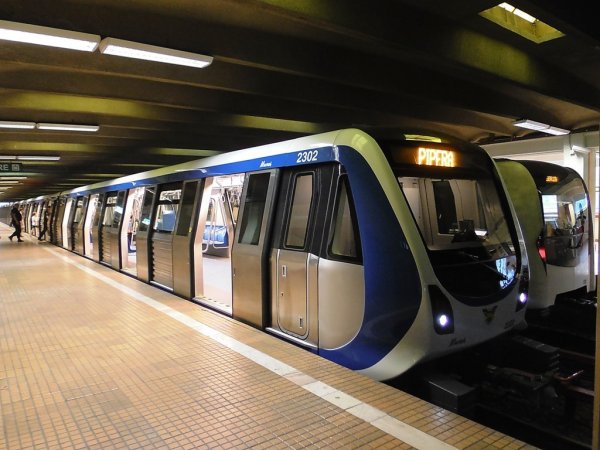
During this same period, at the Arad Wagon Enterprise (IVA), the design and manufacturing of the first Romanian metro trainsets began—the famous IVA trains, recognized for their robust design and stainless steel or distinctively painted bodies. Thus, Romania entered the select club of countries capable of building both their own metro infrastructure and the corresponding trains.
The 1979 Inauguration and the Legacy of a Visionary Project
After just over four years of intense underground work, the first section of Main Line 1 was ready for testing. With a length of 8.63 kilometers and six stations—Semănătoarea (today Petrache Poenaru), Grozăvești, Eroilor, Izvor, Piața Unirii, and Timpuri Noi—the line was experimentally opened to the public on November 16, 1979, just a few days before the 12th Congress of the Romanian Communist Party. The fare for a trip was set at one leu, and Bucharest residents stormed the stations, fascinated by the new means of transport. The official inauguration, in the presence of Nicolae Ceaușescu, took place a month later, on December 19, 1979, after all installations had passed operational tests.
Over the next decade, until 1989, the network experienced spectacular expansion at a construction pace rarely seen in Europe, reaching nearly 60 kilometers of double track and three major lines connecting the capital's main cardinal points. Although the pace of work slowed dramatically after the 1989 political changes due to a lack of funding, development continued gradually, currently reaching five main lines and over 60 stations.
We also recommend: Politehnica Metro Station, a hidden ocean beneath Bucharest