Bucharest stories: The first tram to appear in the capital was horse-drawn 150 years ago
- Articles
- 18 NOV 26
More than a century and a half ago, Bucharest took its first steps toward modern public transportation. On December 28, 1872, the capital’s first horse-drawn tram line entered service, beginning an era that would permanently change the way Bucharest residents traveled around the city. The image of a tram moving slowly along rails, pulled by two or more horses, may seem like something from another world today. In Bucharest in the 1870s, however, it represented a genuine technological innovation. The carriages offered a more comfortable journey than ordinary horse-drawn carriages, could carry more passengers and, thanks to the rails, could move more easily through the city streets. The arrival of the horse-drawn tram was not an isolated event. Bucharest was undergoing a period of rapid modernization following the Union of the Principalities and the city’s transformation into the capital of Romania. During the same period, infrastructure, public lighting, railways and major urban thoroughfares were developing. The tram would become one of the important elements of this process.
Where the idea of the tram came from
The history of the tram is older than the vehicles designed for urban public transportation. As early as the 18th century, rail tracks were being used mainly in mining and industrial operations. Benjamin Outram, an English engineer and builder of industrial infrastructure, played an important role in improving systems using metal plate rails, but he cannot be considered the inventor of the streetcar.
In fact, the term “tram” predates Benjamin Outram’s name, and the direct connection between the engineer’s name and the origin of the word is considered a legend. Outram nevertheless contributed to the development of plate-rail technology, which was used for industrial transportation.
The transformation of this technology into an urban means of transportation took place in the 19th century. The first documented urban railway using horse-drawn vehicles was introduced in New York in 1832. The system was subsequently improved, including through the introduction of grooved rails installed at street level, allowing trams to share the road with other vehicles.
In Europe, tram development followed different timelines from one city to another. Paris experimented with the “American railway” system beginning in the 1850s, and the technology subsequently spread to numerous European capitals. In Romania, Timișoara was the first city to introduce horse-drawn trams, on July 8, 1869.
Bucharest would follow soon afterward.
Bucharest before the horse-drawn tram
During the first half of the 19th century, travel in Bucharest relied largely on carriages, cabs, carts and omnibuses. Private carriages were a sign of social status, while cabs provided paid transportation for those who could afford such a service.
The city was expanding, and the distances between neighborhoods and the commercial center were becoming increasingly difficult to cover on foot. In the absence of a modern public transportation system, travel depended on an imperfect road network and a relatively limited number of vehicles.
The arrival of the railway also changed the way transportation was viewed. Bucharest was connected to the national railway network, and the city was entering a period of faster economic and urban development. In this context, rail-based public transportation became a natural solution.
In 1871, Bucharest authorities granted a concession for the construction and operation of so-called “American railways.” The concession was associated with Harry Hubert de Mervee Slade and a company with foreign capital. The project provided for the construction of lines on which horse-drawn vehicles would operate. One year later, the project entered actual service.
December 28, 1872, the day the tram arrived in the capital
On December 28, 1872, Bucharest’s first horse-drawn tram line officially entered service. The date is recorded by several historical and institutional sources, including documents concerning the development of public transportation in Bucharest.
The first line connected the Calea Târgoviștei area with the city center and Calea Moșilor, passing through important points in the Bucharest of the time. Historical sources indicate a route through the area of Podul Mogoșoaiei, the National Theatre, Sfântul Gheorghe and Calea Moșilor.
The network was subsequently expanded. Three important routes are mentioned as part of this first stage: Bariera Mogoșoaiei–Calea Moșilor, Șoseaua Bonaparte–Calea Călărașilor and Piața Sfântul Gheorghe–Calea Văcărești.
For Bucharest at the time, the introduction of the tram represented a major change. The vehicle no longer depended entirely on the condition of the road surface, but followed a fixed route on rails. In addition, a single tram could carry more passengers than an ordinary carriage.
What the first Bucharest trams looked like
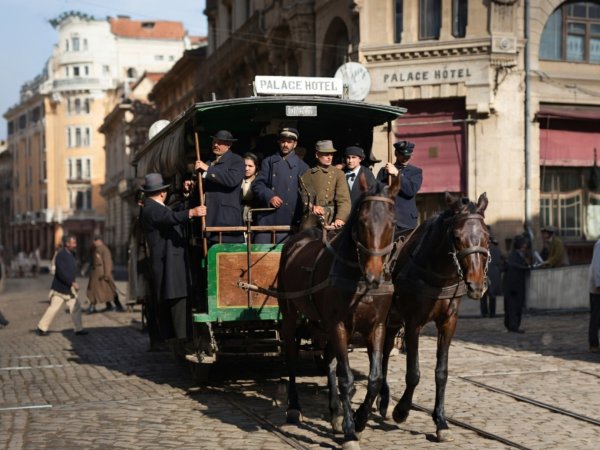
The first horse-drawn trams were far removed from the image of modern vehicles known today. The cars had a relatively small capacity of approximately 20 to 25 passengers and could become overcrowded during busy periods.
Some vehicles also had seats on the roof, accessible by a staircase known as the “imperial.” This solution, which was also found on other forms of transportation of the period, provided additional seating and allowed passengers to travel in the open air.
The trams were pulled by horses, while the driver, or motorman, occupied the platform at the front. Accounts of the first Bucharest trams mention distinctive uniforms and caps, as well as yellow-painted vehicles.
Travel followed its own set of rules. Passengers could signal that they wanted to get off by using a bell, while stops were more flexible than those found in modern public transportation. In a city where carriages and carts still dominated the streets, the tram appeared to many residents as a spectacular novelty.
The horses, the real “engines” of public transportation
The operation of the tram depended entirely on horses. The animals had to be replaced regularly, particularly at the ends of the lines, where tired horses could be exchanged for rested ones.
The work of the tram drivers was also demanding. They had to control the horses, watch traffic and manage the boarding and departure of passengers. In a city without traffic lights and without the traffic rules known today, operating a tram required constant attention.
George Potra, one of the most important historians of Bucharest, described the atmosphere of these journeys in his works. He noted that the drivers eventually came to know their regular passengers, including their names, professions and habits. The tram thus became more than a means of transportation: it was a space for everyday encounters.
According to Potra’s accounts, during certain periods of the day the speed was reduced so that passengers could get off near gates or side streets. The image is representative of a city in which public transportation had not yet adopted the rigid standards of the 20th century.
The problems of horse-drawn trams
The new transportation system was not without problems. The rails could prove difficult to negotiate in certain areas, and trams could derail, particularly where the infrastructure was not sufficiently adapted.
In such situations, passengers could help put the car back on the rails. At the ends of the lines, the absence of modern turning loops meant that the position of the horses had to be changed. The animals were moved to the opposite side of the car so that the tram could travel in the other direction.
Overcrowding was another problem. The vehicles had limited capacity, and passengers were sometimes unhappy when the tram became too full. Some historical sources mention the requirement to display a sign indicating that the car was full.
There were also conflicts with older means of transportation. Cab drivers viewed the new competitor with suspicion because trams could carry more people and offered regular service along fixed routes. Their appearance effectively marked the beginning of a new urban transportation market.
How much did a tram ride cost?
Traveling by tram was not free, and the fare varied according to distance and the seat occupied. Historical sources indicate different fares, with travel on the imperial being cheaper than travel inside the car. Some documents and accounts mention a fare of approximately 20 bani per kilometer.
The cars were also adapted to the seasons. During the summer, open vehicles could be used, with benches arranged along the sides, while winter versions were enclosed and protected by systems resembling sliding covers.
As the system developed, additional operating regulations were introduced. The route had to be clearly indicated, while the number of passengers was not supposed to exceed the established limit. Gradually, horse-drawn tram transportation became an organized public service rather than merely a technological novelty.
From horse-drawn trams to electric trams
Horse-drawn trams represented only the first stage in the history of rail-based transportation in Bucharest. The city’s growth and increasing population made faster and more efficient means of transportation necessary.
In 1894, the capital’s first electric tram line was inaugurated on the Obor–Cotroceni route. The introduction of electric traction radically changed the prospects of urban transportation and gradually reduced the importance of horse-drawn trams.
The process was not immediate, however. Horse-drawn and electric trams continued to operate alongside each other for several decades. In 1909, the Bucharest Municipal Tramways Company was established, later known by the acronym STB, and the electrification of the network became one of the major directions of public transportation modernization.
On June 6, 1929, horse-drawn trams were permanently withdrawn from Bucharest’s routes, bringing an end to an era that had lasted for almost six decades.
An urban revolution that began with two horses
Today, trams are associated with electric networks, modern vehicles and routes stretching from one end of Bucharest to the other. Their beginnings, however, were far more modest.
In 1872, the first horse-drawn cars introduced the idea of public transportation running along fixed routes, offering a more efficient and predictable alternative to traveling exclusively by carriage or cab. Behind this apparently rudimentary vehicle was one of the important transformations of the modern city.
The horse-drawn tram helped bring neighborhoods closer to the city center, created new travel habits and paved the way for the subsequent development of electric transportation. For almost 60 years, horses were the true engines of Bucharest’s tram network.
More than 150 years after its arrival, the horse-drawn tram remains one of the defining images of a Bucharest at the beginning of its modernization. From the yellow cars and rooftop “imperial” seats to electric trams and the complex network of the contemporary city, the history of Bucharest’s public transportation reflects, ultimately, the transformation of the capital from a city of carriages and unpaved streets into a modern metropolis.
We also recommend: Why did Bucharest’s first electric tram line get the number 14 and not 1, as would seem normal? How public transport electrification unfolded in the capital