What Bucharest’s Romanian Broadway Looked Like in the 1920s and 1930s. The History of Luxury Cinemas in Interwar Bucharest
- Articles
- 17 NOV 26
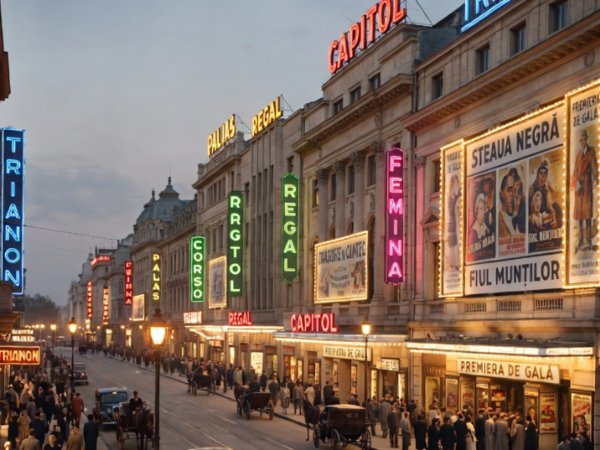
In Bucharest during the 1920s and 1930s, the cinema ceased to be merely a place where people went for a few hours to watch a film. In the city center, the major theaters had become genuine attractions of urban life, and going to the movies could mean attending a premiere, meeting members of high society, taking a stroll along the boulevard, visiting the cinema’s buffet, or even having the chance to see actors and other prominent personalities of the time in person. As Bucharest modernized, its cinemas changed as well. During the 1930s, the so-called luxury cinemas became increasingly well defined, equipped with services and facilities that went far beyond the basic requirements of film projection. Among the names associated with this period were Trianon, Lumina, Corso, Capitol, Regal, and Femina, cinemas that formed part of the spectacular landscape of central Bucharest. Elisabeta Boulevard and the surrounding central area became a genuine cinema promenade. Huge posters, illuminated advertisements, and display windows featuring photographs of movie stars transformed cinema façades into urban spectacles. For interwar Bucharest residents, going to the cinema had become one of the most modern forms of entertainment.
Elisabeta Boulevard and the street of cinemas
One of the most important cinema districts in interwar Bucharest was Elisabeta Boulevard. The thoroughfare had become associated with entertainment, and several theaters in and around the area attracted audiences with films, premieres, and comfortable facilities.
Trianon, Capitol, Regal, and Femina were among the cinemas that gave the area its distinctive character. Each theater had its own audience and reputation, yet all of them were part of the same competition for spectators who wanted to see the latest productions and enjoy increasingly comfortable conditions.
Trianon was one of the important names in Bucharest’s cinema history. Together with Capitol, Regal, and Femina, it helped transform Elisabeta Boulevard into one of the capital’s most spectacular promenades. Audiences could choose between several screenings, while the close proximity of the theaters encouraged fierce competition to attract moviegoers.
Capitol also held an important place in the city’s central cinema landscape. Its name became associated with major productions shown to Bucharest audiences and with an era when going to the cinema had evolved into a complete entertainment experience. Regal and Femina completed this circuit of major central cinemas, contributing to the cosmopolitan atmosphere of the area.
It was no coincidence that major cinemas were concentrated in this part of the city. Elisabeta Boulevard and the surrounding streets were at the heart of Bucharest’s urban life, close to cultural institutions, restaurants, hotels, shops, and other entertainment venues. Cinema had thus become part of a much broader urban circuit.
Trianon, Lumina, and Corso, names of an era
Alongside the major cinemas on Elisabeta Boulevard, theaters such as Lumina and Corso contributed to the remarkable density of cinemas in central Bucharest. Their names became associated with a period when cinema was rapidly developing into a mass phenomenon.
Lumina had a distinctive profile at a time when cinemas were becoming places where audiences could discover both commercial productions and films circulating in major European capitals. Its very name was suggestive of an era in which cinema was associated with technological progress and the fascination with moving images.
Corso belonged to the same world of central cinemas. The importance of theaters of this kind was not limited to their film programs; they also contributed to the life of the streets around them. Spectators could see the posters from a distance, read the program, and decide on the spot where they wanted to go.
Trianon, Lumina, and Corso illustrate particularly well the diversity of Bucharest’s interwar cinema landscape. Not all theaters had the same capacity or status, but central cinemas benefited from their location and from their proximity to the city’s busiest areas.
During the interwar period, cinema names themselves had become brands. Audiences were choosing not only a film, but also the theater in which they wanted to see it. Comfort, location, the reputation of the cinema, and projection quality were becoming increasingly important.
Luxury cinema and a new level of comfort
Luxury cinemas differed from more modest theaters through a series of facilities that may seem commonplace today but represented signs of modernity in the interwar period. There were cloakrooms, attendants, and buffets, while spectators could purchase film programs and promotional materials featuring photographs of movie stars.
Printed programs had become part of the cinema experience. Audiences could keep information about the cast, production, and story, while photographs of American and European stars helped fuel the emerging culture of celebrity. Hollywood had already developed its own sophisticated image industry, and Bucharest was participating in the phenomenon.
Important cinemas also screened newsreels before the main feature. In the absence of television, these represented one of the main ways in which spectators could see moving images of political, sporting, cultural, or social events.
The experience was complemented by increasingly sophisticated organization. Ticket prices could vary according to the seat selected or the time of the screening, while intervals were gradually integrated into the structure of the program. In some cases, spectators could use the break to visit the buffet or look at exhibitions arranged in the cinema’s halls.
These spaces could display photographs of actors or materials related to the film being shown. The entertainment therefore extended beyond the screen. The foyer, auditorium, posters, and buffet all became part of the same experience.
When cinema became a social spectacle
Major central cinemas also played an important social role. Film premieres could attract actors, journalists, politicians, and prominent members of Bucharest society. On such occasions, the cinema became a place where audiences could see not only the film, but also the social world surrounding it.
Advertising played a crucial role. Cinema façades were designed with spaces for posters and promotional panels, while film titles and actors’ names could be seen from a considerable distance. Newspapers and magazines of the period also promoted premieres and special events.
Major American studios such as Metro-Goldwyn-Mayer, Paramount, and Universal invested heavily in film promotion. Stars had become global celebrities, and their photographs circulated in magazines, newspapers, cinema programs, and calendars.
An entire culture of celebrity thus developed around the cinemas. The name of a particular actor could be reason enough for audiences to buy a ticket, while films were promoted through costumes, sets, songs, and spectacular imagery.
From silent films to sound and color productions
The 1920s and 1930s were also decades of major technological transformation. Sound films fundamentally changed the relationship between audiences and the screen. Actors’ voices, music, and sound effects added an entirely new dimension to the cinema experience.
At the same time, filming and projection techniques continued to improve. Color films began reaching audiences, while the emergence of Technicolor productions further intensified the fascination with cinema.
Bucharest residents who visited cinemas such as Trianon, Capitol, Regal, Femina, Corso, or Lumina could witness the rapid transformation of film from an entertainment based primarily on moving images into a complex spectacle in which color, sound, music, and special effects became increasingly important.
Meanwhile, screens became wider and sound systems improved. For luxury cinemas, technical performance had become a commercial argument. The theater had to offer spectators not only a good film, but also a superior experience.
ARO and the new architecture of cinema
One of the most impressive examples of this modernization was ARO Cinema, inaugurated in 1935 as part of the complex designed by architect Horia Creangă on Magheru Boulevard. The theater had nearly 2,000 seats and represented one of the most modern cinema buildings in interwar Bucharest.
The architectural and technical solutions used at ARO demonstrated that cinema had become important enough to influence the architecture of the city itself. The theater was designed for a large audience, while its shape and structure responded to modern requirements for visibility and acoustics.
ARO also demonstrated that a cinema could go beyond its function as a screening room. Other cultural events could be held there, including concerts. In 1937, for example, the theater hosted a concert featuring George Enescu and Pablo Casals.
If Trianon, Lumina, Corso, Capitol, Regal, and Femina represented the generation of cinemas that animated central Bucharest, ARO symbolized the next stage, in which modernist architecture and technology transformed the cinema into an urban landmark.
Cinemas reach the neighborhoods
The success of central cinemas had a direct impact on Bucharest’s neighborhoods. As audiences became accustomed to cinema-going, theaters spread toward peripheral areas and working-class districts.
Griviței Road, Moșilor Road, Rahova Road, Văcărești Road, and Dudești Road became important cinema corridors. These areas had theaters of their own, giving local audiences access to films without requiring them to travel into the city center.
Several cinemas operated along Griviței, while Rahova and Văcărești developed their own entertainment venues. Moșilor also had several well-known cinemas, while Dudești was home to theaters such as Edison.
Neighborhoods also had popular athenaeums, which served broader cultural and educational purposes. Film screenings could be combined with lectures, educational activities, and other events. Cinema was therefore reaching increasingly large sections of society.
Bucharest’s Broadway of the 1930s
Seen through the eyes of an interwar Bucharest resident, the city center offered the image of a capital undergoing constant transformation. On Elisabeta Boulevard and the major central thoroughfares, cinemas such as Trianon, Capitol, Regal, and Femina attracted audiences with premieres and varied programs, while Lumina and Corso added to the city’s rich cinematic offering.
Colorful posters, advertisements, lights, and crowds gathered around the theaters created the impression that Bucharest had become a modern city, connected to the great European capitals and to the American film industry.
Cinema was no longer merely a few hours of entertainment. It had become a social and cultural phenomenon that influenced fashion, advertising, architecture, and even the way Bucharest residents spent their leisure time.
For this reason, the comparison with a “Romanian Broadway” can be understood primarily as a metaphor for this spectacular concentration of cinemas, advertisements, premieres, and social life. During the 1920s and 1930s, Bucharest had created its own cinematic universe, and names such as Trianon, Lumina, Corso, Capitol, Regal, Femina, and, later, ARO became associated with one of the most spectacular periods in the history of entertainment in the Romanian capital.
We also recommend: How the Nissa Cinema Disappeared from Interwar Bucharest