Famous houses in Bucharest: The Iacob Lahovary House, from the villa of the renowned general to the maternity ward of Cantacuzino Hospital
- Articles
- 27 JUL 26
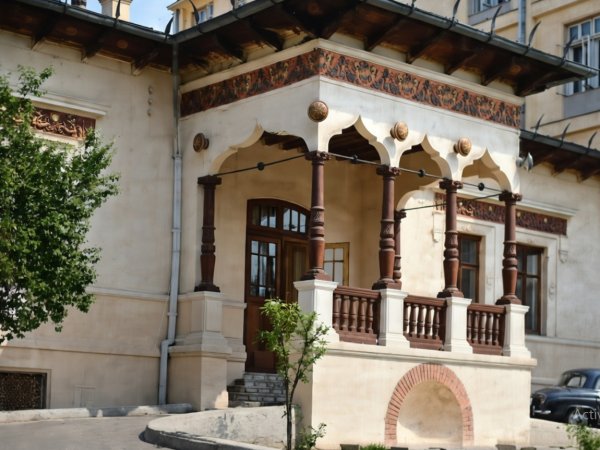
Few buildings in Bucharest illustrate the beginnings of the Neo-Romanian architectural style as well as the Iacob Lahovary House, an elegant residence built at the end of the 19th century on what is now Ion Movilă Street, number 5. Throughout its existence, the building has served several purposes and has witnessed important transformations of the Romanian capital. Originally built as the residence of General Iacob Lahovary, one of the most important military leaders and politicians of modern Romania, the building later became a pavilion of the Maternity Department of Cantacuzino Hospital, a function it still fulfills today. Beyond its historical value, the house represents one of the first creations through which architect Ion Mincu laid the foundations of the Neo-Romanian style, an architectural language inspired by local traditions and adapted to the requirements of the modern era. Today, the historic monument still preserves many of its original elements and is regarded as a true lesson in how Romanian heritage could be reinterpreted in an elegant and innovative manner.
One of Ion Mincu's first masterpieces
The Iacob Lahovary House was built in 1886, during a period when Bucharest was undergoing a stage of accelerated modernization. After Romania gained its independence, the city began adopting Western models in urban planning and architecture, while the new elite sought elegant residences comparable to those found in Europe's great capitals.
In this context, General Iacob Lahovary entrusted the young architect Ion Mincu with designing his future residence. The choice proved inspired, as Mincu was at the beginning of a career that would permanently transform Romanian architecture.
The house on Ion Movilă Street is considered one of the first residences designed in the Neo-Romanian style. Unlike the many eclectic or academic buildings of the period, Mincu's project aimed to highlight traditional Romanian architectural elements and demonstrate that they could form the basis of a modern architectural language.
The architect described this direction as a return to the authentic roots of Romanian culture, considering that the new style represented "a revival of the healthy roots of a tree broken by the storm." The idea perfectly summarized the philosophy that would define his entire body of work.
Inspiration from Romanian houses and European travels
When he received the commission, Ion Mincu had only recently returned to Romania after completing his studies in France. Although he had accumulated extensive experience in Western Europe, he was still searching for his own architectural language inspired by the national identity.
In the recollections later published in the magazine Arhitectura, the architect explained that he had very few sources of inspiration at his disposal. He had visited several monasteries and traditional mountain houses and had used photographs taken by the painter I. Al. Paraschivescu-Alpar. Starting from these observations, Mincu sought to extract the essence of Romanian folk architecture and adapt it to an urban residence.
He recalled that General Lahovary specifically wanted a house designed in the Romanian style and appreciated the fact that, although he came from a family of Greek origin, he deeply identified himself with the Romanian nation.
The architect explained that he aimed for the simplest and most authentic expression possible, while the relatively modest dimensions of the building favored such an approach. For the decorative elements, he chose polychromy, which he regarded as a natural characteristic of the Romanian spirit, and to achieve both durability and elegance, he used glazed ceramic tiles.
A façade that embodies Romanian tradition
More than a century after its construction, the Iacob Lahovary House continues to impress through the richness of its decorative details.
The façade harmoniously combines brick, lime mortar plaster, wood, and sheet metal, materials commonly used during that period but enhanced through an outstanding architectural composition.
Among its most remarkable features are the glazed and colored ceramic decorations, which create refined decorative accents. The wooden columns, broken ogee arches, and ornaments inspired by traditional Romanian architecture give the building a distinctive identity.
One particularly interesting detail is the porch placed above a false entrance leading to the basement. It recalls the layout of Romanian houses from the 15th century and demonstrates Mincu's attention to reinterpreting traditional architecture.
Although his main inspiration came from Romanian heritage, the architect did not ignore the experiences gained during his travels. Some decorative motifs and proportions recall Italian, French, and even Oriental architecture encountered in Istanbul, cities he had visited during his years of study.
The result is a harmonious building in which foreign influences are subtly integrated into an architectural ensemble that remains profoundly Romanian.
A residence that "radiated a Romanian atmosphere"
In the article published in the magazine Arhitectura in 1925, Spiridon Cegăneanu recorded Ion Mincu's recollections about this representative work.
The architect believed that the success of the building was not determined solely by its aesthetic appearance but also by its ability to convey a certain spirit.
According to Mincu, the elements borrowed from Romanian folk architecture gave the house its own identity, making it "radiate a Romanian atmosphere."
This appreciation was later confirmed by generations of architects and art historians, who regarded the Iacob Lahovary House as one of the first mature examples of the Neo-Romanian style. The building thus became a model for numerous villas erected later in Bucharest and throughout Romania.
General Iacob Lahovary, the owner of the house
The destiny of the building is closely connected to the personality of the man who commissioned it. Iacob Lahovary was born in Bucharest on January 16, 1846, into a family of Greek origin. He came from a large family, having four brothers and two sisters.
Two of his brothers, Alexandru Lahovary and Ion Lahovary, became Ministers of Foreign Affairs and prominent figures of the Conservative Party. The future general attended the Officers' School in Bucharest between 1859 and 1864, after which he continued his education at the Polytechnic School and the Staff College in Paris.
His education was not limited to military studies. In 1870, he also obtained a degree in Mathematics from the Sorbonne, an outstanding achievement for that period.
In his personal life, Iacob Lahovary first married Elena Kretzulescu, a marriage that ended in divorce in 1883. He later married Alexandrina Cantacuzino. From his first marriage he had a daughter, Elena, while from his second marriage he had two sons, Iacob and Leon.
Hero of the War of Independence and reformer of the Romanian Army
Iacob Lahovary's military career stood out during the Romanian War of Independence of 1877-1878.
As head of the Operations Section within the Great General Headquarters, he participated in planning and coordinating military operations. For his merits during the campaign, he was promoted on the battlefield to the rank of lieutenant colonel.
The victories at Plevna and Vidin established him as one of the Romanian Army's most respected officers. After the war, he also turned his attention to political life. Beginning in 1891, he served as Minister of War, a period during which he promoted an extensive military reform.
Among the measures introduced were the reorganization of the infantry to improve troop mobility and the acquisition of Mannlicher 6 mm rifles, considered among the most advanced weapons of the time.
During his tenure, Romania's first military stud farm was also established, contributing to the development of the cavalry. In 1904, he became Minister of Foreign Affairs, a position he held until his death.
A respected politician and a highly regarded diplomat
As a diplomat, Iacob Lahovary distinguished himself through balance and skill. His military experience and broad education enabled him to represent Romania during a period when the Romanian state was strengthening its position on the international stage. The respect he enjoyed became evident even at the time of his death.
Among those attending the general's wake was Munir Pasha, Ambassador of the Ottoman Empire, the very state against which Lahovary had fought three decades earlier during the War of Independence.
The Ottoman diplomat's presence was interpreted as a gesture of respect toward the Romanian statesman and his contribution to the development of international relations.
The duels that shaped his reputation
Besides his military and political career, Iacob Lahovary was also known for his fiery temperament. In the aristocratic society of the late 19th century, duels were still regarded as a means of defending one's honor, and the general became involved in several such confrontations.
One of the best-known incidents took place at the Constanța Casino on July 30, 1895. During a card game with Alexandru Catargiu and the young Filitis, a misunderstanding regarding the stakes quickly escalated into a conflict.
Lahovary accused Catargiu of attempting to cheat, the exchange of words intensified, and the general slapped his opponent across the face. The incident was followed by a pistol duel, but neither shot found its target. In the end, the two men shook hands and considered the matter settled.
Shortly afterward, the publication of the article The Opinion of a Military Officer, written by Lieutenant Ionuț Niculescu in Gazeta Poporului, generated another dispute. The general challenged him to a duel as well. During the fourth assault, Lahovary was wounded in the chest, but the injury was not fatal, and the conflict ended without tragic consequences.
The general's death and the tributes paid to a national figure
The end of Iacob Lahovary did not come on the battlefield nor in a duel. On February 8, 1907, at the age of 61, the general died from colon cancer. His passing caused profound emotion throughout Romanian society.
The Senate declared a period of national mourning, and mourning flags were raised on numerous buildings. Take Ionescu, the future Prime Minister of Romania, dedicated an extensive commemorative article to him, stating that the entire country mourned his passing.
His funeral was attended by Prince Ferdinand, the future King of Romania, while Queen Elisabeth, the wife of King Carol I, sent a wreath made of lilacs and roses. The presence of members of the Royal Family and the country's political elite confirmed the exceptional status Iacob Lahovary had achieved during his lifetime.
From private residence to a pavilion of Cantacuzino Hospital
After the death of its owner, the house continued its existence as one of Bucharest's representative buildings. Over time, the building's purpose changed, and after remaining in the ownership of the Lahovary family for many years, it was incorporated into the Cantacuzino Hospital complex.
In 2003, it became a pavilion of the Maternity Department, a function it continues to serve today. This adaptation made it possible to preserve the building while giving it a public purpose, although the changes required by its new function partially altered the original interior.
After 1990, several contemporary elements were added to the interior, affecting the building's original aesthetic without altering its exterior appearance, which gives the monument its architectural value. Today, the Iacob Lahovary House is listed as a historic monument and continues to attract the attention of architects, architecture students, and lovers of Bucharest's architectural heritage.
More than a simple aristocratic villa, this building represents the beginning of a stylistic revolution in Romanian architecture and stands as a testimony to the work of one of the country's greatest architects.
At the same time, its destiny is inseparably linked to the life of General Iacob Lahovary, a military leader, reformer, diplomat, and politician who left a lasting mark on modern Romania. Together, the house and its owner form a valuable chapter in the history of Bucharest, demonstrating that built heritage consists not only of walls and decorations, but also of the stories of the people who brought them to life.
We also recommend: 10 houses in Bucharest built in the Romanian Revival style that take your breath away