Famous houses in Bucharest: Athanasovici Palace, the home of the family of Romania’s first forensic medicine professor
- Articles
- 26 OCT 26
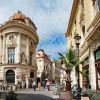
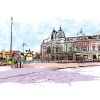
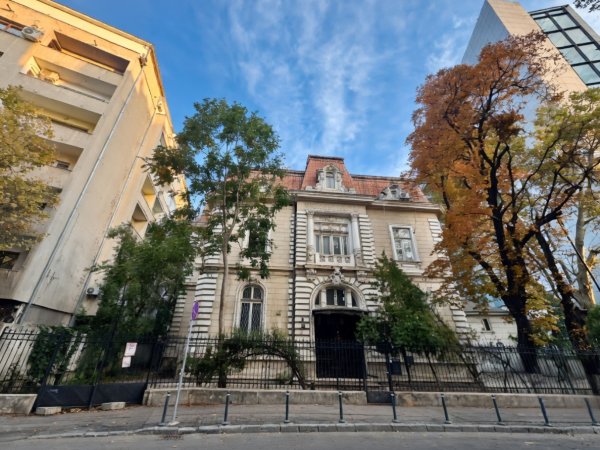
In one of the most elegant historic areas of Bucharest, just a few minutes from University Square and the National Theatre, an imposing building preserves the story of a family that played an important role in the development of medicine and public life in Romania. This is the Athanasovici Villa, located at 39 Batiștei Street, a monumental residence built at the turn of the 19th and 20th centuries that once belonged to lawyer and politician Vladimir Athanasovici. Today, the building is one of the valuable historic properties in central Bucharest and is part of the “Batiștei Street” Architectural Ensemble, listed in the Register of Historic Monuments under code B-II-a-B-18093. The ensemble includes a remarkable urban streetscape, consisting mainly of residences and representative buildings that illustrate Bucharest’s transformation into a modern capital at the end of the 19th century and the beginning of the 20th century. The story of the palace, however, is about more than architecture. Behind the Athanasovici name stands physician Gheorghe Athanasovici, one of the important figures in the early development of Romanian medical education and the country’s first tenured professor of forensic medicine. His son, Vladimir, followed a completely different career path, becoming a lawyer, jurist and politician.
A family connected to the beginnings of modern medicine
To understand the importance of the residence on Batiștei Street, the story must begin with Gheorghe Athanasovici. Born in 1822 in Svishtov, in present-day Bulgaria, he attended secondary school in Athens and graduated from the Faculty of Medicine in Paris in 1848. That same year, he came to Romania and settled in Bucharest, where he would practice medicine for several decades.
His name is associated with the first generations of professors involved in Romanian medical education. Gheorghe Athanasovici taught toxicology and forensic medicine and served as chief physician at the Children’s Hospital. The Museum of the University of Bucharest includes him among the professors of its Faculty of Medicine and lists him under the names Atanasovici, Athanasovici or Athanasescu Gheorghe, explaining the variations in spelling found in historical documents.
The claim that he was “the founder of the National School of Medicine” should nevertheless be qualified. Gheorghe Athanasovici was among the physicians who contributed to the beginnings of modern medical education in Bucharest, alongside Carol Davila and other professors of the period. Historical sources identify him among the early professors of medicine in Bucharest, with a specialization in toxicology and forensic medicine.
In this context, describing him as the first forensic physician in the capital reflects his pioneering role in the field of forensic medicine. More precisely, however, it is worth noting that he was the country’s first tenured professor of forensic medicine. His career unfolded during a period when Romania was building its modern medical institutions and forensic medicine was beginning to emerge as a specialized discipline.
Vladimir Athanasovici and the career that brought him into Bucharest’s elite
His son, Vladimir G. Athanasovici, born in 1864, chose law as his profession. He studied in Paris, where he obtained a law degree, and after returning to Romania he joined the Bucharest Bar. The 1911 Album of the Romanian Bar Association presents him as a lawyer with a significant professional career in Bucharest and records his public positions.
Vladimir Athanasovici served as a state attorney and as government commissioner to the Casa Rurală, an institution involved in rural credit. He also worked as a lawyer for the Dacia-România insurance company and held an important position in the legal press, serving as editor-in-chief of the newspaper “Dreptul”. Documents from the period describe him as one of the better-known lawyers in the capital.
His connection with the National Liberal movement and his position as a senator contributed to the family’s status within Bucharest society at the beginning of the 20th century. The 1923 “High-Life” almanac lists Vladimir Athanasovici at 39 Batiștei Street, together with his wife, Zoe Athanasovici.
The house itself did not appear overnight. The history of the property at the present-day number 39 goes back further than the Athanasovici family. Historical research shows that the land and existing buildings changed hands several times during the second half of the 19th century. In 1897, the property came into Vladimir Athanasovici’s possession, beginning the decisive stage in its transformation into a representative residence.
Athanasovici Palace and architecture at the turn of the centuries
The Athanasovici residence is characteristic of the type of hôtel particulier found in major European capitals at the end of the 19th century. The building combines an eclectic character with classical elements and was designed to convey both the social status of its owner and the taste of an urban elite that wanted impressive residences in the heart of the city.
The residence is associated with architect Dimitrie Maimarolu, one of the important names in Bucharest architecture at the beginning of the 20th century. However, art-history research recommends a cautious formulation: the plans submitted for authorization in 1900 were not signed by the architect, while contractor Julius Hraby is mentioned. Maimarolu’s connection with the property is nevertheless documented through later interventions, including carpentry work carried out in 1905.
Maimarolu was one of the architects who contributed significantly to the development of modern Bucharest. Trained at the École des Beaux-Arts in Paris and later active in Romanian public administration, he is associated with projects and interventions involving buildings such as the Chamber of Deputies Palace, today known as the Palace of the Patriarchate, the National Military Circle Palace, the Armenian Church and Saint Sylvester Church.
In the case of the Athanasovici Villa, his contribution fits within an elegant architectural language in which decoration was more than mere ornament. The façade, entrance, stained-glass windows, stucco work, ceilings and monumental staircase combine to create the image of a residence designed for a family belonging to the upper levels of Bucharest society.
A monumental residence with stained glass, stucco and a grand staircase
One of the villa’s most impressive features is its monumental oak staircase. Specialist descriptions refer to a grand imperial staircase, together with stained-glass windows, coffered ceilings and elaborate interior decorations that give the building the appearance of a genuine aristocratic residence.
The building consists of two separate wings with different functions and dimensions. Urban planning documentation indicates that the main building has four levels — basement, ground floor, upper floor with mezzanine and attic — while the secondary wing has two levels. The total ground-floor built area exceeds 670 square metres, while the total usable area of the buildings exceeds 1,500 square metres. The plot covers approximately 1,264 square metres and has access both to Batiștei Street and Aron Florian Street.
The house was completed around 1911, following a period of transformations that began with the authorizations issued at the beginning of the century. For this reason, some sources give dates such as 1900–1910, while heritage documentation records the property’s history as spanning 1897–1911, and architectural-history research points to 1911 as the completion date.
The value of the building is not determined solely by its size. The residence preserves an architectural language characteristic of Bucharest at the beginning of the 20th century, when wealthy families were building homes that combined Western influences with local solutions and tastes. In this sense, the villa is an architectural document of a period when the centre of the capital was undergoing rapid transformation.
From a Liberal elite residence to a monument with a turbulent history
Vladimir Athanasovici’s death in 1928 changed the fate of the property. His heirs were his children Constantin, Florica and Elena, and the house remained associated with the Athanasovici family. Historical documents and accounts concerning the property indicate that it continued to be one of the important residences in the Batiștei area during the interwar period.
The history of the building became considerably more complicated after the political and social changes of the mid-20th century. Historical documentation concerning the property refers to plans and discussions involving modifications or even the possible demolition of parts of the building, against the backdrop of the urban and political transformations of the period. Ultimately, the property became state-owned during the communist era.
In the years following 1990, the house entered a new chapter. It was consolidated and restored, while some of its interior finishes were renewed in an effort to recover the residence’s original character. Documentation concerning the property mentions work on floors, decorative elements, stucco and other architectural features, with the aim of bringing the appearance of the house as close as possible to its original design.
For a period, the building at 39 Batiștei Street housed the Cultural Centre of the Republic of Hungary. The presence of this institution is confirmed by cultural documentation from the 2000s as well as by publications of the period, which announced exhibitions and film screenings held inside the building.
Athanasovici Palace, a testimony to Bucharest’s past
Today, the Athanasovici Villa remains one of the discreet yet remarkable landmarks of Batiștei Street. Unlike the grand palaces along Calea Victoriei, the building does not lie on Bucharest’s best-known tourist routes. This location, however, preserves part of its charm: behind a central street, among historic buildings and newer constructions, stands a residence that tells the story of an entire era.
Its importance is further enhanced by its connection to the Athanasovici family. On one side stands Gheorghe Athanasovici, the physician who contributed to the education of the first generations of Romanian doctors and taught forensic medicine during a formative period for medical education. On the other stands his son Vladimir, representing another side of the Romanian elite at the beginning of the 20th century: a lawyer, jurist, politician and representative of the Liberal political world.
The palace on Batiștei thus brings together two seemingly different histories — that of medicine and that of law — within a single monument. Its architecture completes the story: the stained glass, decorative ceilings, stucco work, woodwork and impressive oak staircase preserve the image of a world in which a home was not merely a domestic space, but also a statement of social status.
As part of the “Batiștei Street” Architectural Ensemble, the monument is now an important component of Bucharest’s built heritage and of the memory of a neighbourhood that, for more than a century, concentrated the homes of some of the city’s most prominent figures. Its story demonstrates how fragile Bucharest’s architectural heritage can be, but also how important it is for such buildings to be documented, restored and preserved.
Athanasovici Palace is not simply an old house in central Bucharest. It is a link between pioneering Romanian medicine, the legal and political elite of the early 20th century and the eclectic architecture that helped shape the image of modern Bucharest. And the fact that the residence survived the city’s radical transformations makes it even more valuable today: behind its walls lies the story of a family and, at the same time, a part of the story of the capital itself.
We also recommend: Famous Houses in Bucharest: The Cesianu-Boerescu House, Between the Legendary Cina Restaurant and Contemporary Romanian Design Week