26 and 27 October: two feast days and a story of Bucharest. A walking route from Sfântul Dumitru-Poștă to Patriarchal Hill
By Raluca Ogaru
- Articles
- 26 OCT 26
On 26 October, the Orthodox calendar celebrates Saint Demetrius the Great Martyr, the Myrrh-Gusher. The following day, 27 October, honours Saint Demetrius the New, the patron saint of Bucharest. These are two different saints, a distinction that explains why these dates bring both parish celebrations and the pilgrimage on Patriarchal Hill to the capital.
To discover their connection with the city, we suggest a walk through central Bucharest: from Sfântul Dumitru-Poștă Church, through Piața Unirii, towards the Patriarchal Cathedral and Sfântul Spiridon-Nou Church. This is a self-guided cultural route, with stops that you can adapt to service times and crowds.
Why 26 and 27 October are two different feast days
Saint Demetrius, celebrated on 26 October, is associated with Thessaloniki and the persecution of Christians in the Roman Empire. In Orthodox tradition, he is honoured as a great martyr and bears the title “Myrrh-Gusher”. Sfântul Dumitru-Poștă Church in the Old Town is dedicated to him.
Demetrius the New, celebrated on 27 October, is associated with Basarabov, near Ruse in present-day Bulgaria. Church tradition describes him as an ascetic who lived in the 13th century. His direct connection with Bucharest began in 1774, when his relics were brought to the Metropolitan Cathedral, now the Patriarchal Cathedral.
The similar names and consecutive dates can cause confusion. The distinction is straightforward: 26 October honours the martyr from Thessaloniki; 27 October honours the ascetic from Basarabov, the patron saint of Bucharest.
First stop: Sfântul Dumitru-Poștă, a church among the streets of the Old Town
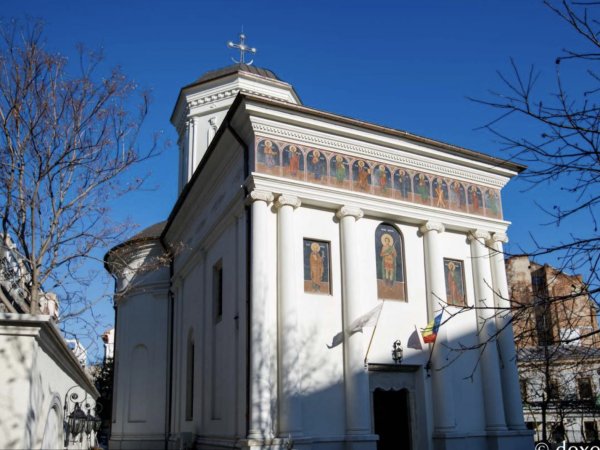
The route begins at Sfântul Dumitru-Poștă Church, at 1 Strada Franceză, on the corner with 2 Strada Poștei, in Sector 3. It stands near Stavropoleos Monastery and the National History Museum of Romania. The name “Poștă” comes from its proximity to the former Postal Palace, the building that now houses the museum.
Before entering, take a moment to look at the façade, with its tall columns and neoclassical decoration. The present building dates from the 19th century, but the history of places of worship on this site goes back further. The history published by the parish records successive rebuilding projects, earthquakes and fires that transformed the church.
Another of its names, “Sfântul Dumitru de Jurământ”, or “Saint Demetrius of the Oath”, preserves the memory of a practice described by historian G. I. Ionnescu-Gion: taking solemn oaths inside the church. It offers a glimpse of a Bucharest in which religious life, community relationships and judicial practices shared the same space.
On 26 October, your visit coincides with the church’s patronal feast. If you enter during a service, be discreet and save photographs for a moment when you will not disturb those who have come to pray.
READ ALSO: The National History Museum and the spectacular story of the former Postal Palace bucharest.ro
Towards Patriarchal Hill, the focal point of the 27 October celebrations
From Strada Franceză, continue towards Piața Unirii and then the foot of Patriarchal Hill, using pedestrian crossings and following directions on site. Your destination is the historic Patriarchal Cathedral on Aleea Dealul Mitropoliei, in Sector 4. This is the church associated with the pilgrimage honouring Saint Demetrius the New, distinct from the National Cathedral near the Palace of Parliament.
The church on the hill, dedicated to Saints Constantine and Helena, was consecrated in 1658. In 1668, Prince Radu Leon decreed that the monastery should become the metropolitan residence. The elevation of the Romanian Orthodox Church to patriarchal status in 1925 also changed the cathedral’s status.
The relics of Saint Demetrius the New were brought here on 13 July 1774. This date marks the historical beginning of his connection with the city. Accounts of miracles and assistance attributed to the saint belong to religious tradition and testimonies of faith; they should be distinguished from the documented chronology of the monument and the arrival of the relics.
If access and crowds allow, look for the bell tower built by Constantin Brâncoveanu in 1698, east of the altar. The complex preserves traces of several periods in Bucharest’s history.
What is happening on 26 and 27 October 2026
In 2026, the pilgrimage honouring Saint Demetrius the New runs from 18 to 28 October, according to the Romanian Patriarchate’s official programme. The two feast days have separate schedules, with services at the outdoor altar on Patriarchal Hill.
On Monday, 26 October, the Divine Liturgy is scheduled for 09:30–12:00. The proclamation of the Feast of the Synaxis of the Holy Military Martyrs is announced for 12:00–13:00. In the evening, a vigil honouring Saint Demetrius the New takes place from 17:00 to 21:00.
On Tuesday, 27 October, the Hierarchical Divine Liturgy is scheduled for 09:30–12:30, celebrated by Patriarch Daniel together with bishops, priests and deacons. This is the main liturgical event of the day dedicated to Bucharest’s patron saint.
If you wish to venerate the relics, allow additional time beyond your walk. Waiting times cannot be inferred from the service schedule. The organisers state that the relics will be returned to the cathedral after the final pilgrim has venerated them, as explained on the Romanian Orthodox Church website.
A stop at Sfântul Spiridon-Nou, connected with the feast-day procession
The route can continue to Sfântul Spiridon-Nou Metropolitan Cathedral, at 29 Calea Șerban Vodă, in Sector 4. Its connection with the celebrations is specific: in the 2026 programme, the church was designated as the starting point for one of the groups taking part in the “Way of the Saints” procession, held on 24 October.
From here, the procession’s route followed Strada Bibescu Vodă to the foot of Patriarchal Hill, where the two groups were scheduled to meet and ascend together towards the cathedral. This stop helps explain the geography of the pilgrimage: the celebration connects several churches and streets in the city centre. The procession on 24 October should not be confused with the services scheduled for 26 and 27 October.
How to plan your walk
You can follow the route Sfântul Dumitru-Poștă – Piața Unirii – Patriarchal Hill – Sfântul Spiridon-Nou, or begin by attending a service. Piața Unirii is a useful arrival point by metro and a landmark for finding your way between stops.
Avoid setting a rigid timetable for the entire route. During the pilgrimage, access to the Patriarchate area may follow designated lanes, and movement depends on the flow of participants. Follow the organisers’ and on-site staff’s instructions, particularly if you are visiting with children or people who tire easily.
For a cultural visit, you can view the churches from outside when they are crowded. If you are attending for religious reasons, let the service schedule set the pace of your day. Both ways of discovering the city can coexist, with consideration for those around you.
READ ALSO: Why do signs at the entrance to Bucharest say “martyr city”? The meaning of a title awarded after the 1989 Revolution bucharest.ro