The National History Museum and the Spectacular Story of the Former Postal Palace
By Eddie Țone
- Articles
- 18 AUG 26
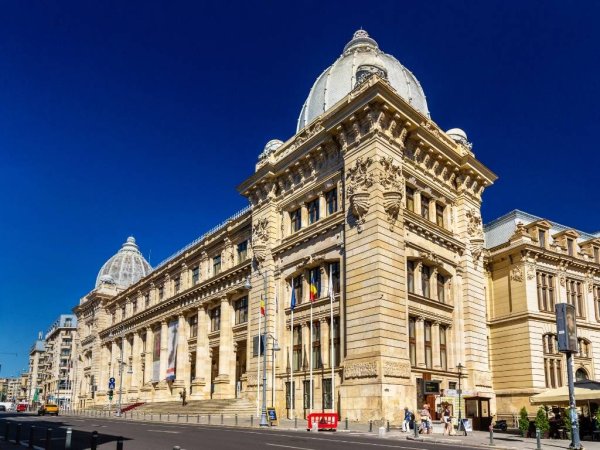
At 12 Calea Victoriei, Bucharest puts on one of its most solemn faces. Ten Doric columns, steps grand enough to usher in an entire era, two corner pavilions, and the stern air of an institution that makes visitors discreetly straighten their ties. Today, the building houses the National History Museum of Romania, but it was originally created for a far more hurried form of memory: letters, telegrams, and telephone calls.
More precisely… the Postal Palace. At the turn of the 20th century, it was nothing less than a declaration of administrative maturity. Romania wanted to communicate quickly, look European, and build something solid. The result was an enormous, expensive, modern building, spectacular enough that, according to an anecdote recorded in specialist literature, Minister Dimitrie A. Sturdza used to cross himself whenever he stood before it and thought about the cost. A deeply human reaction, familiar to anyone who has ever received the final estimate for a renovation.
Before the Palace, There Was an Inn, a Theatre, Several Circuses, and a Vacant Lot
The plot between Calea Victoriei and Stavropoleos, Poștei, and Franceză streets had already lived several lives before the palace appeared. This was once the site of the Constantin Vodă Inn, built between 1692 and 1694 at the initiative of Constantin Brâncoveanu. A plan drawn up by Major Rudolf von Borroczyn shows a complex with a vast courtyard; in 1848, the ground floor contained 35 shops, while the upper floor had 25 rooms. Earthquakes and the fire of 1847 hastened its decline, and demolition began in the 1850s.
By 1861, the site of the former inn was already hosting an agricultural exhibition of the United Principalities. The study by Katia Moldoveanu and Katiușa Pârvan, “The Postal Palace – an Emblematic Building of Early 20th-Century Bucharest,” published in the journal Muzeul Național, vol. XXI, 2009, reconstructs this succession using the works of George Potra, the Borroczyn plan, and documents from the period.
Then comes the part that today’s academic façade conceals with remarkable discretion. Constantin Vodă Square became a venue for shows, public meetings, merchants, and entertainment. The popular Alcazar Theatre hosted Aristița Romanescu, Grigore Manolescu, and even… I. L. Caragiale. Walhalla Hall offered café-concert performances and electoral meetings, the Soulié Circus staged shows with patriotic themes, while the wooden building erected in 1866 successively welcomed the Suhr and Hütemann circuses. Pretzel vendors and boza sellers wandered through the area. In other words, before the state began dispatching solemn telegrams from here, Bucharest residents had already been coming for theatre, acrobatics, politics, and snacks. The city had established its priorities with admirable clarity.
Why Bucharest Needed a Palace for Its Postal Service
Toward the end of the 19th century, the postal administration had grown faster than the buildings housing it. The directorate had operated in the area of Poșta Veche Street and later in the Bărcănescu House on what is now Doamnei Street, where the courtyard contained warehouses and carriage sheds for the cabriolets that brought correspondence from the railway station and the city’s post boxes. Letters were delivered to their recipients by “mounted postmen,” an expression that sounds delightfully romantic until Bucharest mud enters the discussion.
The volume of correspondence explains the scale of the project’s ambition. In his speech at the laying of the foundation stone, director Dumitru Cesianu compared the two million letters recorded in 1873 with the 25 million recorded in 1893. The state was modernising, the economy was moving, and the postal service, telegraph, and telephone were becoming strategic infrastructure. In May 1892, Parliament passed the law authorising the construction of a postal and telegraph headquarters, with an initial credit of three million lei. On 26 July, the Council of Ministers selected Constantin Vodă Square. The official chronology of the building preserves the details of the project almost day by day, like a postal ledger kept by someone exceptionally conscientious.
A Romanian Architect Travels Across Europe in Search of Ideas
The project was entrusted to Alexandru Săvulescu, architect to the Ministry of Religious Affairs, trained in the environment of the École des Beaux-Arts in Paris and an important figure in the first modern generation of Romanian architects. Săvulescu and Ernest Sturza, director of the postal service, were given a mission that any architect would happily describe as “professional research”: a tour of Europe’s major post offices.
They studied buildings in Vienna, Munich, Zurich, Geneva, Paris, Brussels, Turin, Milan, Venice, and Budapest. Their preferred model became the Federal Postal Palace in Geneva. The choice says a great deal about Bucharest’s aspirations. The central post office was to be an efficient administrative machine, clothed in architecture capable of conveying order, stability, and a certain degree of continental seriousness.
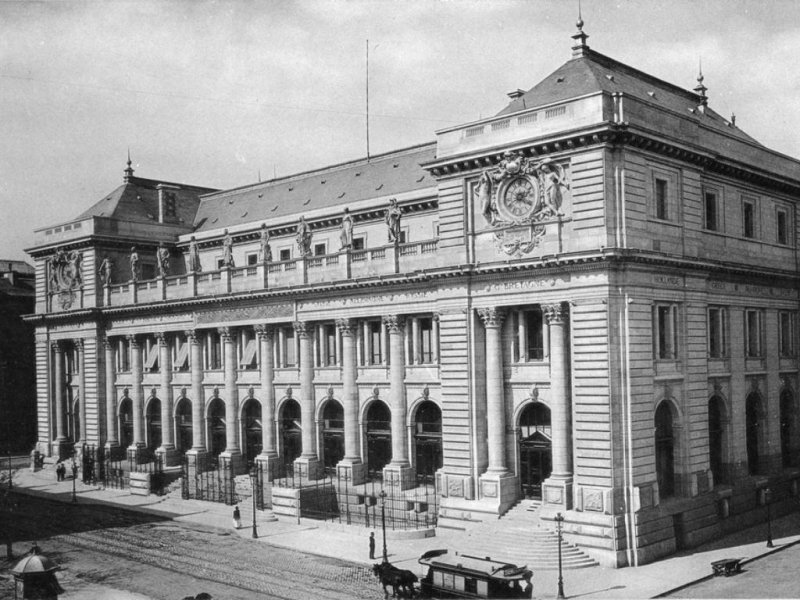 The Federal Postal Palace in Geneva, whose plans served as the model for the Postal Palace in Bucharest.
Săvulescu’s design was examined by the Superior Technical Council and approved by the French architects Julien Guadet and Léon Ginain, professors associated with the Parisian academic world. Romania was importing expertise, but the signature and architectural vision of the building belonged to a Romanian architect.
The tender held on 24 January 1894 was won by the Romanian Society for Construction and Public Works, headed by Effingham Grant. A technical committee that included engineers C. Mironescu, P. Țărușanu, and Grigore Cerchez supervised the contract. Behind the name of a single architect stood, as on any serious construction site, a small republic of specialists, drawings, and observations probably written in extremely emphatic ink.
The Foundation Stone, the Coins Sealed Inside, and the Ceremony’s Exact Time
On 20 October 1894, at 11 a.m., Carol I arrived at the construction site to lay the foundation stone. Awaiting him were Prime Minister Lascăr Catargiu, government ministers, officials from the Chamber, the leadership of the postal service, the Mayor of Bucharest, and representatives of the construction company. The ceremony included a religious service and speeches about the progress of the postal and telegraph service, the country’s development, and the future building, then estimated to cost more than three million gold lei and to cover approximately 8,000 square metres.
In a splendid detail from the period, the foundation document, signed by those in attendance, was sealed inside the walls together with Romanian copper, silver, and gold coins then in circulation. The symbolic time capsule was placed in the corner of the building facing Saint Demetrius Church, at the junction of Poștei and Franceză streets. The palace therefore began its life with its own small treasure hidden in the masonry, almost eight decades before the Historical Treasury moved into the basement.
The main construction work took place between 1894 and 1899. The technical fittings required substantial additional funding. In 1899, further credit was approved for electric lighting, lifts, equipment, furniture, and specialised postal, telegraph, and telephone installations. By the standards of its time, the palace was equipped like a technology centre; in contemporary terms, it would probably have featured a giant screen at the entrance and a presentation liberally sprinkled with the word “hub.”
A Classical Façade for the Technology of the Future
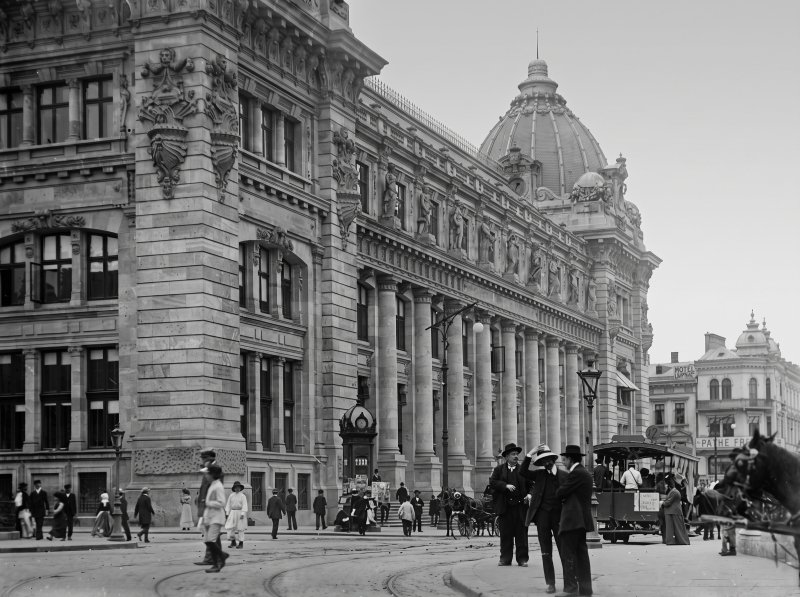 The Postal Palace in 1911. Photo: Rudolf Zimmermann / Image recreated using artificial intelligence, largely preserving the original details.
The building occupies a large, trapezoidal plot and consists of a basement, ground floor, and two upper storeys. Its architecture belongs to the academic eclectic style, while the main façade adopts a monumental Neoclassical vocabulary. Two corner pavilions frame a portico with ten colossal-order Doric columns. The side domes, high roof, and austere rhythm of the openings create an image of public authority that is elegant and slightly intimidating. Exactly what a young state wanted as it practised its official posture.
Ten allegorical statues once stood above the entrance. Two works by Carol Storck represented “The Railway” and “Electricity,” while Ștefan Ionescu-Valbudea created the figure of Mercury and the allegory of Mechanics, associated with scientific progress. The sculptural programme transformed the façade into a summary of the modern world: transport, energy, speed, technology, and messages constantly in motion. The MNIR presentation notes that some of the statues fell during the 1940 earthquake, while the surviving pieces, which had also been damaged, were removed for safety reasons. Bucharest thus lost the allegorical crown that had made the palace even more theatrical.
The dimensions and costs vary across period documents. The land registry records a plot measuring 10,221 square metres. Other historical sources give a total site area of 10,710 square metres and 8,064 square metres of floor space spread across four levels. The figure of 4,221,907 gold lei appears for the construction itself, while the Postal Service’s more comprehensive accounts for 1905–1907 reach 7,787,679 gold lei, including the land and equipment.
This is probably where the legend of Minister Sturdza crossing himself comes from. Construction budgets make excellent anecdotes once the numbers acquire enough zeroes.
An Inauguration That Lasted Several Years
The palace entered service in stages. The technical division and accounting department moved in during 1899, other central services followed in 1900, and the central telegraph and telephone office arrived in 1901. A discreet inauguration took place in the autumn of 1901, against the backdrop of the austerity policies pursued by Dimitrie A. Sturdza’s government. The official ceremony was held in 1903. This explains the three chronological landmarks—1899, 1901, and 1903—that appear in accounts of the palace’s opening. Each refers to a different stage.
The story of the commemorative stamps comes with its own quiet smile. A special issue had been commissioned in Paris as early as 1900. The stamps waited patiently in storage until Dimitrie Berlescu put them into circulation in 1903. Philatelists from Romania and abroad bought the series, and the recorded profit of 453,000 lei financed improvements to the postal stables and the introduction of underground telephone cables in central Bucharest. Rarely, if ever, does the postponement of an inauguration manage to benefit horses and telephony at the same time.
Inside, the Capital’s Communications Hub Was Pulsing with Activity
The palace functioned like an enormous organism. In 1906, the postal service employed 111 senior staff members and 231 postmen in Bucharest, each making four rounds a day. The telegraph service used Morse and Hughes systems, while telegrams were delivered by a team of postmen and couriers. The central telephone office occupied the wing facing Stavropoleos Street. Its multiplex system could serve 4,000 subscribers; in 1906, there were approximately 1,400, and the annual subscription cost 150 francs.
The building generated its own electricity using two 140-horsepower dynamos supplied by four steam generators. Its workshops manufactured and repaired equipment. The Directorate’s stables, located on Calea Plevnei, housed 20 small horses used to collect correspondence and 49 large horses used for journeys to the railway station and for transporting parcels.
These figures appear in the study by Katia Moldoveanu and Katiușa Pârvan published in the journal Muzeul Național, itself based on documents and historical works about the Romanian Postal Service. Beneath the academic domes, electricity, steam, telephone operators, telegraphists, mechanics, and horse-drawn logistics all coexisted. The Belle Époque in a nutshell: one foot in the future and the other in the stable.
The second floor, in the wing facing Franceză Street, even contained a Postal Museum. Its collections included Romanian stamps, documents relating to postal history, seals, postmarks, letter boxes, photographs, models of horse-changing stations, and a specialist library. The building had been practising for its future museum role many decades before its official change of purpose.
Earthquakes, Lost Statues, and the Transformation into a Museum
The 20th century treated the palace in its usual fashion—which is to say, energetically. The earthquake of 1940 damaged both the building and its statuary ensemble. Significant alterations were made around that period: a dispatch building was constructed in the inner courtyard, the skylight above the public counter hall was rebuilt, staircases were modified, and the ceremonial hall was divided into smaller spaces. During the Second World War, German troops built an air-raid shelter in the basement section facing Stavropoleos Street. In 1955, the Postal Palace was granted historic monument status.
A government decision adopted on 20 March 1970 established the History Museum of the Socialist Republic of Romania, and the former Postal Palace was selected as its headquarters. The remodelling profoundly altered the interior. Partitions accumulated over the decades were removed, marble was installed on the ground floor, and the mosaic flooring on many upper levels was replaced with parquet. The dispatch building in the courtyard made way for a new wing housing the Lapidarium and the replica of Trajan’s Column; the former technical area in the basement became the Historical Treasury. The museum opened on 8 May 1972, with 50 galleries arranged chronologically.
The haste with which the conversion was completed left the structure vulnerable. The earthquakes of 1977, 1986, and 1990 caused further damage, and the 1990 structural assessment called for comprehensive reinforcement. Work that began in 2002 stopped in 2006 after only partial intervention, and much of the building remained closed to the public.
Today, the building appears on the List of Historical Monuments under code B-II-m-A-19843. An official document published by MNIR in 2026 states that the redevelopment project is included in a programme financed through an agreement with the Council of Europe Development Bank and that the technical documentation for the intervention is currently being prepared. The institution’s objectives framework for 2026–2031 estimates the investment at €152 million net.
The Building That Once Carried Messages and Later Preserved Memory
The destiny of the Postal Palace possesses a certain literary logic. In the beginning, it carried people’s personal memories in envelopes, telegrams, and telephone conversations. Since 1972, it has preserved public memory in archaeological objects, documents, jewellery, weapons, coins, and fragments of monuments. Its function changed, but the deeper theme remained the same: the connection between people and their time.
The façade still dominates Calea Victoriei with the discipline of its ten columns. Hidden behind them are traces of a Brâncovenesc inn, a circus, the city’s first major communications hub, wars, earthquakes, and museum ambitions. Few buildings in Bucharest can sustain so many stories beneath a single roof while simultaneously maintaining the expression of a civil servant who has just asked for the correct form.
The Postal Palace manages it. With monumental dignity and, presumably, its foundation document still resting among the coins in the corner facing Saint Demetrius Church.
You may also like: CEC Palace – one of the most beautiful architectural symbols of Little Paris