Why do signs at the entrance to Bucharest say “martyr city”? The meaning of a title awarded after the 1989 Revolution
By Raluca Ogaru
- Articles
- 06 OCT 26
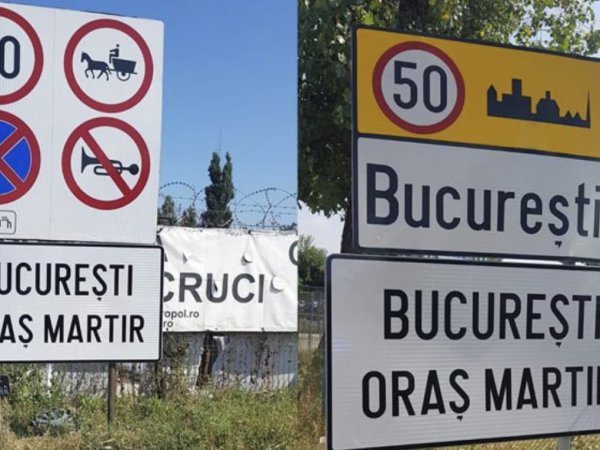
Bucharest was declared a martyr city in January 1990, in memory of those who lost their lives during the December 1989 Revolution. The inscription on signs at the entrance to the capital commemorates their sacrifice and the days when the city’s streets became places of protest against the dictatorship.
Today, these words can easily go unnoticed among road signs. Behind them, however, lies an official decision made shortly after the Revolution and a history that connects Bucharest with Timișoara, the city where the uprising against the Ceaușescu regime began.
Bucharest and Timișoara were declared martyr cities by the same decree
On 9 January 1990, the National Salvation Front Council issued Decree No. 40 on measures to commemorate the heroes of the Revolution. Published the following day in Romania’s Official Gazette, the document stated in Article 2: “The cities of Timișoara and Bucharest are declared martyr cities.”
The designation formed part of a broader set of commemorative measures. The same decree declared 12 January 1990 a national day of mourning and provided for monuments honouring those killed during the Revolution.
It also officially renamed Palace Square Revolution Square. The square’s new name and Bucharest’s recognition as a martyr city therefore appear in the same document, available on the Ministry of Justice’s Legislative Portal.
What the title “martyr city” commemorates
In this context, the word “martyr” evokes people who suffered or died for their convictions. In Romanian, the term carries this broader meaning alongside its religious sense. Associating it with a city’s name makes the memory of that human sacrifice part of the community’s identity.
For Bucharest, the reference is specific: the December 1989 Revolution. The wording on the signs preserves the memory of those whose participation in the protests brought death, injury, arrest or torture.
It is a commemorative title whose meaning depends on the people and events it honours. Read in its historical context, the inscription explains why the memory of the Revolution accompanies the capital’s name at the entrance to the city.
How the capital’s streets became sites of the Revolution
On 21 December 1989, the communist authorities organised a rally outside the headquarters of the Romanian Communist Party’s Central Committee. Intended to demonstrate support for Nicolae Ceaușescu, the gathering was disrupted, and protests against the regime spread through central Bucharest.
That evening, demonstrators gathered near the Intercontinental Hotel, where they erected a barricade. During the night, security forces fired on them. University Square, the Intercontinental Hotel and Dalles Hall became associated with the deaths and injuries of those who had taken to the streets. Many protesters were arrested and taken to Jilava prison, where they were tortured, according to AGERPRES’s historical account of the events of 21–22 December 1989.
The following morning, columns of workers headed towards the city centre. At 12:06 on 22 December, Nicolae and Elena Ceaușescu left the Central Committee headquarters by helicopter. Bucharest was witnessing the collapse of the leadership against which people had been protesting under gunfire just hours earlier.
The title dates from 1990, but the signs appeared much later
Almost three decades passed between the official recognition and the display of the title at the entrances to Bucharest. In May 2019, installing signs reading “București, oraș martir” was among the requests submitted to Bucharest City Hall by Marian Moroșanu, known as Marian “Ceaușescu”, a member of the 21 December Association. The request referred to the 1990 decree, as recorded in a municipal press release reported by HotNews at the time.
By August 2019, photographs published in the press documented the signs’ appearance. Moroșanu announced their installation while criticising their visibility. These reports confirm that the signs existed at that point, without establishing when each individual sign was installed.
The signs therefore made visible an official designation that was almost 30 years old. Their message remains tied to December 1989: Bucharest’s name is accompanied by the memory of those who paid with their lives and freedom for taking part in the Revolution.
Photo source: Marian Moroșanu