Historic Fountains of Bucharest: Their Stories, from the Water Carriers to Octav Doicescu’s Miorița
By Eddie Țone
- Articles
- 20 OCT 26
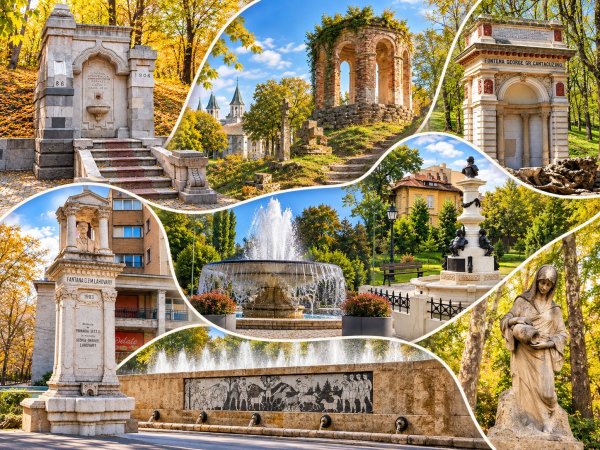
There is a Bucharest we discover by looking up, at cornices, church spires and balconies. But there is also a city whose history can be read at ground level, wherever water once flowed. The Romanian capital’s old fountains tell a surprisingly good story about the city, because around them converge thirst, administration, art, politics, love, duels and that eternal Bucharest obsession with making the urban landscape look at least vaguely Western European.
For centuries, water was one of Bucharest’s major practical problems. The Dâmbovița River, wells and public drinking fountains supplied the population, while water carriers known as sacagii transported water through the streets in barrels mounted on two-wheeled carts. Documents researched by the Bucharest Municipality Museum show that the Dâmbovița remained the main water source until around the middle of the 19th century. Only then did public water networks and supplies drawn from sources outside the city begin to expand.
A few magnificent fountains have survived from that world, alongside monuments built later as exercises in public art and the memory of others that have disappeared. Taken together, they form something close to a condensed history of Bucharest: from the metropolitan bishop who provided the city with clean water to the modernist architects of the 1930s, who turned a fountain into a statement about Romania.
Filaret Fountain: Where Bucharest Came for Water and Stayed for a Stroll
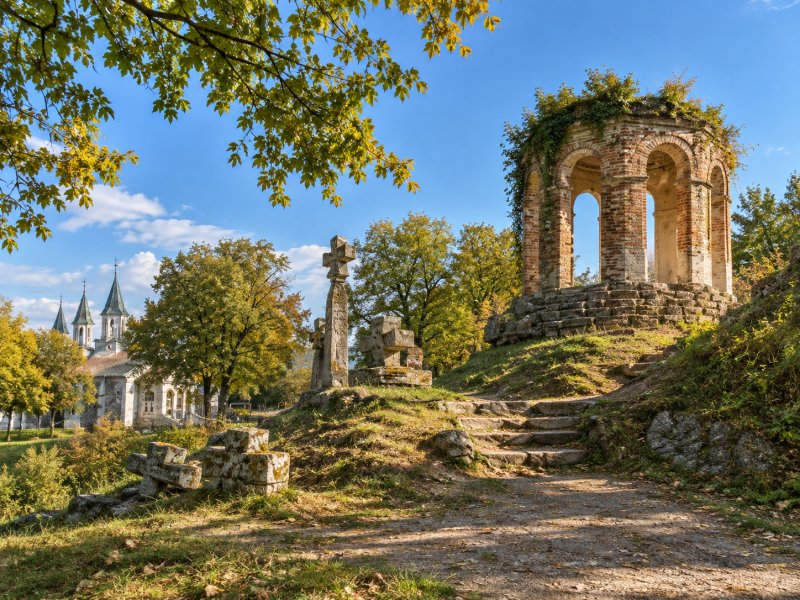
This story deserves to begin with a fountain that no longer exists, because Bucharest has a long tradition of preserving the memory of things impeccably, but only after they have disappeared.
In 1792, Metropolitan Bishop Filaret II built a fountain on Filaret Hill, in the area now occupied by Carol Park. It was supplied by local springs. Historical sources describe it as a monumental structure resembling a pavilion or gazebo, built largely of marble. Its water was highly regarded, and the sacagii carried it to the homes of those who could afford such services.
The place offered both infrastructure and recreation. Bucharest residents came to collect water and, as a bonus, enjoyed an outing on the outskirts of the city, complete with a view. A kind of multifunctional complex, long before the expression became indispensable in real estate presentations.
The fountain deteriorated during the 19th century and was demolished in 1863. Its memory, however, remained attached to the hill and the name Filaret. A few years later, one of Bucharest’s most spectacular monuments of its kind would rise on the same site.
George Grigorie Cantacuzino Fountain: The Monument Paid for by the Mayor
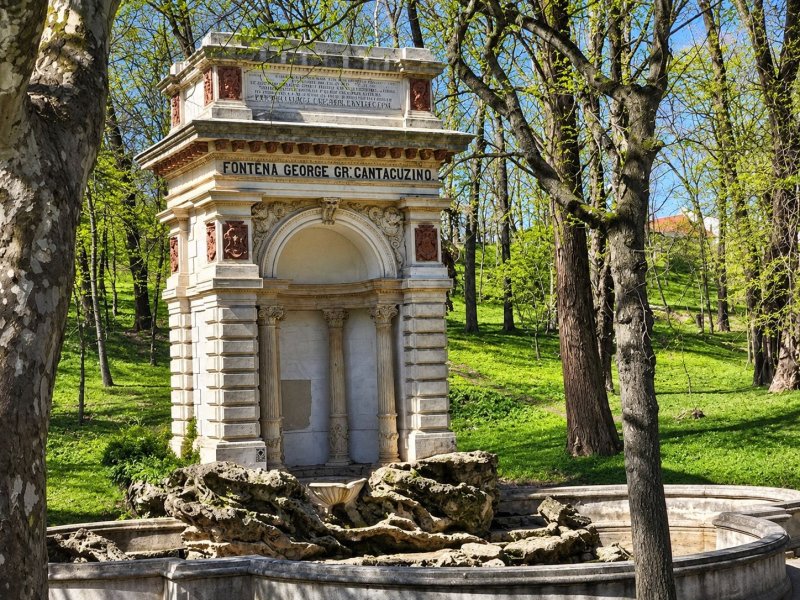
In 1870, Mayor George Grigorie Cantacuzino commissioned the fountain that bears his name on Filaret Hill. It was designed by architect Alexandru Freiwald, with sculptural contributions by Karl Storck.
Cantacuzino financed the project using the money he would otherwise have received as his mayoral salary, which he had declined. The story is recorded in the historical documentation dedicated to the monument, while the inscription on the fountain states that it was built “at the expense of Mr. George Grigorie Cantacuzino,” following a Municipal Council decision in August 1869.
Its architecture resembles a small triumphal arch planted in a landscape of artificial rocks. The façade features bas-reliefs, the ceramic panels depict knights and coats of arms, and the water flows into a semicircular basin. That is quite a lot of ceremony for a glass of water, which says plenty about the 19th century’s appetite for monumentality.
Even more interesting is the fact that the fountain predates Carol Park. The park itself would be laid out decades later for the 1906 Romanian General Exhibition, according to a design by French landscape architect Édouard Redont. The fountain thus became part of the park rather like an old resident whose neighborhood was subsequently built around him.
The 1906 Fountain: A Stone Souvenir of the Great Royal Exhibition
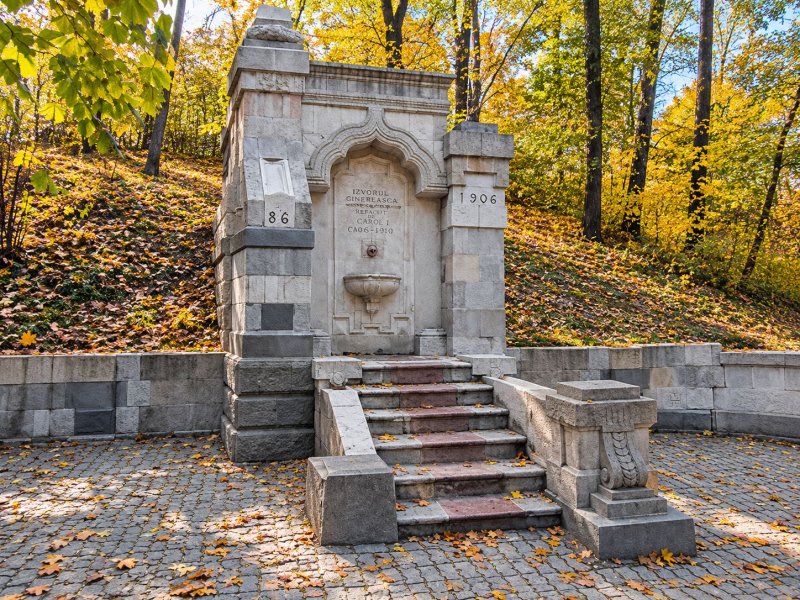
It is remarkably easy to walk past another historic fountain in Carol Park without noticing it. Much more secluded, this one has the advantage of an impeccably precise name: the 1906 Fountain.
It was created for the Romanian General Exhibition, the enormous event organized that year to celebrate the 40th anniversary of King Carol I’s reign. Romania’s official inventory of public monuments attributes it to a team of architects from the Quarry Service and dates it to 1906.
Other studies dedicated to the park establish its connection with the Mines and Quarries Service of the Ministry of Agriculture, Industry, Commerce and Domains, and describe the use of several varieties of stone in a composition inspired by Italian architecture.
The spirit of the 1906 Exhibition is unmistakable. Romania was showcasing its industries and natural resources, and locally quarried stone became the very material of a fountain. Economic propaganda, one must admit, had a certain elegance when carved in granite.
Luigi Cazzavillan Fountain: Where the Universul Newspaper Became Sculpture
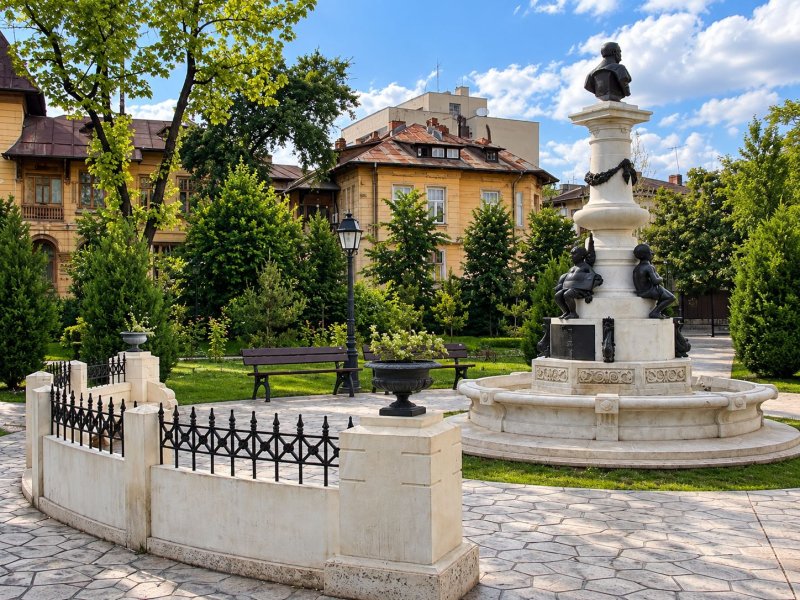
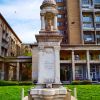
In the small Luigi Cazzavillan Park stands a monument well worth admiring. Erected in 1903 and attributed to sculptor Filip Marin, this fountain-monument commemorates Luigi Cazzavillan, the Italian journalist who settled in Romania and founded the newspaper Universul. Frederic Damé was already listing it among Bucharest’s monuments in his 1906 work dedicated to the city.
Cazzavillan’s bronze bust stands atop a column made of Dobrogea stone. Allegorical figures appear at its base, and one of the children is actually holding a copy of Universul. The word “LABOR” is inscribed on the monument, a rather appropriate choice for a man who had turned a newspaper into an enormously popular institution.
This is one of those fountains that also functions as a biography. Water provides the setting, while the man’s story dominates the structure. Belle Époque Bucharest had a serious fondness for memorials that could perform two jobs at once.
Lahovary Fountain: A Story That Began with a Fatal Duel
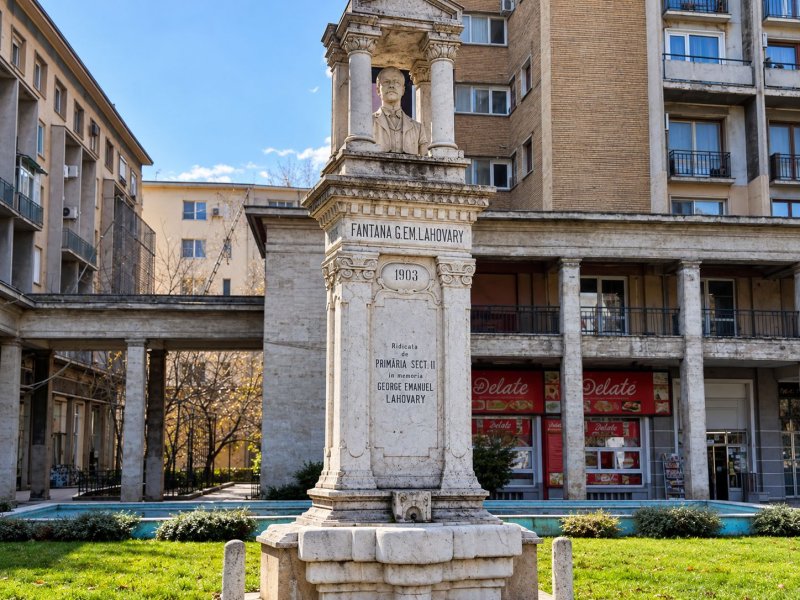
If the story of the Cazzavillan Fountain begins with the press, the George Emanuel Lahovary Fountain takes journalism directly into tragedy.
George Emanuel Lahovary, a journalist and politician, had become involved in a public dispute with Nicolae Filipescu. The conflict escalated into a duel, held in 1897 at the Shooting and Gymnastics Hall in Bucharest. Lahovary suffered a fatal sword wound. Filipescu was convicted but subsequently pardoned by King Carol I.
In 1903, Princess Zoe Suțu, Lahovary’s wife, commissioned sculptor Carol Storck to create a memorial fountain near the site of the tragedy. A historical study prepared for Bucharest City Hall confirms the artist, the date and the original location. It also records the dismantling of the monument during the urban redevelopment projects of the 1980s and its reinstallation in the late 1990s in the area of United Nations Square.
This time, water takes on the role of a memorial. The story feels as though it has stepped straight out of Caragiale’s Bucharest, only to make a sudden turn toward tragedy: journalism, political pride, a sword, death and a monument erected by a grieving wife.
The Sissi Spring in Cișmigiu: A Mother, a Water Jug and the Memory of a Daughter
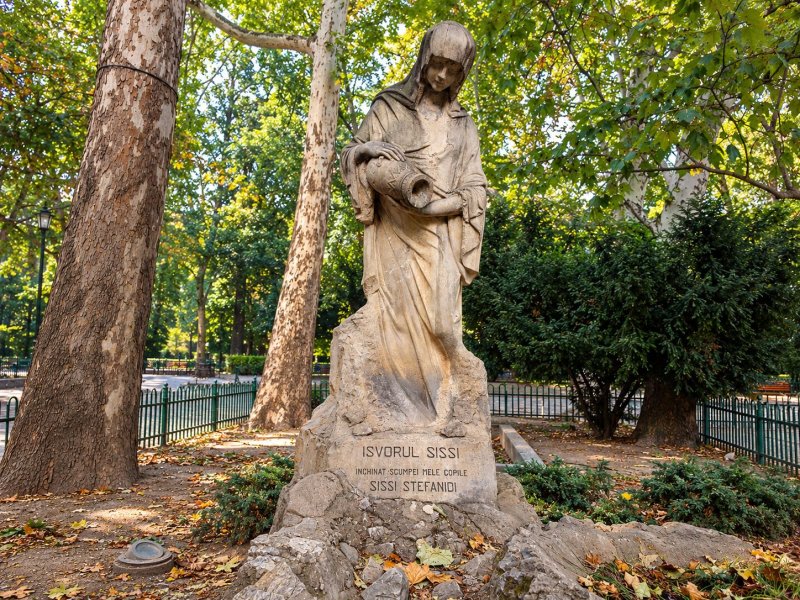
Cișmigiu Gardens is home to one of the city’s most moving fountains. The Sissi Stefanidi Spring was created by sculptor Ioan C. Dimitriu-Bârlad and installed in 1927. The monument appears on Romania’s List of Historic Monuments under the code B-III-m-B-20050.
The sculpture depicts a grieving woman pouring water from a jug. The Stefanidi family commissioned the monument in memory of their daughter Sissi, who died at the age of 21. The inscription at its base preserves the dedication to “my beloved child, Sissi Stefanidi.”
The location adds another layer to the story. The land had belonged to the Stefanidi family and had been donated to the municipality for the expansion of the gardens. The memorial therefore ended up precisely in a place with a personal connection to the family.
Dimitriu-Bârlad chose a very simple image: water flowing from the vessel held by the mother. Anyone hurrying through Cișmigiu sees a fountain. Those who linger for a few moments discover what is essentially a funerary monument transplanted into the everyday life of a park full of children, pensioners and pigeons with territorial ambitions.
Zodiac Fountain: Interwar Bucharest Consults the Stars
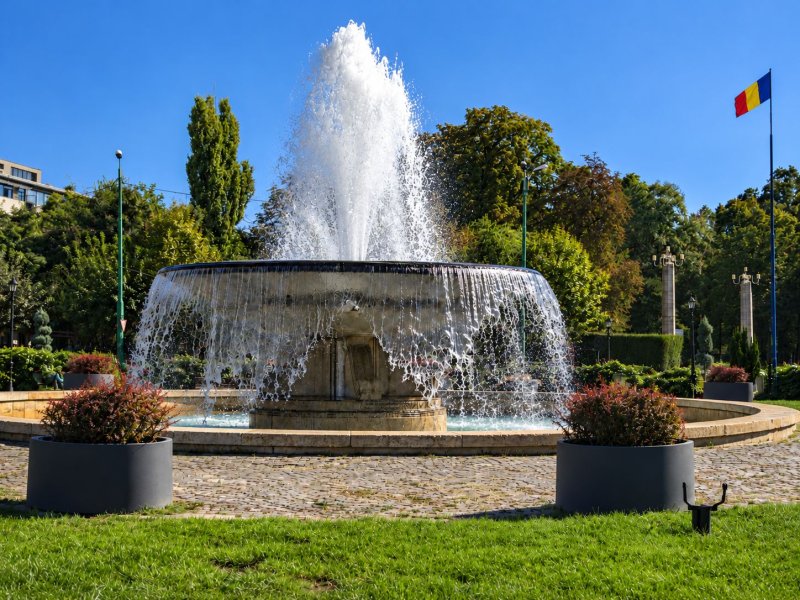
At the main entrance to Carol Park stands one of Bucharest’s most recognizable works of public art. The Zodiac Fountain was inaugurated on May 9, 1935, alongside the first edition of Luna Bucureștilor (Bucharest Month), an event organized to showcase the capital’s achievements and development projects.
The architectural design was the work of Octav Doicescu, while the mosaics depicting the twelve zodiac signs were created by Mac Constantinescu. August Schmiedigen and engineer Dorin Pavel also contributed to the project.
The fountain marked the entrance to the exhibition grounds in Carol Park and formed part of the grand urban spectacle of 1935. Bucharest wanted to appear modern, well administered and thoroughly confident about its future. Somewhat paradoxically, it chose to put the zodiac at the entrance.
The monument has remained in place through dramatic political changes, war and major urban redevelopment projects. Today, it is included on Romania’s List of Historic Monuments and continues to give Liberty Square a distinctive visual identity that is difficult to mistake for anywhere else.
Miorița Fountain: When a Traditional Ballad Reaches the Roadside
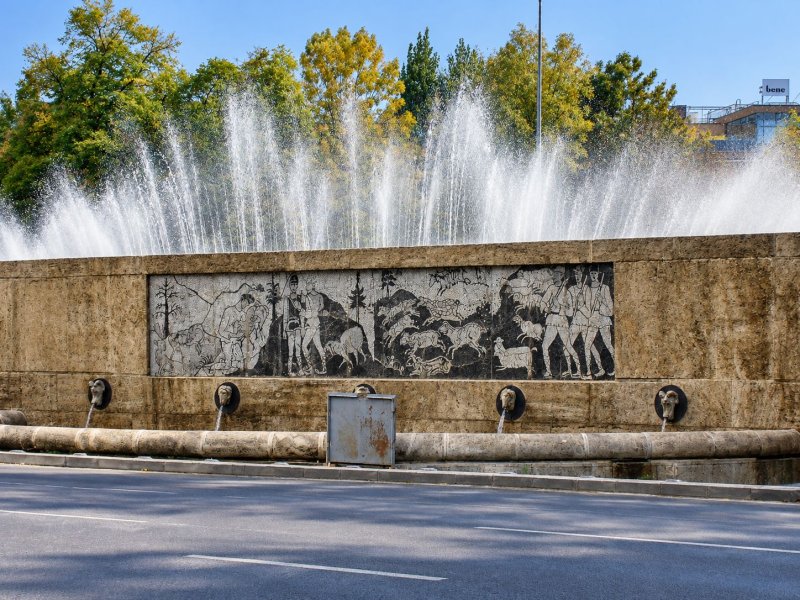
A year later, in 1936, Luna Bucureștilor moved toward the northern part of the capital. At the entrance to the city, along the Bucharest–Ploiești Road, the Miorița Fountain appeared, also designed by Octav Doicescu. Mayor Alexandru Donescu inaugurated it during that year’s edition of the event.
The monument, made of Dobrogea granite, features an elliptical basin measuring approximately 50 by 20 meters along its two axes. Two massive walls rise from the center, decorated with mosaic friezes inspired by the Romanian folk ballad Miorița. The artistic concept was developed by Milița Petrașcu, while ceramic artist Gheorghe Niculescu Mogoș contributed to the mosaics.
One side depicts shepherds and their flocks; the other develops the themes of the shepherd’s wedding and death. Folklore had been translated into the language of modernism, using massive stone surfaces, black-and-white mosaics and water. The result feels austere and poetic at the same time.
Its location says something about interwar Bucharest, too. The fountain welcomed travelers arriving from Ploiești, near the Minovici Villa, in an area specially landscaped for the international edition of Luna Bucureștilor. The city was quite literally building itself a calling card at its entrance.
In 2019, the monument underwent an extensive restoration that included its structure, water installations and mosaics. Today, surrounded by roads and the traffic of northern Bucharest, Miorița continues to tell its story about shepherds. The capital occasionally produces contrasts as wonderful as this.
Bucharest and Water: A Relationship Older Than Its Boulevards
These fountains belong to very different periods, and that is precisely where much of their charm lies. There is another interesting detail, too. In 1906, Bucharest still had more than 1,300 wells, and traces of them survive in the city’s historic place names. The modernization of the water supply would gradually transform the entire urban system.
Bucharest’s fountains therefore deserve to be regarded as documents written in stone. Some tell us who administered the city. Others commemorate loved ones, grand exhibitions or bruised egos that ended with a sword in hand. And running through all of them is the same thoroughly practical story, centuries old: a large city needs water. Bucharest, naturally, found a way to turn even that problem into a story.
You may also like: How Old Bucharest Fed and Hydrated Itself, the City of Mills, Price Controls, and Water Carriers