How Old Bucharest Fed and Hydrated Itself, the City of Mills, Price Controls, and Water Carriers
By Eddie Țone
- Articles
- 08 JUN 26
Old Bucharest can be read through its palaces, inns, neighbourhoods, and churches, but Constantin C. Giurescu proposes, in The History of Bucharest, a less festive and far more honest route: through bread, meat, and water. This is where the city appears in its practical form, with the daily concerns of administration, with mills damming the Dâmbovița, with bakers checked down to the weight of the loaf, with water carriers hauling barrels through the streets, and with mayors trying to turn a Balkan settlement into a modern capital.
Giurescu tells us about the city’s food supply, about mills and water, describing a world in which basic food had the status of a public issue. The authorities feared shortages, price increases, and popular unrest, which is why, beginning at least in the second half of the 18th century, maximum prices, known as “narturi,” became increasingly visible. In a Bucharest stretching between the Dâmbovița, Colentina, vineyards, gardens, ponds, and muddy lanes, the stability of bread was a matter of urban order.
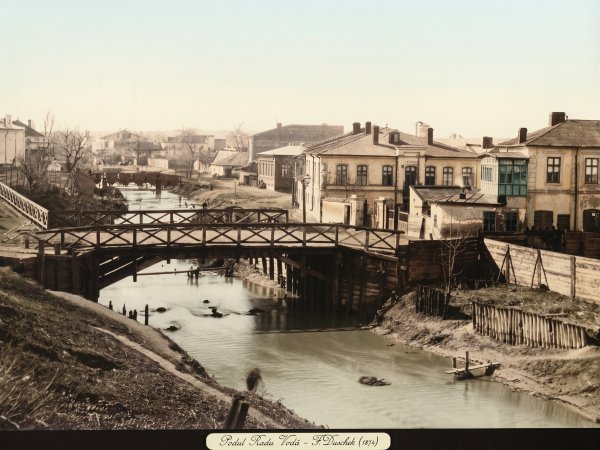
Main photo: Dâmbovița in 1874 (Radu Vodă bridge), picture by Franz Duschek / Image restored and colorized using artificial intelligence, preserving the original details.
The city that ground its life on the Dâmbovița
Before Bucharest acquired the image of a city of boulevards, it was, for a long time, a city of mills. Most mills stood on the Dâmbovița and Colentina, and their role was vital: wheat, and later corn as well, had to be ground constantly for a growing population. The mills belonged to the ruler, monasteries, boyars, and freeholders who owned numerous mill sites, meaning good places for harnessing the power of water.
The princely mills stood near the Princely Court, in the area close to today’s Domnița Bălașa Church, according to the document dated February 10, 1630, and they had water wheels, which says enough about their economic importance. In that era, a profitable mill could bring in serious income. Giurescu recalls the observation of the Syrian traveler Paul of Aleppo about Constantin Șerban Basarab’s mill at Dobreni, which brought an annual income of one thousand Venetian scudi, an impressive sum for the time.
The Dâmbovița was full of such installations, some grouped in pairs, one on each bank. This is where the expression “yoked mills” comes from, explained through a Brâncovenesc document from 1692, connected to the Radu-Vodă Monastery. The image is almost comic to modern eyes: the river crossed the city like a working artery, while along its banks stood mechanisms, people, horses, sacks of wheat, carts, bakers, monk administrators, and plenty of townspeople ready to occupy any “free” patch of land left available.
Monasteries, boyars, and the flour economy
Monasteries played a major economic role in old Bucharest. Through donations and purchases, they came to control numerous mills on the Dâmbovița. The Radu-Vodă, Mihai-Vodă, Cotroceni, Plumbuita, Mărcuța monasteries and others appear in documents connected to mill sites, mills, disputes, and administrative obligations. The spiritual city therefore had a very earthly accounting system, measured in sacks of flour, mill wheels, and annual revenues.
Also interesting is the pressure the mills placed on the river. They were indispensable, but at the same time they formed obstacles to the free flow of the Dâmbovița. The large number of mills increased the risk of flooding when the waters rose. In 1632, for instance, the mills of treasurer Nicula are mentioned as a source of problems because they “drowned” the mills of the Radu-Vodă Monastery and even the princely garden. Leon Vodă’s solution was firm: an on-site investigation and the destruction of the troublesome mills.
In the following centuries, such conflicts continued. Water was a resource, energy source, economic route, and threat all at once. A mill site could produce money, but it could also cause damage to neighbours. Even to the entire city, which suffered during the enormous flood of 1865. Bucharest functioned through fragile compromises, and the Dâmbovița, before modern regulation works, behaved like a parallel administrative authority, with a changeable mood.
Windmills, horse mills, and the obsession with continuity
Bucharest also had several windmills. One larger windmill stood on the slope near Mavrogheni Church and survived until 1831, when it was demolished because the road’s route passed over its site. Another stood north of the Vergului Barrier and appears on Ulysse de Marsillac’s 1872 plan. Their presence shows a Bucharest still tied to solutions adapted to the place, with water, wind, and horses put to work depending on the season and circumstance.
For periods when water mills became problematic, in winter because of freezing and in summer because of floods, the authorities demanded horse mills. On October 2, 1803, Constantin Ipsilanti ordered the abbots of the monasteries that owned water mills in Bucharest and its surroundings to each have a horse mill. The order was repeated on July 13, 1805, after an episode of flooding. This says a great deal about Bucharest at the time: the administration reacted to crises with practical solutions, and horses became, for a while, the guarantee of bread.
After 1850, steam mills gradually changed the landscape. Giurescu notes the disappearance of mills from the Dâmbovița within the city, once “vapor” mills were introduced, meaning mills powered by steam. The most famous remains the Assan Mill, built in 1853, known as the first steam mill in Romania, founded by George Assan and Ioan Martinovici in the Obor-Lizeanu area. Industrial heritage sources describe it as a major landmark of Bucharest’s modernization, even though today the ensemble is in a sad state, difficult to reconcile with its historical importance.
Bread, bakers, and the price control that kept the market in check
The wheat ground in Bucharest’s mills became bread, the city’s central food. Giurescu explains the shift from the term “pitar,” derived from “pită,” to the term “brutar,” which came through a Slavic intermediary from the Germanic brot. Traces of the old trade have remained in the city’s toponymy, through Pitar Moș Church and the street of the same name.
Bucharest had famous bakers. The Ottoman traveler Evliya Çelebi, who visited the city in the 17th century, wrote about its white loaves. In 1780, Constantin de Ludolf observed that the bread was very good, thanks to German bakers from Transylvania, who made it as in Vienna. Giurescu also mentions the Armenian Babic’s jimblă, sold near the Bărăție, so sought after that the expression “a crust from Babic” came to mean something almost impossible to find. A perfect advertisement, born long before advertising wore a suit and asked for a monthly budget.
The price control for bread was calculated meticulously. The authorities took into account the price of wheat in Obor, the shop rent, workers’ wages, firewood, salt, transport, and the baker’s reasonable profit. The system also had a severe side. Bakers who reduced the size of the bread to compensate for the fixed price risked having their products confiscated and receiving public punishments. Giurescu recalls the harsh practice from before the Organic Regulation, when a speculator could be nailed by the ear to the shop door and made to wear around his neck one of the underweight loaves found in his shop. The old city had direct pedagogical methods, and the baker’s reputational marketing suffered instantly.
Meat, the slaughter yard, and the emergence of the modern abattoir
After bread, meat was the second food under the administration’s attention. Raicevich, the first Austrian consul in the Principalities and tutor to Alexandru Ipsilanti’s children, wrote in 1788 that the rulers took care that the common people had bread and meat. Meat, in turn, was subject to price controls. There were prices from the beginning of the 19th century, followed by significant increases between 1820 and 1830.
In old Bucharest, cattle were initially slaughtered in the butchers’ yards of the Scaunelor Vechi neighbourhood, near the Bucureștioara stream. The “scaune” were, in fact, thick wooden blocks on which chunks of meat were cut. After the Old Princely Court was abandoned, the butchers used its stables, then sites on the bank of the Dâmbovița, right in the middle of the city. The document dated September 8, 1801, speaks of filth and a smell difficult to bear, which led to the relocation of the slaughterhouse downstream, near the Dâmbovița.
Modernization arrived in the second half of the 19th century. The City Hall signed a contract with the French entrepreneur Alexis Godillot for the construction of a modern communal abattoir, a contract ratified on May 30, 1868. The works lasted until 1872, when the abattoir was handed over to the City Hall, and its cost was 700,000 gold francs. Architectural and heritage sources confirm the connection between the former communal abattoir, Godillot’s projects, and the construction phases of 1870–1872, followed by later extensions.
Bucharest’s water, between the Dâmbovița, wells, and water carriers
The chapter on water has a particular flavor because it describes a city dependent on improvised solutions, religious traditions, and infrastructure in the making. Before modern works, Bucharesters drank water from the Dâmbovița, brought by housewives in buckets or by water carriers with their barrels, clarified with alum. Others used water from wells, while a minority had access to natural springs.
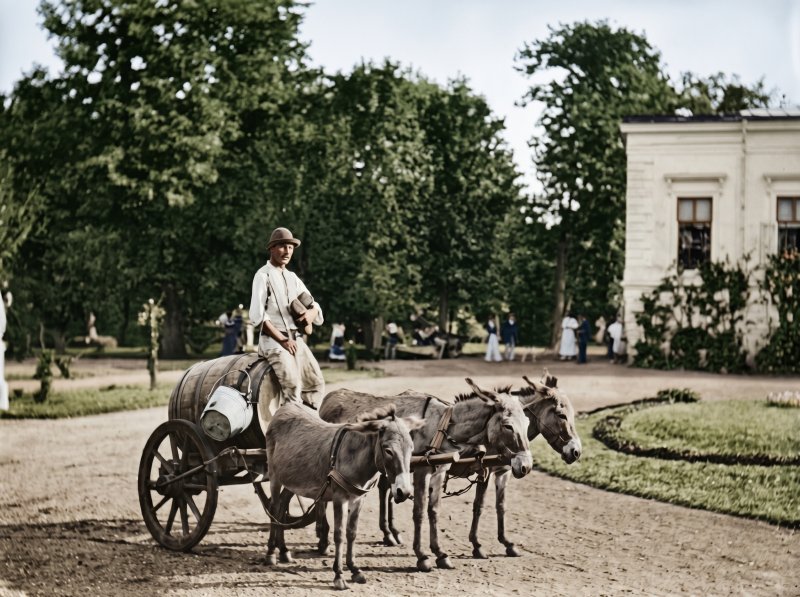
Water carrier in Bucharest, near the Vilacross Passage, 19th century. / Image restored and colorized using artificial intelligence, preserving the original details.
Wells were numerous and had, alongside their practical function, a moral and religious meaning. Digging a well by the roadside was an act of charity. Crosses were raised beside some of them, bearing the name of the person who had paid for the work and often those of his family as well. In 1906, there were still more than 1,300 wells in Bucharest. Some remained in the memory of street names: Puțul cu Plopi, Puțul de Piatră, Puțul cu Apă Rece, Puțul Înalt, Puțul cu Tei, Puțul cu Roată. The city’s toponymy discreetly preserves a map of thirst.
The water from wells, however, had serious limitations. Since they were dug at shallow depths, many wells provided water of modest quality, a fact also observed by foreign travelers. For a large city, with a growing population, dense neighbourhoods, and increasingly diverse activities, the well and the water barrel were beginning to look like charming but outdated solutions.
Filaret Fountain, Bucharest’s lost jewel
Among the city’s old fountains, Giurescu gives a special place to Filaret Fountain. Built by Metropolitan Filaret II at the end of the 18th century, it stood in the area of today’s Carol Park and gave the place its name. It was constructed like a pavilion with a ground floor and upper floor, largely of white marble, with pipes through which flowed water captured from the springs of the hill. It was a place for walking, viewing the city, and supplying oneself with good water, which was then carried by water carriers to boyar houses and wealthy households.
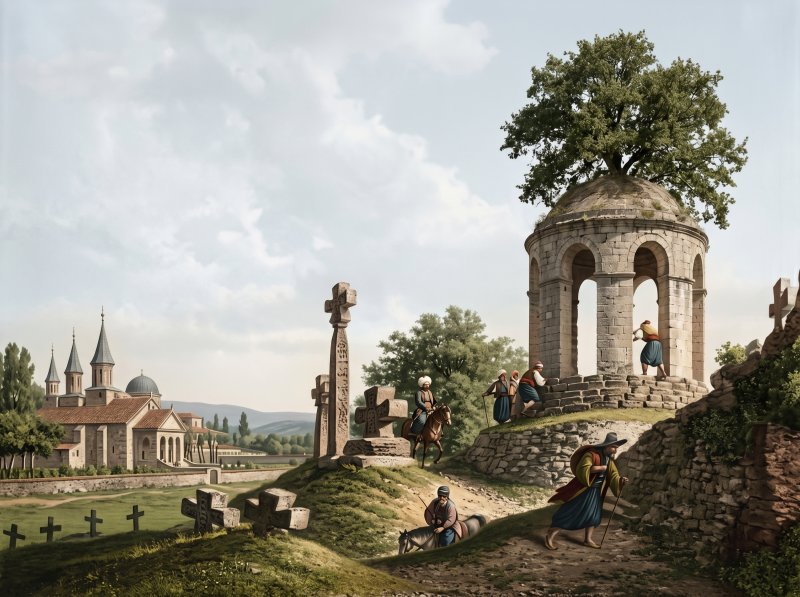
Filaret Fountain, in the 19th century / Image restored and colorized using artificial intelligence, preserving the original details.
In 1863, the old construction was demolished after it deteriorated, and in 1870 Mayor Gheorghe Grigore Cantacuzino built the fountain that exists today in Carol Park.
Here, however, one of Bucharest’s great melancholies can be felt: the city often lost refined things before understanding exactly how much they were worth. Filaret Fountain seems like one of those urban apparitions that today would have become a tourist guide star, a film set, and a reason for sighing on social media, provided it had survived the centuries intact.
From public fountains to Arcuda and the Fire Tower
Alexandru Ipsilanti played an important role in bringing water from a distance through clay pipes and in establishing public fountains. For their maintenance, a “suiulgiu-bașa” was appointed, meaning a chief of waters, a function showing that water was gradually becoming an urban service, with staff, funds, and responsibilities. Nicolae Mavrogheni increased the number of public fountains and placed them under the protection of Metropolitan Filaret, a great lover of fountains. Alexandru Moruzi, in turn, built public fountains at Târgul de Afară, meaning in the Obor area.
An important technical step came in 1846, when the filtration of Dâmbovița water began through a steam-powered hydraulic machine. Still, the systematic solution to the water supply came only toward the end of the 19th century, through the Arcuda filters and the water catchments in the Ulmi-Bragadiru area. The modern history of the water service confirms the development of these sources and the later modernizations of Bucharest’s water supply system.
The Fire Tower enters this story with an interesting episode. Giurescu presents it as a water tower with a 750-cubic-meter reservoir and an observation function for firefighters. Current sources from the National Firefighters’ Museum state that it was built between 1891 and 1892 according to the plans of architect George Mandrea, with the intended role of both water tower and fire tower, standing 42 meters high and having a 750-cubic-meter reservoir. For technical reasons, it ended up functioning as a fire observation tower, later becoming a museum.
Bucharest seen through the basic things
The small mechanisms that kept the city alive have an obvious historical charm. The mills, bakeries, slaughter yards, public fountains, wells, and water barrels made up the real infrastructure of everyday Bucharest. There one could see the power of the ruler, the influence of the monasteries, the ingenuity of merchants, the limits of administration and, of course, the patience of the Bucharester forced to negotiate constantly with mud, thirst, the price of bread, and the smell of the abattoir.
Modernization came gradually, through steam, filters, communal abattoirs, distribution networks, water meters, and the relocation of inconvenient activities toward the edge of the city. Bucharest moved from mill sites and buckets to waterworks, from the butchers’ chopping blocks to the modern abattoir, from Babic’s jimblă to mechanized bakeries. In this history of simple things, the city gains a particular depth: before it became a capital with pretensions, Bucharest had to learn to grind, bake, cut, carry, and filter. And Giurescu, with his patience as a great historian of detail, shows that sometimes the true biography of a city begins with good bread and a clean glass of water.
You may also like: The love story of the beautiful Dâmbovița and the shepherd Bucur, the most famous legend of Bucharest