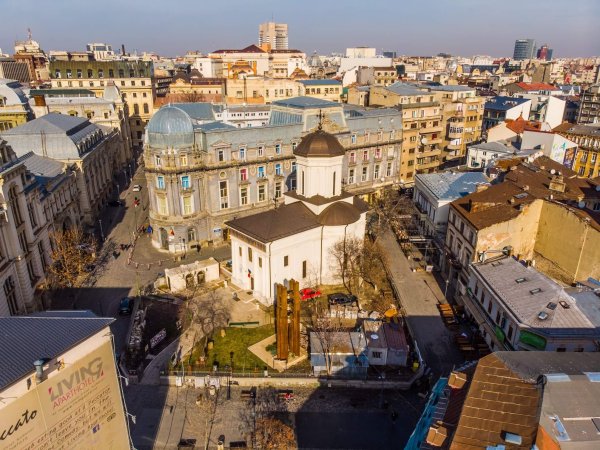
Sfântul Dumitru-Poștă Church in Bucharest. The history of the oath-taking church saved from demolition
By Raluca Ogaru
- Articles
- 26 OCT 26
Behind the former Postal Palace, among the streets of the Old Town, Sfântul Dumitru-Poștă Church preserves the memory of a Bucharest where oaths sworn before the altar played a part in settling disputes. Its history includes rebuilding, fires and a campaign that saved the church from demolition.
For those who discover it on a walk, the façade’s tall columns are the first distinctive feature. Beyond its architecture, the church’s story reveals the connections between religious life, education and the city’s community.
Why it is called “Poștă” and “de Jurământ”
The name “Poștă”, meaning “post office”, comes from the nearby Postal Palace, the building that now houses the National Museum of Romanian History. The name helps distinguish the church in a city with several places of worship dedicated to Saint Demetrius.
The name “de Jurământ”, or “of the Oath”, refers to an older practice. People involved in legal disputes would take solemn oaths here, pledging to tell the truth. The account published by Doxologia also mentions merchants swearing oaths to reinforce their commercial agreements. The church therefore played a role in community life that extended beyond religious services.
A history older than the present building
The age of the religious establishment must be distinguished from that of its surviving walls. Research published in the parish magazine Dimitrios traces the church’s existence to before 1590 and examines documents from the 17th century. A deed dated 5 November 1652, cited from historian George Potra’s collection of documents, mentions a priest of the “oath-taking church”.
The same research explores the church’s connection with the boyar Badea Bălăceanu and his family’s properties. Historical sources associate him with a wooden church, although details of the earliest buildings remain unclear. The author of the parish study himself presents the existence of a stone church before 1595 as a hypothesis rather than an established fact.
The earthquakes and fires that changed the church
In the early 19th century, the church was damaged by the earthquake of 1802 and the fire of 1804. The history published by the parish dates the start of rebuilding in its present form to 1819, under Bishop Constandie Filitti, and records its consecration on 26 October 1843.
The Great Fire of 1847 destroyed the roof and damaged the paintings. Repairs in 1852 included structural reinforcement and roof reconstruction, while the restoration of the paintings is attributed to Carol Pop de Szathmári. The church’s appearance today therefore reflects successive phases of work.
READ ALSO: The National History Museum and the spectacular story of the former Postal Palace
Architectural details worth noticing
The main façade features six tall Ionic columns, while the exterior decoration draws on the Neoclassical style. Medallions depicting the apostles complete the upper section. Before stepping inside, take a moment to look at both the overall composition and the ornaments around the entrance.
Inside, the Baroque iconostasis is attributed to Dumitru Spătaru, a sculptor from Buzău. The combination of the Neoclassical exterior and this carved screen offers a starting point for understanding the monument’s varied artistic influences.
The campaign that saved the church from demolition
By the early 20th century, the building’s deterioration had begun to threaten its survival. Historian Ioan C. Filitti intervened to save the church, and his press campaign helped preserve the monument. It reopened for worship in 1930.
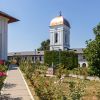
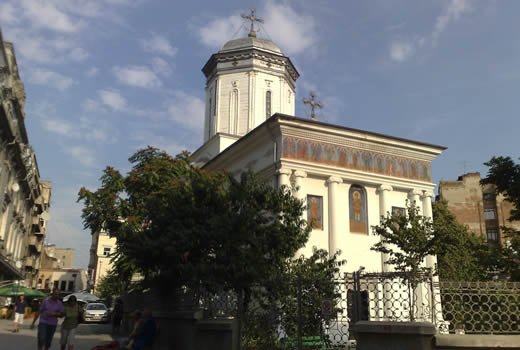 Sfântul Dumitru-Poștă Church in Bucharest’s Old Town, a place of worship rebuilt over the centuries and saved from demolition (Photo source: Sector 3 City Hall)
Maintenance and structural reinforcement continued in the following decades. In 1986, following damage associated with the 1977 earthquake, the roof was rebuilt and the wooden tower reinforced. Preserving the church therefore required several stages of work beyond the decisive campaign that prevented its demolition.
A community continuing the story of the place
The church’s links with education and sacred music also feature in the account published by the Romanian Patriarchate’s news agency. A school of Byzantine chant once operated within the old religious establishment, and Iosif Naniescu, the future Metropolitan of Moldavia, was among the figures associated with it.
Today, the parish serves as a university chapel and runs social projects through the Tadeu Humanitarian Association. In May 2026, Basilica reported the laying of the foundation stone for a social and pastoral centre designed to host children’s activities, cultural gatherings and community support programmes. The project includes a museum space and an archive, with completion announced for 2027.
Where to find it and how to include it in a walk
Sfântul Dumitru-Poștă Church stands at 1 Strada Franceză, at the junction with 2 Strada Poștei, in Sector 3. You can include it in a walking route that also takes in the nearby Church of Stavropoleos Monastery.
If you wish to attend a service, check the announcements on the parish website. If you are visiting to see the architecture and paintings, plan your visit around religious services and ask permission before photographing the interior.
READ ALSO: The sacred side of Bucharest: 5 churches and monasteries worth discovering