Autumn School Holiday in Bucharest: Six Museums Where Children Discover More Than Just Exhibits
- Articles
- 26 OCT 26
The autumn school holiday, from October 26 to November 1, 2026, is a great opportunity to explore Bucharest's museums with children. And we're not just talking about quiet rooms where young visitors are expected to stand still and look at objects behind glass. Romania's capital has museums filled with impressive animal skeletons, miniature trains, historic inventions, crystals, mysterious maps and even the chance to observe the night sky through a telescope.
Some museums are also organizing special children's workshops during the holiday week. At certain institutions, schoolchildren can benefit from free admission during school holidays.
We've selected six places where families can discover something new together, focusing on what children can actually see, learn and experience rather than simply listing the exhibits.
Grigore Antipa Museum – Fascinating Animals and Special Holiday Workshops
The Grigore Antipa National Museum of Natural History, located at 1 Kiseleff Road, is one of the best choices for children who are curious about the animal kingdom.
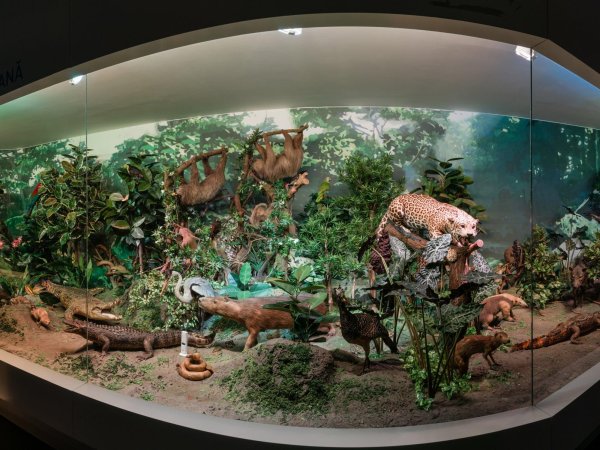
Visitors can explore detailed dioramas recreating natural habitats, animal skeletons, insects and specimens from different parts of the world. For children, the visit can feel like a journey through nature, from species found in Romania to animals living on other continents.
Instead of trying to see every exhibition room, turn the visit into a game. Ask your child to find five animals they've never seen in real life and discover one interesting fact about each.
During the 2026 autumn school holiday, the museum is organizing several special activities. On October 27, children can join A Journey into the World of Crystals – Amethyst, followed by The Predator in the Shadows – The Black Panther on October 28. On October 29, the Colours at Dusk painting workshop will focus on bats, while October 30 and 31 will feature Halloween-themed workshops.
Advance registration is required for the workshops, and participation fees may apply separately from regular museum admission.
Useful information: The museum is open Tuesday to Sunday, from 10 AM to 8 PM until October 31. It is normally closed on Mondays. Adult admission is 32 RON, while children up to 18 years old are eligible for free admission during school holidays, under the museum's regulations.
Workshop schedules and reservations are available on the official Antipa Museum website.
For more about the institution and its collections, you can also explore 10 fascinating facts about the Grigore Antipa Museum.
Dimitrie Leonida National Technical Museum – Where Children Discover How Things Work
Located in Carol I Park, at 2 General Candiano Popescu Street, the Dimitrie Leonida National Technical Museum is an excellent choice for children interested in cars, machinery, electricity and inventions.
Founded in 1909, the museum has a history spanning more than a century. Its collections include engines, vehicles, electrical devices, industrial equipment and inventions that illustrate the evolution of technology.
In March 2026, the museum reopened its historic wing after approximately 40 years of restricted public access. The renovated space includes eight museum sections, restored historical exhibits, digital content and interactive activities designed for different age groups.
Among the objects likely to capture children's attention are early Romanian computers, engines and mechanical devices. The visit offers an opportunity to talk about how everyday life worked before smartphones and modern computers.
Simple questions can make the experience more engaging: How does an engine produce movement? Where does electricity come from? How large were computers in the past?
The museum was born from an engineer's ambition to preserve and explain the inventions that transformed society. The fascinating story behind its foundation is explored in the history of the National Technical Museum and Dimitrie Leonida's dream.
Useful information: The museum is located near the entrance to Carol I Park, accessible from General Candiano Popescu Street. Visiting hours should be confirmed before departure, as published information varies following the museum's recent modernization. Indicative admission prices for 2026 are 25 RON for adults and 7 RON for schoolchildren, but visitors should verify current rates directly with the institution.
If the weather is pleasant, the visit can be combined with a walk through Carol I Park, where children can explore historic monuments, pathways and green spaces.
National Museum of Maps and Old Books – An Adventure Through Lost Worlds
At first glance, a museum dedicated to maps might not sound particularly exciting to a child. But for young explorers fascinated by treasure hunts, distant lands and mysterious places, the National Museum of Maps and Old Books could be an unexpected discovery.
Located at 39 Londra Street, the museum houses historic maps, atlases and representations of the world created during different periods. Children can discover how people imagined continents long before satellites and GPS applications existed.
One simple activity is to look for Romania on old maps and observe how place names and borders have changed. Children can also search for decorative illustrations, ships and unusual symbols appearing on historic cartographic documents.
From October 2 to November 15, 2026, the museum is hosting the temporary exhibition The Story in the Frame, dedicated to the decorative cartouches found on historical maps. The exhibition features more than 30 cartographic documents, complemented by reproductions from an international collection.
The building itself is also worth exploring. The museum occupies a historic residence in Bucharest's Capitals' Quarter, with richly decorated interiors and unusual architectural influences. Its history and the origins of the collection are explored in the story of the Museum of Maps and the historic mansion on Londra Street.
Useful information: The museum is open Wednesday to Sunday, from 10 AM to 6 PM, and closed on Mondays and Tuesdays. Under the museum's regulations, schoolchildren are eligible for free admission during school holidays. Separate conditions or charges may apply to temporary exhibitions.
Additional information is available on the official museum website.
CFR Railway Museum – Miniature Trains and Historic Locomotives
For children who love trains, the CFR Railway Museum in Bucharest, located near Gara de Nord railway station, could be one of the most memorable stops of the holiday.
Its main attraction is an impressive railway diorama featuring miniature trains, tracks, bridges, tunnels and stations. Measuring more than 14 metres in length, the model recreates an entire railway landscape on a reduced scale.
The museum also displays locomotive models, historical documents and objects illustrating the development of Romania's railway system. Historic locomotives can be seen in the inner courtyard, while one of the exhibition rooms is dedicated to engineer Anghel Saligny.
Parents can turn the visit into a challenge by asking children to identify the differences between a steam locomotive and a modern train, or to follow a miniature train's route through the diorama.
The museum also has a remarkable history of its own, including the destruction caused by World War II bombing raids and efforts to preserve surviving exhibits. You can discover more in the history of Bucharest's CFR Museum and its extraordinary railway collection.
Useful information: The museum is located at 193B Calea Griviței and is open Wednesday to Sunday, from 10 AM to 4 PM. Published admission prices are 10 RON for adults and 2.50 RON for schoolchildren. Access is through the inner courtyard on Calea Griviței, rather than platform 14 of Gara de Nord, which is currently closed as a museum entrance.
Visitors are advised to confirm the opening hours and whether the railway diorama is operating before their visit.
National Geological Museum – Crystals, Fossils and the Story of Our Planet
Directly opposite the Antipa Museum, at 2 Kiseleff Road, stands the National Geological Museum. It is an excellent alternative for children curious about what lies beneath the Earth's surface and what our planet looked like millions of years ago.
The collections include minerals, rocks and fossils, making it easy to turn the visit into an observation game. Children can compare the colours and shapes of crystals, discover traces of prehistoric life and learn how different rocks are formed.
One interesting exercise is to let each child choose a favourite mineral and explain what makes it different from the others. For older children, the museum can spark conversations about volcanoes, earthquakes and the movement of the Earth's crust.
Another advantage is its proximity to two other major cultural institutions: the Antipa Museum and the National Museum of the Romanian Peasant. In September 2026, the three institutions were brought together through a cultural initiative known as the Museum Triangle, featuring workshops and activities for children.
Although that particular event has already taken place, the museums' close proximity makes it possible to plan a similar cultural outing during the autumn holiday, exploring their regular exhibitions.
Useful information: The museum's published opening hours are Tuesday to Sunday, from 10 AM to 6 PM, with last admission at 5 PM. Ticket prices vary between different published sources, so current admission fees should be confirmed before visiting.
Contact details and visitor information are available on the official National Geological Museum website.
Admiral Vasile Urseanu Astronomical Observatory – A Journey Among the Stars and Planets
For children fascinated by outer space, the Admiral Vasile Urseanu Astronomical Observatory, located at 21 Lascăr Catargiu Boulevard, offers an experience quite different from a traditional museum visit.
Here, young visitors can learn about the Solar System, planets, stars and the wider Universe. When weather conditions are suitable and observation sessions are scheduled, visitors may also have the opportunity to look at the night sky through astronomical instruments.
The observatory is particularly appealing to children who ask questions about the Moon, other planets or why stars are visible at night.
However, telescope observations are not guaranteed. They depend on weather conditions, visibility and the observatory's schedule.
The building has an unusual history too. It was commissioned by Admiral Vasile Urseanu, a naval officer passionate about astronomy who wanted his home to resemble a ship, complete with a dome for observing the sky.
His extraordinary story is explored in the history of Admiral Vasile Urseanu and the astronomical observatory he built in Bucharest.
Useful information: The observatory is open Tuesday to Saturday, from 2 PM to 10 PM, and closed on Sundays and Mondays. Adult admission costs 20 RON, while reduced tickets for schoolchildren cost 10 RON. Children under seven can enter free of charge.
Opening hours and visiting conditions are available on the Bucharest Municipality Museum website.
How to Choose the Right Museum for Your Child
Not every museum appeals equally to every age group, and a successful visit often depends on what your child is interested in.
For preschoolers, the animals at the Antipa Museum and the miniature trains at the CFR Museum may be easier to enjoy than detailed explanations about cartography or technological history. Primary school children may find museums more engaging when they have a specific mission: find a particular object, compare two exhibits or discover the answer to a question.
For older children, the Technical Museum, Geological Museum and Astronomical Observatory can open the door to discussions about science, inventions and space exploration.
There is no need to visit every exhibition room or turn the outing into a formal lesson. Sometimes, an hour spent exploring a handful of objects that genuinely capture a child's curiosity can be more rewarding than a long museum visit that leaves everyone exhausted.
And the autumn school holiday is a good opportunity to discover that Bucharest has plenty of places where children can learn without feeling as though they're back in the classroom.