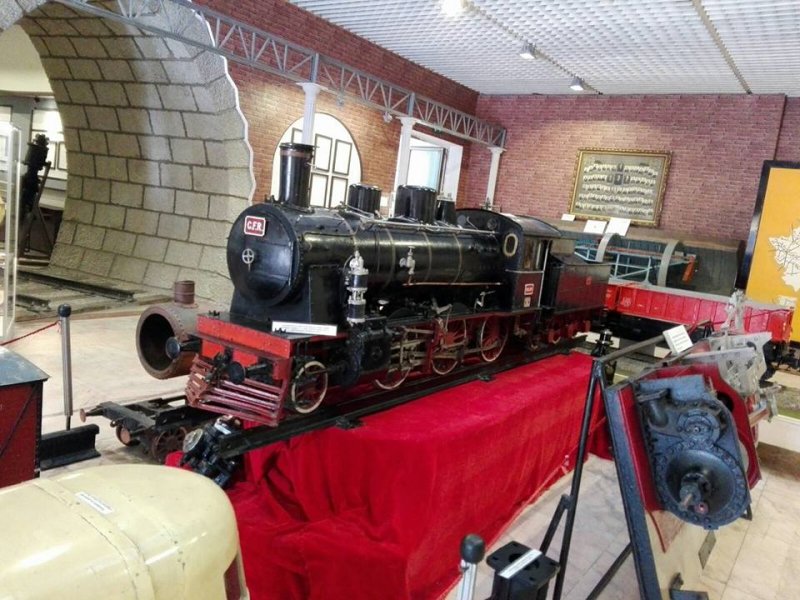
On Calea Griviței nr. 193B, in the inner courtyard of a railway administrative complex immediately adjacent to Gara de Nord, sits one of the oldest technical museums in Bucharest. The CFR Museum does not impress through scale and makes no attempt to — it impresses through the density of a heritage built over more than eight decades, bringing together the history of one of the most important railway networks in Eastern Europe.
An institution with a history of its own
The CFR Museum was inaugurated on 10 June 1939, as part of the Ceferiadă celebrations marking the 70th anniversary of the first train running on Romanian territory, in the presence of King Carol II. Its first location was beneath the stands of Giulești Stadium, where the collection's exhibits were shown to the public for the first time.
In 1944, the bombing raids that severely damaged the northern part of Bucharest destroyed a large part of the collection. The museum reopened on 1 May 1953, in the building of the Railway Technical House — constructed during the interwar period — where it continues to operate today. A further reorganisation took place in 1969, on the occasion of the centenary of the Bucharest–Giurgiu railway line, when the collection's thematic structure was replaced with a chronological one.
What the collection holds
The museum traces the history of the railway from the first European lines — opened in 1830 between Liverpool and Manchester — to the modern Romanian railway network. The first railway line on what is now Romanian territory opened in 1854, on the Oravița–Baziaș route, intended exclusively for coal transport. The first passenger line, Bucharest–Giurgiu, was inaugurated in 1869.
The collection brings together scale models of locomotives and carriages, original historical documents, CFR uniforms and equipment, signalling instruments, various types of switching control panels, period clocks — including a suspended mechanical clock, a Paul Garnier clock and an electric clock centre — and objects related to figures who shaped Romanian railway history, among them engineer Anghel Saligny, designer of the Cernavodă bridge.
In the inner courtyard, accessible through the Calea Griviței entrance, two full-size steam locomotives are on display: the "Călugăreni" locomotive and locomotive 763.215.
The diorama — the centrepiece
The focal point of any visit remains the demonstrative diorama of a Romanian railway route, inaugurated on 16 May 2012 and the largest of its kind in Romania. Built to a scale of 1:87, it measures over 14 metres in length and approximately 4.4 metres in width. The route passes through plains, hills and mountain terrain, runs through tunnels and over bridges, and includes a locomotive depot and a repair shed modelled on the București Călători depot.
The movement of the miniature trains is computer-controlled through digital decoders for locomotives, track sections, switches and signals — all designed according to Romanian specifications, faithfully reproducing the elements of the operational railway system.
Practical information
Address: Calea Griviței nr. 193B, Sector 1, Bucharest Entry: through the inner courtyard on Calea Griviței — access through Gara de Nord, platform 14, is currently closed Opening hours: Wednesday – Sunday, 10:00 – 16:00; closed Monday and Tuesday Phone: 0316 203 910 / 0758 886 060 Email: muzeu.cfr@cenafer.ro
Admission:
- 10 lei — adults
- 2.5 lei — pupils, students, retirees
- Free — visitors with disabilities
- Photography fee: 13 lei/hour
Transport: metro — Gara de Nord station; buses: 105; trolleybuses: 65, 86