Malmaison, a Dark Chapter in Bucharest’s History: From Bibescu’s Cavalry Barracks to a Detention Center and Art Studios
- Articles
- 27 OCT 26
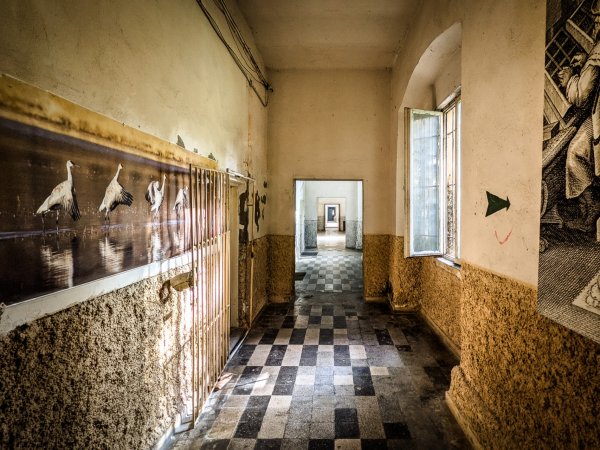
On Calea Plevnei, in one of Bucharest’s busy areas, stands one of those buildings that thousands of people pass every day without knowing its history. At first glance, Malmaison appears to be just another former military complex, similar to many others in the capital. In reality, its walls preserve traces of radically different eras: soldiers were once quartered here, military justice institutions operated within its premises, people persecuted for political reasons were imprisoned and interrogated here, and today some of its spaces house artists and galleries. The story of the building begins in the 19th century, during the reign of Prince Gheorghe Bibescu, and continues through the modernization of the Romanian state, the dictatorship of Ion Antonescu and, later, the first decades of the communist regime. Malmaison thus became associated with some of the most difficult chapters in Romania’s recent history. In 2026, the Saint George–Malmaison Barracks complex was officially listed as a historic monument, giving it heritage recognition that reflects its importance. At the same time, the building is experiencing a new chapter. Part of it has been converted into a space for contemporary artists, while Atelierele Malmaison has become an important venue for Bucharest’s independent cultural scene. The transformation is particularly symbolic: a place once associated with detention and interrogation now hosts artistic creation, exhibitions and cultural projects.
A barracks built during the reign of Gheorghe Bibescu
The origins of Malmaison can be traced back to 1844, when Prince Gheorghe Bibescu ordered the construction of a cavalry barracks. At the time, the Romanian army was undergoing a process of reorganization, while Bucharest needed appropriate facilities for its emerging military structures. The barracks was also known as Saint George Barracks, after the nearby church.
Its construction was part of the broader process through which the Romanian army sought to abandon older forms of organization and adopt modern military models. While the infantry had an important base in the Dealul Spirii area, the cavalry was provided with the barracks on Calea Plevnei. The complex included soldiers’ quarters, administrative spaces and facilities specific to a cavalry garrison.
Over time, the area surrounding the barracks developed a strong military identity. Other institutions and buildings connected with the army appeared nearby, meaning that Malmaison should not be regarded simply as an isolated building, but as part of a larger military complex. Documents and studies on the history of the neighborhood show that, during the second half of the 19th century, this was one of the important military hubs of the capital.
Where does the name Malmaison come from?
The name is one of the most interesting stories associated with the building. The barracks constructed during the reign of Gheorghe Bibescu came to be known as Malmaison during the reign of Alexandru Ioan Cuza. The name referred to Malmaison, the famous French residence associated with Joséphine, the wife of Napoleon Bonaparte, and subsequently also connected in historical memory with Napoleon III.
In Bucharest, the choice of the name should be viewed in the context of the close relations between Romania and France during Cuza’s reign and the French support provided for the modernization of the Romanian army. France even sent a military mission intended to contribute to the training and reorganization of the Romanian forces.
It is therefore more accurate to associate the origin of the name with the French model and Franco-Romanian military relations than with an alleged Masonic affiliation of Cuza and Napoleon III. The latter claim appears in some contemporary accounts of the building, but it is not necessary to explain the origin of the name and could create a historical connection that is more categorical than the available sources allow.
Malmaison continued to serve a military role after Cuza. Over the years, the complex also housed military justice institutions. During the interwar period, structures such as the Military Prosecutor’s Office, the Court-Martial and the detention facility operated here, and the building became associated not only with military life but also with the judicial mechanisms of the armed forces.
From barracks to a place of repression
Malmaison’s history became considerably darker during the 20th century. The building became part of the history of political repression, serving as a prison during Ion Antonescu’s regime and, later, as a detention and interrogation center operated by the Securitate during the early years of communist rule.
After the communist regime was established, Malmaison became one of the places through which people regarded as opponents of the new political system passed. Unlike the classic image of a large prison, its role was particularly connected to temporary detention, interrogation and the transfer of prisoners. This function explains why the memory of the place is so strongly associated with Securitate interrogations.
Among the people associated with detention or interrogations at Malmaison were Iuliu Maniu, Corneliu Coposu, Nicolae Steinhardt and Ecaterina Bălăcioiu-Lovinescu. The Sighet Memorial, for example, confirms that Corneliu Coposu passed through Malmaison during his long political imprisonment, alongside numerous other prisons and detention centers.
In a testimony published by the Sighet Memorial, Corneliu Coposu even recalled the period he spent at Malmaison and a clandestine encounter with Iuliu Maniu, who was being held in a nearby cell. The episode provides a direct perspective on the way the detention facility operated and the atmosphere of constant surveillance.
Another name connected to this place is Ecaterina Bălăcioiu-Lovinescu, the mother of writer and journalist Monica Lovinescu. She was arrested in 1950 and sentenced in a fabricated trial, and the Sighet Memorial records her passage through Malmaison prison before she was transferred to other detention facilities.
Dozens of prisoners disappeared without a trace
The full scale of the repression at Malmaison is difficult to reconstruct. According to information presented by the Association of Former Political Prisoners of Romania and reported by Radio Free Europe, dozens of political prisoners are believed to have disappeared without a trace after passing through the center during the 1950s. There has even been speculation about the existence of a mass grave, but this information should be treated cautiously, as a hypothesis rather than as a definitively proven fact.
Part of the mystery surrounding the site also comes from its closed and secretive nature. During the communist period, Malmaison was an institution about which the public knew very little. Former prisoners who later described their experiences provided limited information about the building’s exterior, while historical research faced a lack of photographs and accessible documents. Radio Free Europe has noted that, until the 1970s, those who had been imprisoned there mainly described the interior routes and the paths leading to interrogation rooms.
This lack of photographs and documentation contributes to Malmaison’s mysterious aura today. It is not simply an old building, but a place where the history of communist repression unfolded largely away from public view.
The 1977 earthquake and the building’s transformations
Malmaison did not remain unchanged from an architectural perspective either. The 1977 earthquake severely damaged one of the wings of the complex, which was subsequently demolished. Recent research into the building shows that its present form no longer fully reproduces the configuration it had when it served as a cavalry barracks.
Its functions also changed radically. After the period when it was used by military and repressive institutions, the building became part of the property of IPROCHIM, the Institute for Chemical Engineering. Today, the complex has several different uses, and its spaces are no longer dominated by the military function that defined its first decades of existence.
The paradox is striking: the same architecture once associated with the army, military justice and political detention has, in recent decades, become a space for civilian, cultural and artistic activities.
Atelierele Malmaison, a new life for a troubled place
Around 2020, contemporary artists began exploring the possibility of using parts of the building as studios. The Atelierele Malmaison community gradually developed in this context, transforming two floors of the building into a space dedicated to artistic creation. In 2024, the press reported that approximately 40 artists had studios here, while information from 2026 indicates a community of 35 artists.
The studios have not remained completely closed to the public. Exhibitions, guided tours, conferences, artist talks, Open Studios and other cultural events have been organized at Malmaison. For the artists, the building has represented not only a place to work but also a space with a powerful identity, in which the history of the property could become part of the artistic experience.
The transformation has nevertheless come with difficulties. The artistic community has faced problems related to rental contracts and increased rents, with artists at risk of having to leave the building in 2024. These disputes once again brought attention to the challenge of protecting historic buildings that can simultaneously possess architectural, memorial and cultural value.
Malmaison, between the memory of repression and Bucharest’s heritage
In July 2026, the Saint George–Malmaison Barracks complex and several of its component buildings were officially listed as historic monuments. The decision marked an important moment in the protection of one of Bucharest’s most complex historic military ensembles.
The classification is particularly significant because Malmaison does not have a single story. It is simultaneously a testimony to the modernization of the Romanian army in the 19th century, a place associated with military justice, a site of political detention and Securitate interrogations, and, today, a center for artistic creation.
This layering of different eras makes Malmaison a unique case in Bucharest’s collective memory. Military history, political history, communist repression and contemporary culture meet within a single building. No spectacular reconstruction is needed to understand the site’s past. The surviving architecture itself provides a physical link between generations and between very different moments in history.
For those interested in the darker history of the capital, Malmaison could become one of the most significant stops on a route dedicated to the memory of communism. The fact that these spaces now host artistic work and exhibitions gives the site an additional layer of meaning. A place once intended for barracks and detention has become a space for freedom of expression.
Perhaps this is the most powerful transformation in Malmaison’s history. The past and the memory of those who were imprisoned there have not disappeared, but the building continues to exist and has acquired a new purpose. From a place associated with authority, interrogation and fear, Malmaison has become a space where art attempts to reclaim a part of the city that remained hidden behind its walls.
We also recommend: Dark Tourism in Bucharest: Sites of Repression, Death and Tragedy That Have Become Part of the City's Collective Memory