Civil Protection Shelters in Bucharest: Where to Find Them and How Functional They Really Are
- Articles
- 04 MAR 26
This article is strictly informational. Its purpose is to calmly and clearly answer questions that more and more Bucharest residents are legitimately asking. It is not meant to cause alarm, but to provide a practical guide based on publicly available data as of 2026.
The topic of civil protection shelters has returned to public attention as conflicts in Romania’s vicinity have intensified. This is not panic — it is legitimate curiosity. People want to know what exists, where these shelters are located, and whether they actually work. This article attempts to answer those questions using the information currently available.
How many shelters exist in Bucharest
Bucharest has more than 1,170 registered civil protection shelters, unevenly distributed across the city’s six sectors. Sector 2 concentrates the largest number — approximately 345 locations — followed by Sector 6 with 295 and Sector 1 with 164.
At the opposite end is Sector 5, with only 58 shelters for a population of over 270,000 residents.
On paper, this represents one of the best levels of coverage in Romania. The reality, however, is more complicated.
How many of them are actually functional
This is the uncomfortable question.
According to a report by the Romanian Court of Accounts, only one out of three shelters registered in Bucharest and Ilfov is operational.
Romania still operates under regulations dating from 1999, and under a National Civil Protection Strategy adopted in 2005, which assumed that the probability of a major military attack was minimal — a document that did not include scenarios involving armed conflict near Romania’s borders.
Many shelters today are unsanitary, unusable, or have been converted by owners into storage spaces. Others have undergone structural modifications that make them unsuitable for their original purpose. For decades, shelter infrastructure simply has not been a priority in national security planning.
At the same time, Romanian law allows public civil protection shelters to be used for other purposes in peacetime, provided they can be cleared within 24 hours in case of emergency, with prior notification to the emergency authorities. In theory, therefore, a shelter currently used as storage space is not permanently lost — but this assumes the space has been maintained in operational condition, which is not always the case.
How to recognize a shelter on the street
Civil protection shelters must be marked with the national distinctive sign: an equilateral blue triangle on an orange background, placed on the access door and often on the wall near the entrance to the building.
If you have ever walked past an older apartment block in Bucharest and noticed this symbol near the basement or entrance, you may have already seen one without realizing it. Most shelters are located in the basements of residential buildings constructed during the communist period, when building regulations required such spaces.
The metro — the most accessible shelter in the city
As in several other European capitals, Bucharest’s metro system is considered part of the national shelter infrastructure.
Romanian military officials have confirmed that the Ministry of National Defence maintains records of the metro network that could be used for civil protection purposes.
Metro stations are now explicitly included among the types of infrastructure where civil protection shelters must be incorporated under government regulations clarifying earlier rules.
The metro network has two major advantages: it is distributed across the city and accessible on foot from most neighborhoods, and its underground depth provides a real degree of structural protection.
Where to find the official list and interactive maps
There are several public sources you can consult directly.
IGSU list
The Romanian General Inspectorate for Emergency Situations publishes the official list of civil protection shelters in Romania, including addresses, on its website.
DSU mobile app
The official DSU mobile application includes an interactive map of shelters in the “Useful Information” section. The app is available in both the App Store and Google Play.
adapostulmeu.ro
This is an independent application developed by a Romanian programmer. It allows users to identify the nearest shelter using real-time location. It works both for shelters near home and for locations in areas where you are traveling.
Sector-level lists
Sector administrations periodically publish updated lists. Sector 3 City Hall, for example, provides a list of both public and private shelters based on data from the Bucharest-Ilfov Emergency Inspectorate.
What authorities say may change
The Chief of the Romanian Defence Staff, General Gheorghiță Vlad, has stated that the shelter system needs to be reassessed, calling it a matter of national security, especially in the context of the war near Romania’s borders.
Romania still lacks a fully centralized and transparent record of shelters that are actually accessible to the public, who can use them, and what condition they are in. This gap is reflected in the contradictory figures sometimes circulated by different official sources.
The General Inspectorate for Emergency Situations (IGSU) has drafted proposals to amend Law no. 481/2004 on civil protection, aiming to adapt the legislation to the current international context.
What you can do as a Bucharest resident
Check the shelter in your building.
If you live in an apartment block built before 1990, there is a good chance the basement is registered as a civil protection shelter. Look for the distinctive symbol or ask the building administrator.
Install the DSU app.
Besides shelter maps, the app provides emergency alerts, earthquake information, and guidance for various emergency scenarios.
Know your nearest metro station.
If there is no accessible shelter nearby, the metro remains the most practical option for many residents.
Consult official lists.
The websites of IGSU and ISU Bucharest-Ilfov provide address-based lists of shelters organized by sector.
What remains unclear
Transparency in this area remains limited. There is no publicly accessible, real-time map showing the operational status of each shelter — whether it is functional, unusable, occupied, or accessible.
The largest shelter in Bucharest, located beneath the CFR Palace, reportedly has a capacity of around 1,800 people, but the Ministry of Transport has stated that it falls under a special legal regime and classified information, and is not intended for public access.
In other words, there is a gap between the number of shelters officially registered and the number that are actually accessible to ordinary citizens. This gap is acknowledged by public institutions and is currently the subject of ongoing policy discussions.
Information is the first step. Not because an extreme scenario is imminent, but because knowing where you are and what options exist is simply a matter of common sense, not panic.
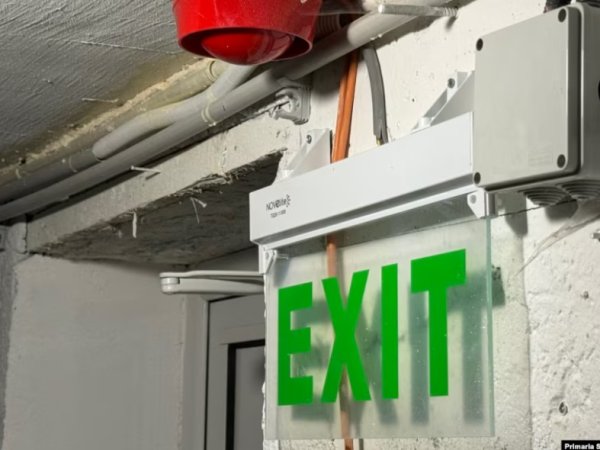
Photo: Civil Shelter District 2