“Scala Has Fallen!” 49 Years Since the 1977 Earthquake That Wiped Out Half of Central Bucharest
- Articles
- 04 MAR 26
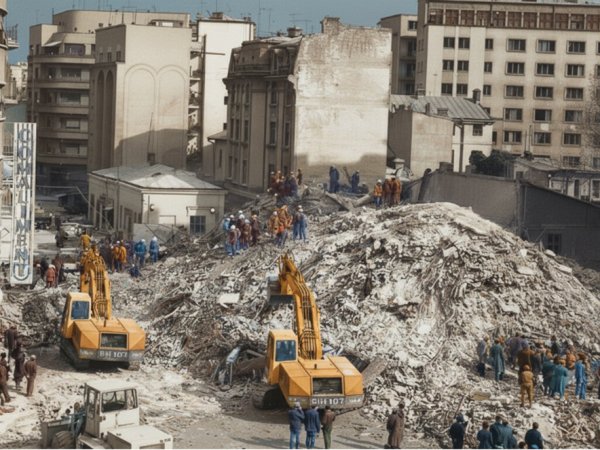
On March 4, 1977, at 21:22, Romania experienced one of the most dramatic moments in its modern history. An earthquake with a magnitude of 7.2 on the Richter scale, with its epicenter in Vrancea, violently shook the south of the country, and the capital was hit directly. In just a few tens of seconds, the familiar image of central Bucharest was transformed into an apocalyptic landscape, with collapsed blocks, streets covered in rubble, and sirens cutting through the night.
A city shaken in a single night
Among the buildings that did not withstand the quake was the “Scala” block, a symbol of interwar elegance. Its collapse became one of the most powerful images associated with the 1977 tragedy. “Scala has fallen!” – the cry that spread that night remained, for decades, a painful echo of a collective loss.
The birth of an interwar modernity symbol
The “Scala” block was built during a period of urban effervescence, at a time when Bucharest was redefining its architectural identity. In the 1930s, the city embraced Western influences, and the Art Deco style became an expression of optimism and modernization.
Construction began in 1937 and was completed in 1938, the project carried out by the construction company Algiu. Initially, the building even carried the company’s name, but the proximity to the famous Scala confectionery and cinema quickly led to the popular name taking hold. Located at the intersection of Bulevardul Brătianu (currently Bălcescu) with C.A. Rosetti Street, the building dominated the area through its elegant tower and harmonious proportions.
The block impressed through high-quality materials, carefully executed finishes, and rare comfort for that time. The apartments sold quickly, becoming sought-after residences for the urban elite. The ground floor hosted upscale commercial spaces, and the Scala confectionery became a meeting point for intellectuals and artists.
A vulnerability ignored
Behind the elegance and apparent solidity, however, lay a major problem: the lack of adequate earthquake-resistant regulations. Romania had not yet developed strict construction norms for buildings capable of withstanding major earthquakes.
The earthquake of November 10, 1940, with a magnitude of 7.4, seriously affected the structure of the Scala block. Cracks appearing on the façade were a clear signal of the weakening of the building’s resistance. Subsequent reinforcements were carried out hastily, with limited resources and without thorough analysis. The visible cracks in the following years showed that the problems had not been solved.
Despite this, life went on. From the 1950s onwards, the building remained inhabited, and the area continued to be animated by daily bustle. No one anticipated that structural vulnerability would have such dramatic consequences.
The night a symbol collapsed
On the evening of March 4, 1977, the violent movement of the ground caught residents at home, in cinemas, or on the streets. The seismic waves struck with devastating force, and the old buildings in the city center began to collapse one after another.
The Scala block did not withstand it. Its emblematic tower collapsed almost completely, and the rest of the structure was destroyed. Under the rubble were hundreds of people: residents, customers of the confectionery, cinema-goers, and passersby caught in the area.
In the first moments, rescue teams intervened quickly. They dug desperately among beams and concrete slabs, racing against time to save survivors. Among those involved was Constantin Eană, who came up with an ingenious idea: he installed microphones on the broken concrete fragments to amplify any sounds coming from inside the ruins. At regular intervals, the work would pause to listen to the recordings, hoping to identify signs of life.
Tragically, although there were clear indications that people were still alive under the rubble, political decisions changed the course of the intervention. Just two hours after the operations began, the communist regime leader, Nicolae Ceaușescu, ordered the searches to be stopped. The decision remained one of the most controversial and painful of the earthquake response.
After the collapse: forgetting and reconstruction
Shortly after the tragedy, the ruins were removed, and the land was leveled. In place of the old building, a new structure known as “Scala II” was erected. Although its central location gave it visibility, the new building had a simple design, lacking the refinement and personality of its predecessor.
Nothing recalled the elegant tower or the bohemian atmosphere of the old confectionery. The passage of time blurred collective memory, and the new building failed to become an emotional landmark for Bucharest residents.
However, the tragedy of the Scala block was more than the loss of a building. It represented the fragility of an era and how political decisions could amplify human suffering. The stopping of rescue operations under the rubble remained an open wound, recalled by witnesses and survivors for years.
A lesson about memory and responsibility
49 years after the earthquake, the story of the Scala block continues to be evoked as a warning. It speaks about the importance of construction standards, the need for responsibility in crisis management, and the obligation to keep alive the memory of those who perished.
Scala was not just an Art Deco building; it was a symbol of a generation that believed in progress and urban elegance. Its collapse coincided with the collapse of an illusion: that the modern city was invulnerable.
Today, central Bucharest still bears traces of that black March. Behind renovated or rebuilt buildings lie untold stories, broken lives, and decisions that changed destinies. “Scala has fallen!” is not just a phrase from the past, but a memory that demands reflection and respect for history.
We also recommend: The History of the Carlton Block, the Monument Forgotten by Bucharest Residents. How It Was Wiped off the Face of the Earth in the 1940 Earthquake